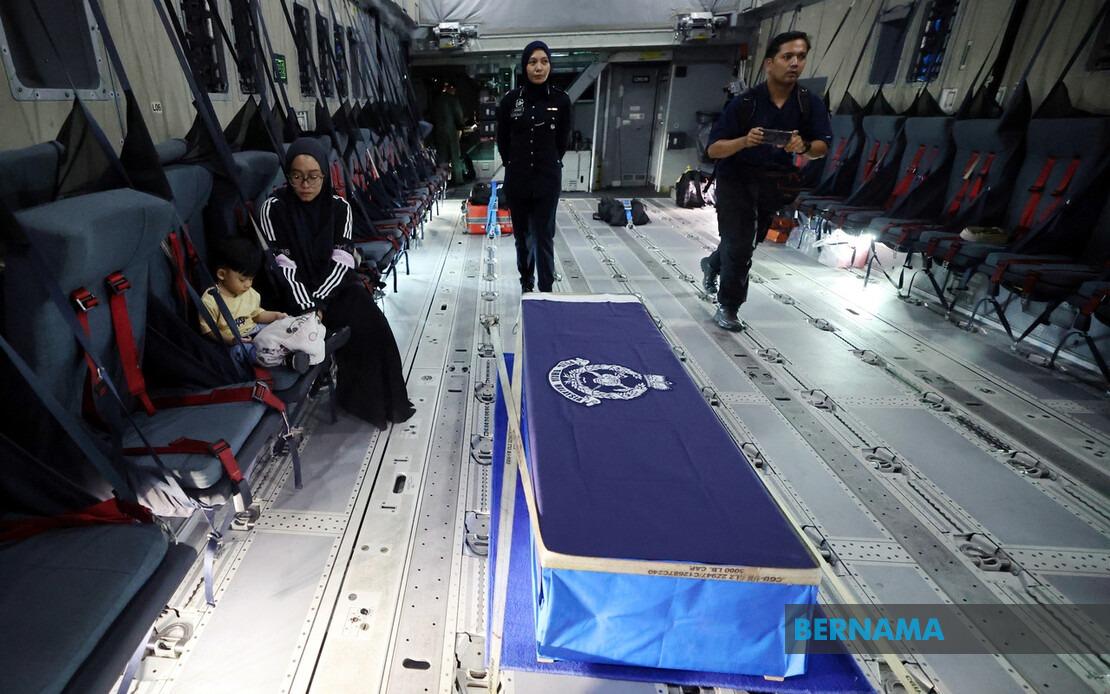
The remains of three Royal Malaysia Police officers who perished in an electrocution incident in Beaufort have been flown to their respective hometowns, bringing an end to the identification and examination phase of the tragic incident. The repatriation operation, conducted on the evening of August 7, involved both Royal Malaysian Air Force and police air assets, reflecting the gravity of the loss and the cross-state coordination required to return the officers to their families.
Corporal Mohamad Nur Hafiz Ibrahim, aged 29 from Kelantan, and Constable Muhammad Raimi Ismarubee, aged 26 from Terengganu, were transported via RMAF aircraft that departed Kota Kinabalu International Airport at 7.10 pm. The flight path took the aircraft to the RMAF Air Base in Kuantan before proceeding to Gong Kedak in Terengganu, where both officers would be received by their families and local authorities. Corporal Chiu Teck Siong, the third victim aged 40 and a native of Sarawak, was separately transported via police air operations to the island state, highlighting the logistical complexities involved in managing such repatriations across Malaysia's vast geography.
The three officers were pronounced dead following an electrocution incident that occurred at approximately 5.50 pm on August 6 outside the Weston Police Station in Beaufort. The circumstances surrounding the incident remain under investigation, though electrocution at a police facility raises questions about occupational safety protocols and electrical infrastructure maintenance at government installations. Such incidents, though rare, underscore the various hazards that uniformed personnel face beyond the more publicised aspects of police work.
Before repatriation, all three bodies underwent post-mortem examinations at Queen Elizabeth Hospital in Kota Kinabalu on the morning of August 7. The examinations, conducted at midday, were completed efficiently, allowing the Forensics Department to release the remains by approximately 2.56 pm. The prompt completion of these procedures, while respecting the dignity of the deceased and the grief of their families, demonstrates the coordination between medical and police authorities in handling such sensitive matters.
The loss of three officers simultaneously represents a significant personnel blow to the Royal Malaysia Police, particularly within the Sabah contingent where the incident occurred. Each officer brought years of service to the force, with their ages ranging from the late twenties to mid-forties, suggesting a mix of experience levels across the rank structure. Their sudden and unexpected deaths will reverberate through their respective state police commands and across the broader police fraternity nationwide.
For the families dispersed across three different states, the repatriation flights offered the opportunity to receive their loved ones for funeral rites according to their respective customs and religious traditions. In Malaysian society, where family bonds remain central and funeral arrangements carry deep cultural and religious significance, the provision of appropriate transport for the deceased reflects both institutional respect and practical recognition of the emotional and logistical burdens placed on grieving families.
The use of both RMAF and police air assets for the repatriation operation underscores the inter-agency cooperation that characterises Malaysia's security apparatus. The Royal Malaysian Air Force, primarily tasked with national defence, regularly provides humanitarian and support services to civilian authorities and other government agencies. Similarly, the Royal Malaysia Police's dedicated air operations force, established to support operational capabilities, extends its mandate to include dignity operations such as this repatriation.
Occupational safety in government institutions remains an area requiring continuous attention and improvement. Electrocution incidents, whether at police facilities or elsewhere, often point to deficiencies in electrical safety protocols, equipment maintenance, or training in handling electrical systems. Investigations into this incident will likely examine whether standard safety procedures were in place, whether infrastructure had been properly maintained, and whether personnel were adequately trained in electrical hazard recognition and response.
The incident also highlights the inherent risks faced by law enforcement personnel in their daily duties. While much public discourse focuses on policing operations and crime-fighting roles, the workplace fatalities resulting from preventable causes such as electrocution remind stakeholders of the necessity for robust occupational health and safety frameworks across all government agencies. For the police force, ensuring that officers work in safe environments remains as critical as equipping them for operational duties.
Looking forward, the aftermath of this tragedy will likely prompt reviews of electrical safety procedures at police stations throughout Sabah and potentially nationwide. Departmental safety audits, infrastructure assessments, and refresher training on electrical hazard awareness may be implemented to prevent similar incidents. The loss of three competent officers serves as a sobering reminder that comprehensive occupational safety measures, though unglamorous, are essential to protecting the workforce that keeps the nation functioning.

