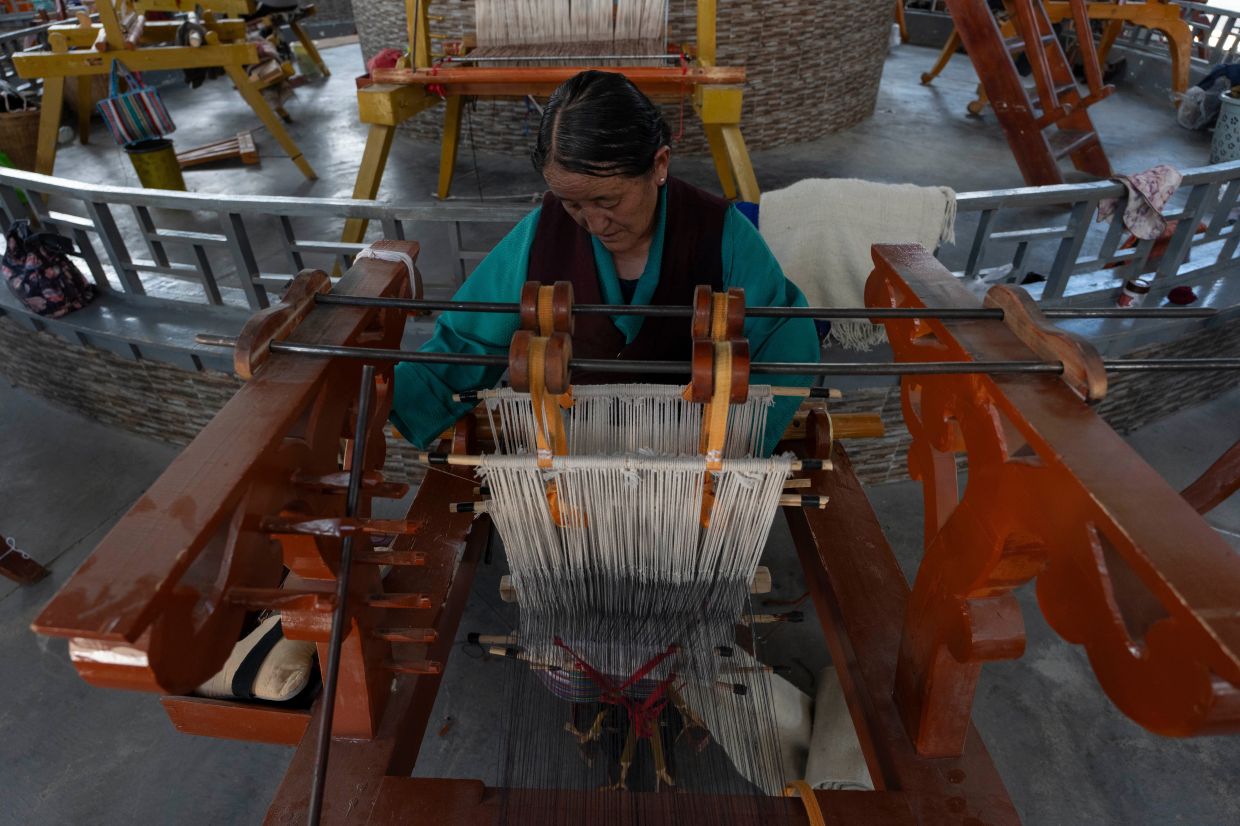
Inside the Ethnic Huaji Handwoven Cooperative in Shannan, rhythmic movements echo through a workshop filled with wooden looms. Artisans—men and women working side by side—guide shuttles through strands of wool with practiced precision, pulling each thread tight in the repetitive dance that creates Pulu, a distinctly Tibetan fabric that has warmed bodies across the high plateau for more than a thousand years. What outsiders might see as simple handiwork represents something far more significant: the preservation of a cultural practice that nearly vanished entirely, rescued by one man's determination to honor his heritage.
Founded in 2008 by Tibetan artisan Pasang, the cooperative has become an unlikely anchor for cultural continuity in an era of rapid modernization. The enterprise now provides steady employment to more than 100 local residents, many of whom faced significant barriers to finding work. The cooperative's commitment extends beyond economics—it actively recruits people with disabilities and dedicates considerable resources to teaching younger Tibetans a craft their own parents often abandoned in pursuit of more conventional opportunities. For Pasang, this mission grew from personal urgency. When he began learning weaving from his parents, fewer than ten people in the entire region still possessed the knowledge to create Zeter, the finest and most prized variety of Pulu.
The distinction between ordinary Pulu and Zeter represents the specialized knowledge that makes Pasang's work so culturally significant. Zeter uses wool harvested exclusively from the necks and backs of sheep, where the fibers grow softest and finest. This superior material requires considerably more skill to spin and weave—the finer threads demand greater dexterity and patience than standard Pulu production. The resulting fabric is lighter, more delicate, and visibly softer, qualities that apparently impressed Chinese imperial courts during the Ming dynasty, when Zeter was presented as a tributary gift from Tibet. The craft thus represents not merely a practical skill but a marker of prestige and technical mastery, laden with historical significance.
According to Pasang's recounting of local tradition, the weaving arts arrived in Tibet through Princess Wencheng's marriage to the 7th century King Songtsen Gampo. The cooperative's workshop includes statues of both figures, positioned prominently among the looms as a visible reminder of that legendary cultural transmission. Whether historical fact or cherished origin story, this narrative carries weight in contemporary Tibet. Pasang himself emphasizes that Pulu weaving represents an integration of Tibetan and Chinese cultures—a framing that situates the craft within broader historical narratives of cultural exchange and unified heritage. For Malaysian and Southeast Asian observers, this blending of local tradition with state-recognized cultural significance offers insight into how heritage preservation functions within China's framework of intangible cultural property.
The Chinese government has formally recognized Zeter weaving as part of the nation's intangible cultural heritage, a designation that provides both prestige and institutional support. This official acknowledgment strengthens the cooperative's legitimacy and potentially opens doors to funding, tourism, and education initiatives. However, it also situates the craft within a larger state narrative about cultural continuity and Han-Tibetan relations. The cooperative's location in Shannan, situated at approximately 3,700 meters above sea level on the Tibetan plateau, proves essential to production. The sheep grazing in this high-altitude terrain produce the distinctive wool that cannot be easily sourced elsewhere, anchoring the craft to its geographical origins and preventing it from becoming merely an urban handicraft disconnected from its environmental and pastoral roots.
The cooperative's business model extends beyond pure cultural preservation into practical commerce. A showroom adjacent to the workshop displays finished products—scarves, shawls, jackets, bags, and other items—aimed at customers throughout China and increasingly beyond. According to Pasang, most sales occur within Tibet itself, suggesting that local and regional demand drives the enterprise more than aspirations toward international markets. This grounding in local markets may actually protect the craft from the pressures of mass commercialization that often damage traditional practices when they become primarily tourist commodities. The products carry genuine utility and cultural meaning for their primary consumers, not merely aesthetic or souvenir value.
The human dimension of the cooperative becomes apparent in the stories of individual artisans. Tsering Yangchen, now 80 years old, had struggled to secure employment in her home county before relocating to Shannan and joining the cooperative seven years ago. The workshop's instructors taught her the weaving techniques from scratch, transforming her from a jobless older woman into a productive artisan. Her simple statement—that people in the community usually wear Pulu, that the garments are made from pure wool—captures why this cooperative matters beyond economic statistics. These are functional items embedded in daily life and cultural identity, not exotic objects created solely for outside consumption.
For younger Tibetan artisans learning the craft, the cooperative serves as a counterweight to demographic and economic pressures that traditionally drive youth away from rural handicraft traditions. In many societies undergoing modernization, heritage crafts become elderly pursuits, practiced by aging artisans with fewer younger practitioners to eventually take their place. By institutionalizing the teaching of weaving, offering stable employment, and creating pathways for people with disabilities to participate, the cooperative tackles the succession problem that threatens most traditional crafts. The government-organized tour that brought international observers including Associated Press journalists to the workshop suggests official interest in showcasing such preservation efforts, though the carefully curated nature of such visits—including temples, tourist sites, and selected businesses—reflects the controlled manner in which China manages outside perspectives on Tibetan culture.
The broader significance of this cooperative extends beyond Shannan's borders into questions about how heritage preservation happens in contemporary Asia. As rapid industrialization and globalization reshape societies across the region, the tension between cultural continuity and economic modernization intensifies everywhere. Southeast Asian nations face similar challenges with their own traditional textiles, weaving practices, and artisanal crafts. The Ethnic Huaji cooperative demonstrates one approach: establishing formal institutions that combine cultural education with market-oriented production and employment creation. This model acknowledges that traditional crafts cannot survive through nostalgia alone—they require economic viability, younger practitioners, and genuine market demand.
Pasang's personal commitment to reviving a nearly-extinct craft reflects broader Asian patterns of cultural guardianship, where respected elders take responsibility for transmitting endangered knowledge. Yet the cooperative's success also depends on broader economic forces—tourist interest in authentic cultural products, government support for intangible heritage, and consumer willingness to pay premiums for handmade items. Whether these conditions will prove sufficient to ensure Pulu and Zeter weaving flourishes across another century remains uncertain. What seems clear is that without institutions like the Ethnic Huaji Handwoven Cooperative, without founders like Pasang willing to formalize and systematize knowledge that their parents transmitted through family apprenticeship, many such traditions would simply disappear into historical memory. For communities across Southeast Asia wrestling with similar challenges of cultural preservation in the modern era, the cooperative offers both inspiration and practical lessons about sustaining heritage while creating meaningful livelihoods.

