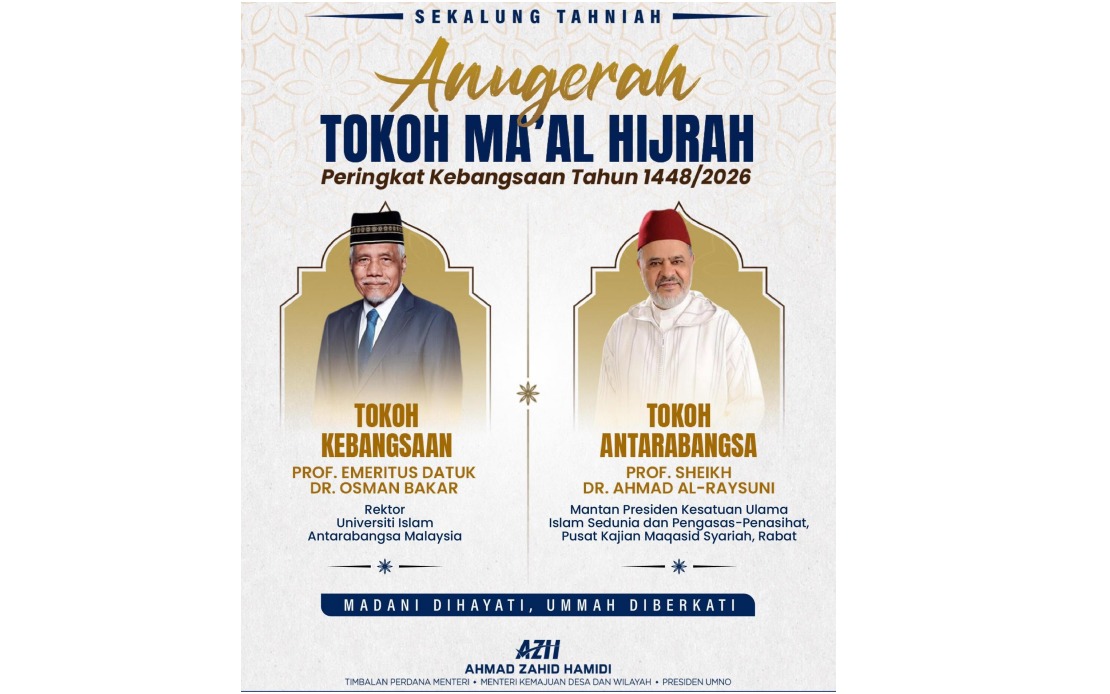
Malaysia's Deputy Prime Minister Datuk Seri Dr Ahmad Zahid Hamidi has urged the Muslim community to draw inspiration from this year's Tokoh Maal Hijrah award recipients, whose recognition exemplifies a commitment to advancing Islamic knowledge and community welfare. The awards, presented at a national-level celebration held at Masjid Putra in Putrajaya, honour individuals who have made significant strides in empowering Muslims and elevating Islamic values across Malaysian and international spheres. By highlighting these exemplary figures, Ahmad Zahid emphasised that their achievements should serve as a catalyst for broader engagement among the faithful in pursuit of collective development and social progress.
The two recipients of the 1448H/2026M Tokoh Maal Hijrah awards represent distinct yet complementary contributions to Islamic scholarship and community service. Prof Emeritus Datuk Dr Osman Bakar received the National Tokoh Maal Hijrah Award, recognising his decades of work in advancing Islamic thought within Malaysia's academic and intellectual landscape. Simultaneously, Prof Sheikh Dr Ahmad Al-Raysuni, an Islamic jurisprudence expert from Morocco, was honoured with the International Tokoh Maal Hijrah Award, reflecting the programme's scope in acknowledging Muslim scholars and leaders beyond Malaysian borders. Both selections underscore the award's role in identifying figures whose influence extends across intellectual, educational and spiritual dimensions of Muslim societies.
Ahmad Zahid's statement emphasised that the honours conferred upon these recipients reflect far more than individual achievement; they embody the substance of their contributions in reshaping how Islamic knowledge is transmitted, understood and applied to contemporary challenges. He highlighted their efforts in empowering the Muslim community, raising the intellectual standing of Islamic scholarship, and disseminating Islamic values grounded in principles of mercy, wisdom and practical benefit to society. This framing positions the awards not as ceremonial recognition alone but as acknowledgment of work that carries tangible implications for how Muslim communities navigate modern life while maintaining theological and ethical grounding.
In his response, Deputy Prime Minister Datuk Seri Fadillah Yusof extended the message of inspiration beyond Muslim communities specifically, presenting the awards as broadly relevant to all Malaysians. Fadillah characterised the recognition as emblematic of broader national values centred on service, contribution and societal development. His comments suggest an understanding that the principles embodied by award recipients—commitment to knowledge, community engagement and ethical leadership—transcend religious boundaries and constitute universal aspirations within Malaysia's multicultural context.
Fadillah drew particular attention to the Islamic concept of hijrah, contextualising it not merely as the historical migration of Prophet Muhammad from Mecca to Medina but as an enduring philosophical principle guiding Muslim conduct and values. He argued that hijrah embodies sacrifice, unity, resilience and determination in pursuit of positive transformation, qualities that he suggested remain vital for contemporary efforts to build societies that are simultaneously progressive, prosperous and grounded in ethical and spiritual values. This reinterpretation moves beyond historical narrative toward practical application, suggesting that the hijrah framework provides ongoing guidance for Muslims navigating social change and nation-building.
The presentation ceremony, presided over by Sultan Nazrin Shah of Perak, lent ceremonial weight and royal endorsement to the awards process. The Sultan's conferment of cash prizes, trophies and certificates of appreciation to both recipients formalised state recognition of their contributions, positioning the Tokoh Maal Hijrah programme within Malaysia's official honours system. Royal involvement typically signals the national importance attributed to the award, elevating it beyond institutional recognition to matter of state significance and public interest.
For Malaysian Muslim readers and Southeast Asian observers, the emphasis on knowledge-seeking and community service in both officials' statements reflects contemporary tensions within Islamic societies regarding how traditional values interact with modernisation and development demands. Both Ahmad Zahid and Fadillah positioned Islamic engagement not as withdrawal from national or social concerns but as active participation in building prosperous, values-informed societies. This framing addresses concerns, particularly among younger generations, about Islam's compatibility with education, innovation and civic contribution—suggesting that Islamic commitment and national development reinforce rather than compete with one another.
The international dimension of the awards, evidenced by Ahmad Al-Raysuni's recognition, indicates Malaysia's engagement with broader Islamic intellectual networks and scholarship traditions. Morocco's prominent role in Islamic jurisprudence and theology means that Al-Raysuni's selection reflects Malaysia's awareness of and participation in global Islamic discourse. This outward orientation suggests Malaysian leadership's investment in positioning the country as a hub for Islamic thought and interfaith dialogue, with implications for how Malaysia presents itself regionally and internationally as a Muslim-majority nation committed to education and moderate, progressive Islamic frameworks.
Fadillah's call for working together to strengthen unity, enhance faith and increase virtuous action reflects recurring themes in Malaysian political discourse, particularly in contexts where religious and national identity intersect. The language of collective effort and shared purpose suggests that Muslim community development is understood as fundamentally linked to broader national prosperity and stability. This interconnection carries implications for how religious and secular governance structures coordinate and how religious leaders and politicians jointly frame community aspirations and obligations.
The Tokoh Maal Hijrah awards programme itself represents Malaysia's approach to honouring and institutionalising Islamic scholarship and community leadership within a structured, state-recognised framework. By annually selecting and publicly celebrating individuals whose work advances Islamic knowledge and community welfare, the programme reinforces certain priorities regarding what constitutes valued Islamic engagement in the contemporary context. The emphasis on education, intellectual rigour and community benefit suggests official preference for Islam expressed through scholarly achievement and practical social contribution rather than through other possible modes of religious engagement.
For Malaysian policymakers and thought leaders, the awards ceremony provides occasion to articulate broader visions of Islamic society's role in national development. Both Ahmad Zahid and Fadillah used the platform to reinforce messages about Islam's compatibility with progress, prosperity and national solidarity, addressing audiences beyond the immediate Muslim community. This inclusive rhetorical approach reflects Malaysia's multicultural political context, where religious affairs must be discussed in ways that acknowledge both specific Muslim concerns and broader national unity imperatives.
The recognition accorded to Osman Bakar and Ahmad Al-Raysuni through the Tokoh Maal Hijrah awards ultimately functions as public affirmation that intellectual rigour, scholarly achievement and commitment to community advancement represent central Islamic values worthy of state acknowledgement and public celebration. By presenting these figures as models for emulation, Malaysian leadership positions Islamic engagement as fundamentally oriented toward knowledge, service and collective welfare—messages with potential resonance for Muslim communities across Southeast Asia navigating comparable questions about Islam's modern expression and social relevance.