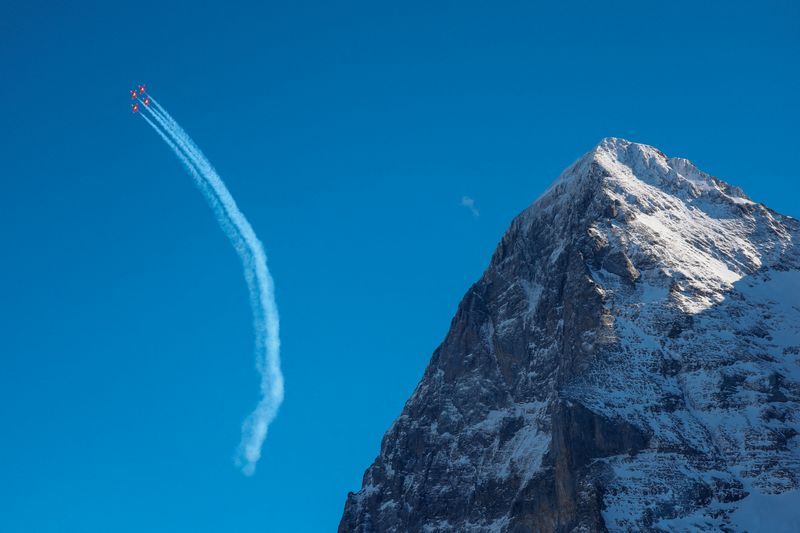
Fay Manners, a British mountaineer, has etched her name into Alpine climbing history by accomplishing what no British woman had done before: opening an entirely new route on one of Europe's most formidable peaks. Working alongside Swiss climbing partner Roger Schaeli, Manners spent thirteen gruelling days ascending the legendary Eiger North Face to establish "Solar Eclipse," a challenging 900-metre route spanning 33 pitches that required pioneering work across previously unclimbed terrain.
The Eiger's North Face, part of the Swiss Alps, has long captivated and terrified climbers in equal measure. Rising 1,800 metres of exposed rock and ice, the wall presents a gauntlet of environmental hazards including unpredictable weather patterns, cascading rockfall, and the sheer technical difficulty of its pitches. Its menacing reputation was forged through tragedy before the first successful ascent by a German-Austrian team in 1938, making subsequent achievements on the face significant milestones in Alpine climbing history.
Manners was not entirely new to the mountain when she undertook this historic push. A previous ascent of the established Heckmair Route four years earlier had sparked an obsession that ultimately drove her decision to return and attempt something far more ambitious. That earlier expedition planted seeds of curiosity about the wall's untapped potential, leading her to study the face with painstaking intensity and eventually conceive of a line where none had existed before.
What distinguishes route-establishing from repeating existing climbs reveals itself immediately in the psychological and technical demands it imposes. Climbers tackling established routes benefit from accumulated knowledge about difficulty ratings, protection requirements, and proven pathways to the summit. Route-openers, by contrast, venture into genuine uncertainty. Manners articulated this reality plainly: "You don't know how hard it's going to be, you don't know the sort of protection that you'll need to put in, you really don't know if you're going to be able to make it to the top." This fundamental unpredictability transforms every decision into a leap of faith grounded only in experience and intuition.
Beyond the technical achievement, Manners sees profound symbolic significance in her accomplishment. The mountaineering world's guidebooks, which chronicle climbing history through the names of those who pioneered routes, have long been overwhelmingly male. This historical imbalance carries subtle but powerful messaging about who belongs in the sport's upper echelons and who drives its evolution. At 39, Manners articulates a clear vision of representation's importance: women must not merely participate in mountaineering but actively engage in the creative, groundbreaking work of establishing new routes. When women's names appear in guidebooks as route-openers rather than merely as followers of existing paths, it sends a different message about women's agency and capability in extreme sports.
Women have in fact contributed to the Eiger's climbing legacy for decades, though their achievements have often been overshadowed or minimised. Daisy Voog claimed the distinction of being the first woman to successfully climb the North Face in 1964, a remarkable feat made more remarkable by historical records showing she had previously been rejected from a mountaineering club solely because of her gender. Five years after Voog's ascent, Japanese climber Michiko Imai made her own mark by becoming the sole female member of a six-person team establishing the "Japanese Summer Direttissima" route. These precedents, while important, remained relatively isolated achievements amid a male-dominated landscape.
Manners identifies something profound in the cumulative effect of gendered assumptions, particularly the subtle messages individuals internalise from childhood about what they can and cannot achieve. She reflects on how constant small reminders that women are physically weaker or less capable—even when framed supportively, such as a stronger partner carrying more weight—accumulate into self-doubt that women rarely recognise as culturally constructed rather than inherent. These stereotypes operate so insidiously that their targets often fail to notice them, let alone recognise their limiting effects on aspiration and achievement.
Her own career trajectory exemplifies how gendered assumptions shape opportunity differently for women. Growing up in England with genuine athletic passion, Manners envisioned a sports career until those around her—coaches, mentors, perhaps family—suggested that women lacked viable professional pathways in athletics. Internalising this apparent reality, she pursued data science instead, following what appeared to be the sensible, realistic route. Only after relocating to Chamonix, France, and maintaining climbing as a sideline did opportunity knock in the form of sponsorship from The North Face, gradually allowing her to transition from data consulting to professional mountaineering.
Manners' astonishment at her own career possibility speaks volumes: "I really only realised that it was possible when it was happening, because I still had in my mind that there was no way that a female could have a career in sports." This comment, from someone now at the pinnacle of Alpine achievement, encapsulates the damage wrought by systematic under-representation and normalised scepticism about women's professional viability in sports. Her eventual success required not just talent and determination but also confronting deeply internalised limitations.
Looking forward, Manners measures her achievement not merely by the technical difficulty overcome or the personal satisfaction gained, but by what her example enables for others. She explicitly hopes to see all-female teams attempt to repeat the Solar Eclipse route, recognising that opening a new line matters partly because it creates opportunities and inspiration for subsequent climbers. This orientation—viewing her achievement as the beginning of something larger rather than its culmination—reflects a sophisticated understanding of how representation functions in male-dominated fields. Each woman who pioneers in these spaces creates not just a route but a template for possibility.
For Malaysian and Southeast Asian readers, Manners' story carries particular resonance in a region where outdoor pursuits and mountaineering communities are rapidly expanding. As climbing gyms proliferate in Kuala Lumpur, Penang, and beyond, and as more regional athletes tackle peaks across Southeast Asia and the greater Asian range, questions about who feels welcome in these spaces and who sees themselves reflected in climbing's heroes become increasingly pertinent. Manners' achievement demonstrates that technical excellence and historical firsts require not just individual talent but also the willingness to challenge systems that have long excluded women from certain roles and achievements.

