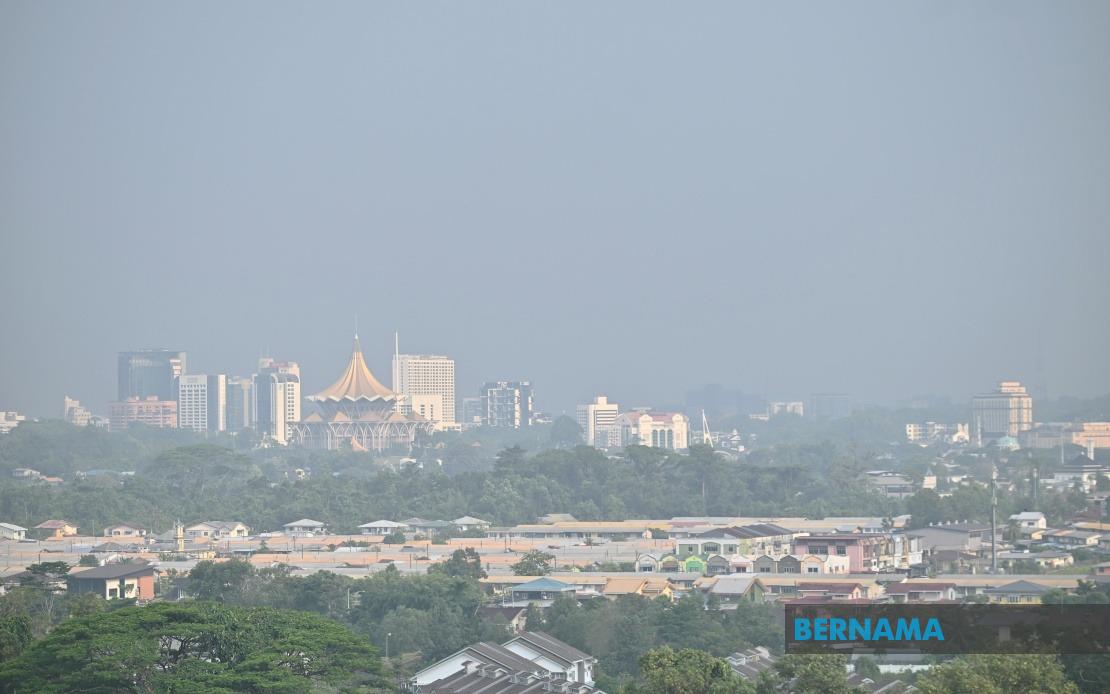
Sarawak is bracing for a significant deterioration in air quality as transboundary haze sweeps across nearly a fifth of the state's administrative divisions over the coming days. The warning, issued by Sarawak Deputy Premier Datuk Amar Douglas Uggah Embas in his capacity as chairman of the Sarawak Disaster Management Committee, identifies 19 areas vulnerable to unhealthy concentrations of particulate matter, with the impact already visible in several locations along the western and central zones of the state.
The 19 affected districts span a geographical arc from Betong in the south to Marudi in the north, encompassing major urban centres and less densely populated areas alike. The roster includes Betong, Bintulu, Daro, Julau, Kanowit, Kuching, Lundu, Marudi, Miri, Mukah, Pakan, Samarahan, Saratok, Serian, Sibu, Simunjan, Song, Sri Aman and Tatau. This widespread distribution suggests that the phenomenon is not confined to a single region but rather represents a state-level environmental challenge requiring coordinated response across multiple administrative jurisdictions.
Meteorological analysis provided by Malaysia's Meteorological Department points to the transboundary nature of the pollution event, with prevailing wind patterns carrying smoke emissions from neighbouring regions across state borders. The precise trajectory indicates that smoke plumes are being carried northward from hotspots concentrated in West Kalimantan, suggesting that the source of much of the haze lies in Indonesian territory where land-clearing practices and agricultural burning during certain seasons generate substantial emissions. This pattern is consistent with historical occurrences of regional air pollution in Southeast Asia, where meteorological conditions periodically transport particulates across vast distances, affecting multiple nations simultaneously.
Early morning readings from the Department of Environment recorded concerning air quality indices across five locations as of 8 am on the day of reporting. Serian registered the most severe reading at 171, classified as unhealthy, whilst Kuching and Samarahan both reached 154, also in the unhealthy category. Sri Aman recorded 139 and Bintulu 124, with the latter approaching unhealthy thresholds. These measurements reflect a measurable deterioration from baseline conditions and suggest that the predicted worsening trajectory may proceed more rapidly than typical scenarios. The concentration of high readings in western and central Sarawak aligns with meteorological projections regarding smoke movement patterns.
Environmental authorities attribute the ongoing air quality degradation to multiple plume systems operating simultaneously across the region. Moderate to thick smoke formations are advancing northward from West Kalimantan into western Sarawak, whilst additional moderate to dense smoke concentrations have been detected over other parts of Kalimantan before drifting toward central Sarawak. This multi-directional inflow of pollutants creates a complex atmospheric situation where air quality can fluctuate based on which plume system dominates at any given time and location. The involvement of multiple source regions complicates prediction and suggests that relief may not arrive until meteorological patterns shift fundamentally.
Uggah emphasised that atmospheric conditions remain inherently variable and subject to rapid change, cautioning residents against complacency even as official warnings are issued. Public vigilance and continuous monitoring of real-time air quality indices and official guidance remain essential elements of any adaptive response strategy. The unpredictability of weather systems and wind patterns means that forecasts, while grounded in meteorological science, cannot guarantee precision beyond certain timeframes. Residents are therefore encouraged to remain attentive to official communications and adjust behaviour in response to observed conditions rather than relying solely on advance warnings.
The health authority recommendations issued through official channels emphasise lifestyle modifications during periods of poor air quality. Outdoor activities, particularly those involving sustained physical exertion, should be curtailed or relocated indoors to minimise exposure to concentrated particulates. Environmental controls within residential and workplace settings, including keeping doors and windows sealed during episodes of heavy haze, reduce indoor accumulation of pollutants. Appropriately fitted face masks, particularly for vulnerable populations including children, the elderly, and individuals with pre-existing respiratory conditions, provide a degree of personal protection when outdoor exposure cannot be avoided entirely.
Medical preparedness also forms part of the official guidance framework. Maintaining adequate hydration helps support bodily systems under environmental stress, whilst seeking professional medical attention at the earliest signs of respiratory distress, thoracic discomfort, or persistent coughing ensures that serious complications are identified and managed promptly. This multi-layered approach recognises that vulnerable individuals may experience significant health impacts even from moderate air quality degradation, necessitating proactive rather than reactive health management.
Legal enforcement mechanisms underscore the seriousness with which state authorities treat anthropogenic contributions to haze formation. Open burning activities, whether for agricultural land preparation or waste disposal, are explicitly prohibited under the Sarawak Natural Resources and Environment Ordinance. Non-compliance triggers substantial penalties, including fines reaching RM100,000 and imprisonment terms extending to five years, or both penalties applied concurrently. This legislative framework recognises that individual burning activities, whilst often small in scale, collectively contribute to regional air quality degradation when multiplied across numerous actors over extended periods.
The Natural Resources and Environment Board serves as the primary reporting mechanism for instances of open burning detected within state territory. Public participation in enforcement through voluntary reporting complements formal monitoring systems and strengthens the state's capacity to identify and prosecute violators. Community awareness of these mechanisms and willingness to report observed violations represents an important element of air quality management in contexts where meteorological patterns create regional transboundary challenges. Individual responsibility, when aggregated across populations, can meaningfully reduce controllable sources of atmospheric pollution.

