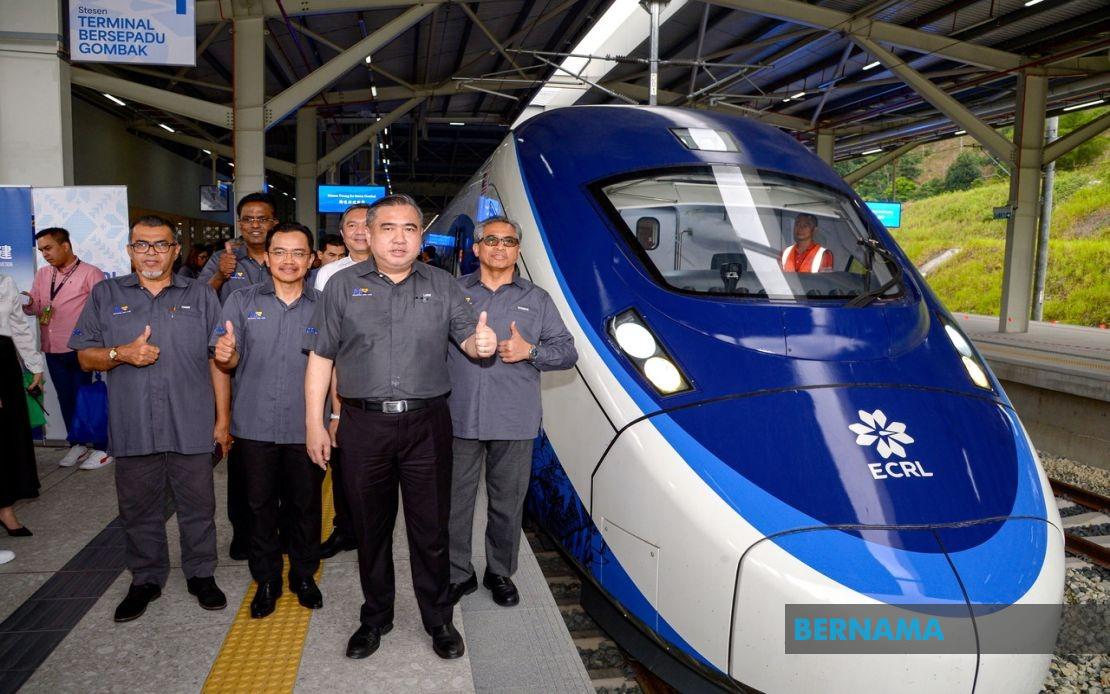
Transport Minister Anthony Loke Siew Fook has signalled an ambitious acceleration of the East Coast Rail Link (ECRL) Phase 1 project, targeting a December launch for services connecting Kota Bharu to Gombak rather than the previously scheduled January 2027 commencement. The accelerated timeline represents a potential nine-month reduction in waiting time for commuters across Kelantan and Selangor, though the minister emphasised that such advancement hinges entirely on the successful and uninterrupted progression of rigorous testing protocols now underway.
The push to bring forward operations reflects confidence gained from extensive pre-deployment assessments conducted in China before the rolling stock arrived in Malaysia. According to Loke, various train systems underwent comprehensive factory testing before shipment, providing a foundation of verified performance data that officials believe could justify compressing the traditional certification schedule. This overseas work appears to have strengthened the case for streamlining processes that normally consume considerable time when completed only at the destination site.
Central to the acceleration strategy is the coordination between Malaysia Rail Link Sdn Bhd (MRL), the project's implementing agency, and main contractor China Communications Construction Company Ltd (CCCC) to compress two critical testing phases now commencing. System Integration Testing (SIT) began this month and will validate the seamless operation of interconnected electrical and signalling infrastructure before September's scheduled Fault-Free Run (FFR), which demands that fully assembled train sets traverse 8,000 kilometres under genuine operational conditions without passengers aboard. The Land Public Transport Agency (APAD) has been enlisted to facilitate regulatory approval stages, with Loke indicating officials are exploring whether the customary two to three-month certification window can be materially shortened without sacrificing procedural integrity.
The minister's remarks reflect a delicate balancing act between project ambitions and safety imperatives. Loke stressed repeatedly that no procedural corner-cutting will occur, emphasising that all preliminary tests must achieve completion and official approval before FFR commences, thereby preventing any scenario where accelerated timelines translate into circumvented safeguards. His candid statement—"We are more afraid than you. I am more afraid than you if there is a risk"—underscores the political sensitivity surrounding railway safety in an era of heightened public scrutiny over infrastructure incidents across Asia.
The ECRL Phase 1 segment has achieved 95.08 per cent overall completion as of July, indicating that physical infrastructure development has substantially concluded, leaving primarily testing and validation work to determine the operational commencement window. This progress metric suggests that the bottleneck preventing earlier opening is administrative and regulatory rather than constructional, making the APAD coordination particularly consequential for realising Loke's December target.
Beyond Phase 1, the broader ECRL initiative continues advancing through subsequent stages. Phase 2, extending from Gombak to Port Klang, maintains a December 2027 completion target with operational launch anticipated in January 2028. This sequencing means the rail link will eventually provide continuous connectivity from Kelantan's coast through Selangor's commercial heartland to Malaysia's principal port, fundamentally reshaping freight and passenger movement patterns within the western corridor.
The project's significance extends beyond transportation metrics into broader Malaysian economic positioning. The rail link promises enhanced logistics efficiency for East Coast manufacturers seeking Port Klang access, potentially reducing shipping costs and lead times for regional commerce. For commuters, the service will integrate into the wider Kuala Lumpur metropolitan transport ecosystem, though detailed fare structures and service frequency remain under finalisation.
The December launch aspiration also carries political dimensions in Malaysia's competitive infrastructure landscape. Achieving accelerated timelines would validate the government's approach to major projects following previous delays affecting multiple initiatives. Conversely, should December prove unattainable, the January 2027 fallback remains significantly more ambitious than original proposals, constituting a demonstrable achievement even if the most optimistic targets slip.
China Communications Construction Company's role as primary contractor positions Chinese engineering capacity centrally within Malaysia's transport infrastructure development, continuing a pattern of substantial Chinese involvement in Southeast Asian rail projects. The presence of Chinese Ambassador Ouyang Yujing at the testing launch ceremony underscored the diplomatic dimensions accompanying technical coordination, reflecting the project's importance to bilateral relations.
The Comprehensive Inspection Train deployment and Main ECRL Station Design Concept introduction marks the project's transition toward operational readiness visibility. These initiatives allow stakeholders and the public to assess the tangible infrastructure taking shape, moving beyond abstract timelines and construction reports. The Gombak Integrated Terminal Station's development represents a significant urban transport node that will require careful integration with existing public transport networks including the KTM Komuter system and potential future MRT extensions.
For Malaysian transport analysts and planners, the ECRL's acceleration trajectory demonstrates how strategic engagement with regulatory agencies and contractors can compress implementation timelines when foundational work has reached sufficient maturity. The APAD's expanded coordination role signals growing sophistication in Malaysia's approach to complex transport projects, moving beyond traditional approval bottlenecks toward proactive facilitation.
Looking forward, the December target will depend fundamentally on FFR execution quality and regulatory responsiveness during September through November. Any technical anomalies during fault-free operations or certification delays could reset expectations toward the January 2027 baseline. Nevertheless, Loke's public commitment reflects genuine momentum within the project team and suggests that commuters may reasonably anticipate ECRL Phase 1 services within the relatively near term, finally delivering connectivity that was conceptualised over a decade ago.

