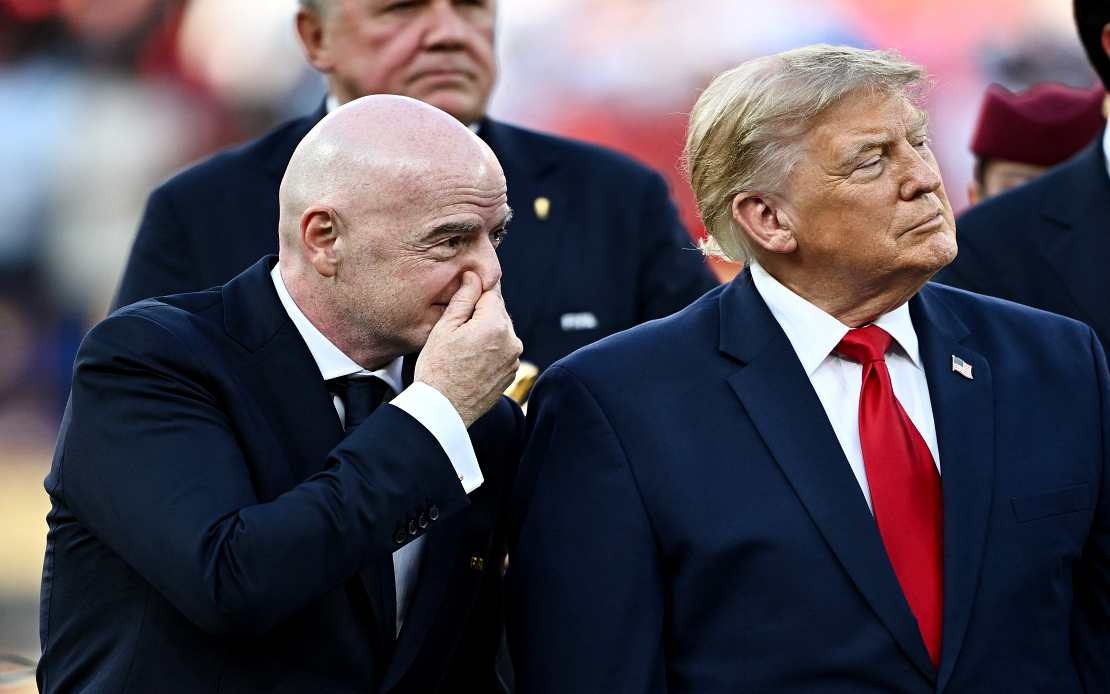
Donald Trump has stepped into the swirling controversy surrounding FIFA President Gianni Infantino's leadership, offering a forceful public endorsement of the football chief even as three major regional confederations escalate their criticism of his management. The US President took to his Truth Social platform to declare that Infantino represents irreplaceable leadership for international football and warned against any attempt to remove him from office, signalling a rare intervention in sports governance by a sitting head of state.
The backdrop to Trump's remarks involves a fundamental disagreement over FIFA's financial future and commercial strategy. In July, FIFA unveiled an ambitious plan to generate US$4.2 billion in new revenue by selling approximately 20 per cent of a newly created commercial entity to private investors. This entity was designed to assume control of FIFA's media and broadcasting rights, including the lucrative World Cup broadcasting contracts that represent the organisation's largest revenue stream. The proposal immediately triggered alarms among football's governing bodies, who viewed it as a potential threat to the sport's independence and the equitable distribution of resources.
The leadership of UEFA, representing Europe's football federations, joined with the AFC, which governs Asian football, and CONCACAF, overseeing North American and Caribbean football, to issue a jointly signed open letter condemning the proposal. These three confederations together represent the vast majority of FIFA's member associations and wield substantial political influence within global football governance. Their statement specifically demanded an independent investigation into the circumstances and decision-making processes that led to the commercial rights sale initiative, suggesting concerns that transparency and proper consultation had been absent from the planning stages.
Media reporting added another layer of complexity to the dispute by suggesting that Joshua Kushner's foundation was being positioned as a primary investor for the new commercial entity. Joshua Kushner is the brother of Jared Kushner, who served as a senior adviser to Trump during his first presidency and maintains close personal ties to the former president. This potential financial connection raised questions about whether Trump's public defence of Infantino might be influenced by personal or business relationships, though Trump made no reference to these potential connections in his statement.
Infantino's position within FIFA had already become precarious by early August, prompting him to convene an emergency meeting with the federation's senior leadership to assess his standing. At this gathering, FIFA's top officials ultimately reaffirmed their support for the president, though Infantino felt compelled to apologise for missteps related to the FIFA Forward Enterprise commercial project, acknowledging that his handling of the initiative had contributed to the controversy engulfing the organisation.
Trump's defence of Infantino focused primarily on his record as FIFA president, particularly his stewardship of the most recent World Cup tournament. Trump asserted that Infantino had presided over the most successful World Cup in the competition's history, and claimed the financial returns had exceeded all previous editions by a factor of four. The American leader further argued that FIFA would face severe consequences if it were to lose Infantino's leadership, contending that the organisation would never again achieve comparable levels of commercial success or operational profitability under alternative leadership.
The conflict between the confederations and Infantino reflects deeper tensions within global football governance regarding the balance between maintaining the sport's traditional institutional structures and pursuing aggressive commercialisation. The confederations' concerns extended beyond financial accountability to encompass broader questions about whether privatising portions of FIFA's most valuable assets represented an appropriate use of resources that many view as belonging to the global football community rather than to individual executives or private investors.
Facing the unified opposition from three continental confederations, Infantino ultimately chose to retreat from the commercial rights sale proposal entirely. FIFA announced the abandonment of the plan, effectively conceding to the pressure orchestrated by UEFA, AFC, and CONCACAF. This reversal represented a significant political defeat for the FIFA president, who had championed the initiative as essential for the organisation's financial future and capacity to distribute funds to member federations worldwide.
For Malaysian and Southeast Asian football observers, the episode underscores the complex dynamics that influence international sports governance and the reality that decisions made in Switzerland's FIFA headquarters carry direct implications for regional confederations and their member nations. The AFC's participation in the confederations' joint letter demonstrated that Asian football bodies, including those representing Malaysian football interests, maintain sufficient collective leverage to influence major FIFA policy decisions when they choose to exercise it.
Trump's intervention also illustrates the intersection of sports politics with broader diplomatic and business relationships between major powers. His public support for Infantino, regardless of its underlying motivations, demonstrates that football governance cannot be entirely separated from the interests and preferences of influential political figures and the business networks surrounding them.
The resolution of this dispute, with Infantino retaining his position but abandoning his signature commercial initiative, suggests a degree of equilibrium in FIFA's internal balance of power. However, it leaves unresolved the fundamental questions about FIFA's financial model, the appropriate pace and scope of commercialisation, and whether Infantino's authority has been genuinely restored or merely suspended pending the next controversy. For Asian football stakeholders, the incident has reinforced the importance of continental solidarity when challenging proposals that affect the global football ecosystem.

