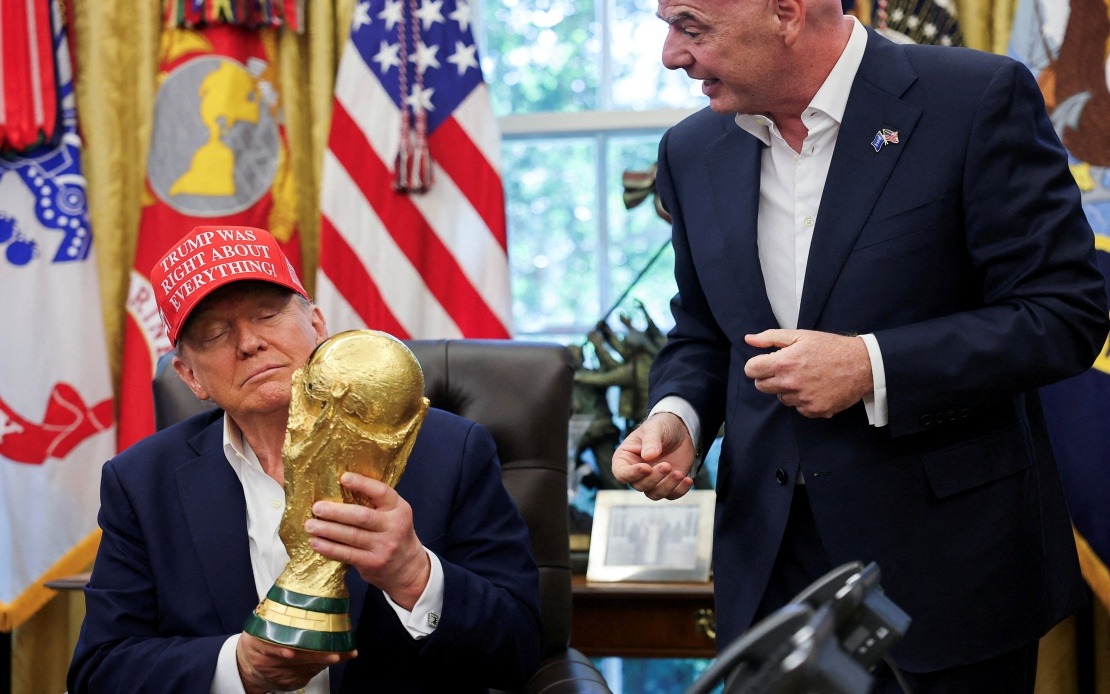
President Donald Trump adopted a notably conciliatory tone towards Spanish Prime Minister Pedro Sanchez on Sunday, declaring an absence of tension between the two leaders and congratulating Spain on its 1-0 victory over Argentina in the FIFA World Cup final in Istanbul. The dramatic shift in messaging represents a striking reversal from statements the American leader made merely weeks earlier at a NATO summit gathering in Ankara, Türkiye, where he had unleashed a scathing public critique of the Spanish government and its strategic alignment with Washington's interests.
When addressing reporters at the World Cup final, Trump emphasized that he harbored no animosity towards Sanchez or Spain, portraying the football championship as an "exciting" and "great event" that had showcased Spain's superior performance. He acknowledged the competitive nature of the contest, conceding that while Spain had emerged victorious, the margin separating the two finalists remained narrow. His remarks projected a diplomatic composure that stood in stark contrast to the vituperative language he had deployed during the NATO summit just weeks prior.
The NATO conference in Ankara had witnessed Trump launching a series of inflammatory accusations against Madrid. He characterized Spain as a "wasted cause" and described the nation as a "terrible partner in NATO," citing grievances over Spanish refusal to grant American military forces access to bases located on Spanish territory during potential confrontations with Iran. Additionally, Trump took issue with Madrid's reluctance to commit to the alliance's target for defence expenditure, which stood at five per cent of gross domestic product. These concerns reflected broader friction within the transatlantic relationship regarding burden-sharing and military cooperation.
Trump's earlier condemnation extended beyond mere policy complaints. At the NATO summit press conference, he had issued an explicit ultimatum, declaring "I don't want anything to do with Spain" and demanding that his administration "cut off all trade with Spain, please, including visits." The rhetoric intensified further when he instructed observers to "don't even talk to them," characterizing Spanish officials as "hopeless, bad people." Such language represented one of the more severe public denunciations Trump had levelled against a NATO ally, signalling a fundamental breakdown in diplomatic relations between Washington and Madrid.
The World Cup setting appears to have provided an opportunity for Trump to recalibrate his messaging without explicitly acknowledging the previous harsh statements. By pivoting to praise Spain's athletic achievement and its quality of play, Trump managed to reset the tone of the bilateral relationship in the public eye. This tactical manoeuvre demonstrates the administration's willingness to compartmentalize grievances and maintain diplomatic flexibility when circumstances permit a graceful exit from escalated rhetoric.
For Southeast Asian observers and policymakers, the Spain episode offers instructive lessons about the volatility of Trump's diplomatic approach. The swift transformation from declaring a complete trade embargo to congratulating a nation on sporting achievement illustrates how personality-driven leadership can produce unpredictable swings in foreign policy positioning. Countries throughout the region that maintain complex relationships with Washington must contend with the possibility that stated positions regarding trade, military cooperation, or alliance commitments might shift rapidly based on political convenience or media opportunity.
The underlying disputes between Washington and Madrid remain unresolved despite Trump's conciliatory public statements. The fundamental disagreements over NATO base access, defence spending commitments, and broader strategic alignment continue to characterize the relationship. Trump's willingness to set aside harsh rhetoric does not necessarily indicate a resolution of these substantive policy conflicts. Rather, it suggests a preference for managing tensions through selective engagement rather than maintaining a posture of sustained hostility.
The World Cup final setting served as an international stage where Trump could demonstrate grace in defeat—or perhaps more accurately, grace in celebrating a rival's triumph. By framing Spain's victory as a testament to superior execution rather than dwelling on the disappointment of Argentina's loss, Trump attempted to position himself as a magnanimous observer of global sporting competition. This approach allowed him to offer compliments to Spanish leadership without appearing to capitulate on policy matters.
Spain's football victory, while seemingly unrelated to geopolitical concerns, provided a valuable circuit-breaker in a deteriorating relationship. The shared appreciation for competitive sports offers a cultural touchstone that transcends the friction over military bases and defence budgets. Trump's ability to recognize and celebrate this achievement suggests that diplomatic channels remain open, even when serious disagreements exist regarding strategic priorities and alliance obligations.
The broader implications for transatlantic relations and NATO cohesion warrant careful observation. If disputes with American leadership can be papered over through gestures of sporting civility, it raises questions about the durability of commitments and the weight accorded to policy disagreements. European capitals will likely interpret Trump's flexibility as indicating that sustained pressure, whether diplomatic or commercial, can be abandoned when opportune without substantive concessions from the other party.
For Malaysian and Southeast Asian nations tracking American diplomatic behaviour, the Spain episode underscores the importance of maintaining multiple channels of communication and seeking pragmatic engagement despite rhetorical hostility. The lesson appears to be that public statements, however inflammatory, may not necessarily predict actual policy implementation. Governments must discern between genuine ultimatums and performative criticism designed for domestic political audiences or media consumption.

