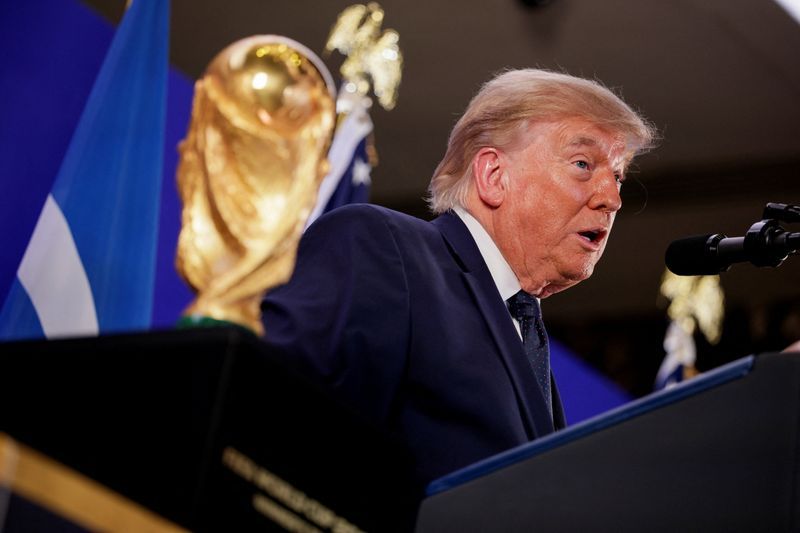
US President Donald Trump is set to make a prominent appearance at Sunday's World Cup final at New York/New Jersey Stadium, where he will sit alongside FIFA President Gianni Infantino and present the trophy to the winning team. The gesture underscores the deepening relationship between Trump and world football's governing body, a partnership that has shaped the trajectory of the tournament since its award to the United States, Canada and Mexico in 2018 during his first presidential term.
Trump's presence at the final arrives on the heels of a controversy that has threatened to overshadow the tournament's final matches. The American president recently confirmed that he had personally requested Infantino to review a red card issued to US striker Folarin Balogun, an intervention that ignited widespread debate about the integrity of international football competition and the appropriate boundaries of political influence over sporting decisions. The incident has exposed fundamental tensions between national pride in hosting a global event and the principle of competitive fairness.
The extent of Trump's influence within FIFA circles became evident during a lavish reception held Friday at Trump Tower in Manhattan, where Infantino publicly praised the president before roughly 300 attendees including Brazilian football legend Ronaldo and various FIFA officials. Infantino's assertion that the tournament would not have achieved its record-breaking success without Trump's stewardship reflects the administration's instrumental role in facilitating what has become the most heavily attended World Cup in history. For Malaysian and Southeast Asian observers, such overt political involvement in major sporting events raises questions about whether similar pressure campaigns might influence tournament outcomes in other regions.
The relationship between Trump and Infantino has weathered multiple controversies throughout the tournament's preparation and execution. Beyond the Balogun incident, the administration initially triggered international concern among potential visitors by implementing immigration restrictions on several nations, prompting US host cities to undertake reassurance campaigns targeting international fans. Later, Trump threatened to relocate matches from Democratic-controlled cities—a move FIFA firmly rejected by clarifying that any such decisions would remain entirely within the federation's domain, not the White House's.
At Friday's reception, Trump suggested the United States should host the World Cup again in 2038, but proposed doing so unilaterally and without the participation of Mexico and Canada, the current co-hosts. This throwaway remark, made in the presence of Infantino, illustrates both the president's view of the tournament as a prize to be claimed and the complex geopolitical dynamics at play. For Southeast Asian nations considering their own bids for major tournaments, such statements underscore how hosting decisions can become entangled with broader diplomatic relationships and presidential ambitions.
Trump's intensifying engagement with high-profile sporting events reflects a broader strategic shift in recent months. With his approval ratings during his second term showing concerning trends, the president has increasingly sought the amplification that major sporting occasions provide. His appearance at last year's Ryder Cup on New York's Long Island yielded enthusiastic crowds, though subsequent appearances have generated more mixed responses, most notably when he was loudly booed during Game 3 of the NBA Finals last month.
The logistics surrounding Trump's World Cup appearance have created unique operational challenges, particularly for Fox Sports, which will broadcast the final using FIFA's world feed. Unlike domestic broadcasts where networks control their own camera angles and editorial decisions, the American broadcaster has limited influence over whether cameras will cut to Trump during play or when such cutaways might occur. This uncertainty reflects the broader unpredictability surrounding presidential appearances at public events, where security protocols and spontaneous crowd reactions can disrupt standard broadcasting procedures.
Play-by-play announcer John Strong acknowledged the polarizing nature of the presidential attendance, observing that Trump's presence at the final will generate sharply divergent reactions among viewers. For some Americans, the appearance will represent a moment of national pride and validation that the United States successfully hosted and supported a world-class tournament. For others, his involvement—particularly his intervention in the Balogun case—will embody unwarranted political interference in sport, a concern that resonates broadly across international football communities.
The controversy surrounding the Balogun red card and Trump's request for its review has proven particularly damaging because it occurred at precisely the moment when football authorities sought to project professionalism and impartiality. FIFA's subsequent insistence that Trump played no role in the card's suspension being granted has satisfied few observers, and the episode has become emblematic of broader anxieties about the tournament's integrity. For Southeast Asian football administrators and fans, the incident serves as a cautionary tale about the risks of allowing political figures too much proximity to sporting governance.
The timing of Trump's ascension to such prominence in World Cup affairs illustrates how major tournaments have become platforms for political theater as much as sporting competition. His movement from the periphery to the centre of the tournament's narrative reflects not only his political position but also his intuitive understanding of how global sporting events can amplify political messages and cultivate international prestige. As FIFA prepares to award future World Cup hosting rights, the template established by Trump's experience in 2024 will inevitably influence how national governments approach their own bids and interactions with the federation.
Looking forward, the president's promise to pursue another World Cup hosting opportunity in 2038, combined with his willingness to exclude America's current co-hosts, suggests that football diplomacy will remain a significant dimension of US foreign policy and Trump's political agenda. For Malaysia and other Southeast Asian nations that may harbour World Cup aspirations of their own, the lesson is clear: hosting the world's most prestigious sporting tournament requires not merely infrastructure and organizational capacity, but also careful negotiation with powerful political actors whose interests extend well beyond the beautiful game itself.

