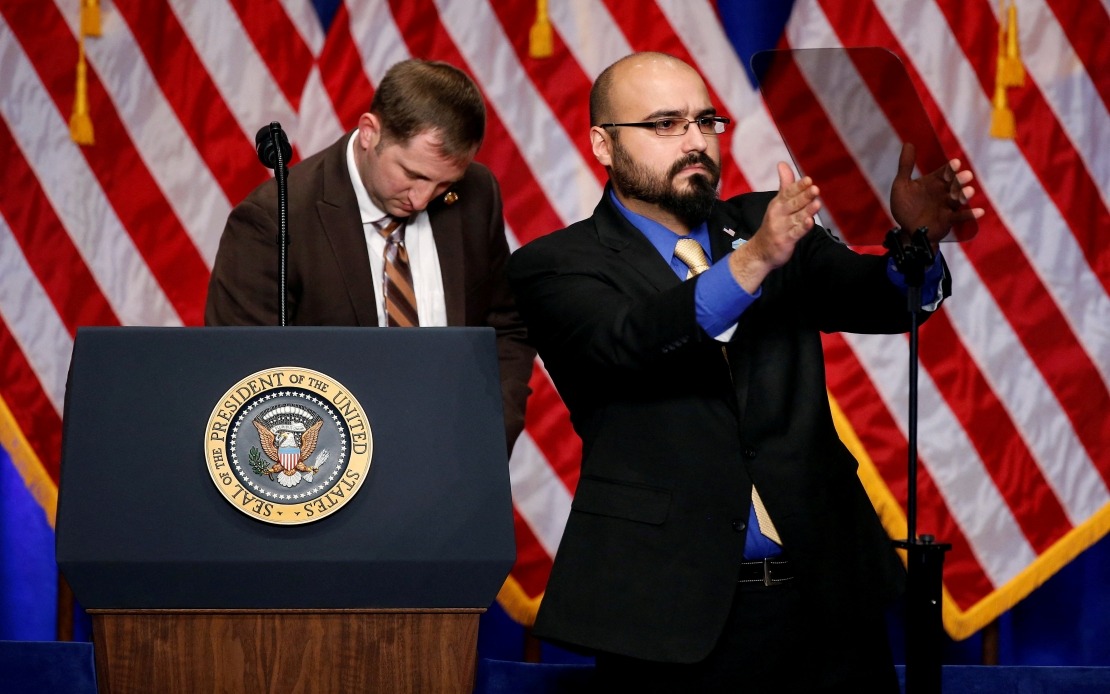
The White House announced on Thursday that a teleprompter operator employed since 2016 has been placed on unpaid leave following allegations that he exploited privileged access to President Donald Trump's remarks to place lucrative bets on a prediction markets platform. White House press secretary Karoline Leavitt characterised the situation as troubling, stating that Trump had been informed and describing the matter as "deeply unfortunate and frankly a disgrace." The incident highlights an unusual vulnerability in the security protocols surrounding high-level political communications and raises fresh questions about insider trading concerns in emerging digital betting markets.
According to reporting from broadcaster ABC, the operator allegedly accumulated winnings exceeding $100,000 through bets placed on Kalshi, a platform specialising in prediction markets where participants wager on real-world occurrences. The mechanism of the alleged scheme appears straightforward in principle: having access to the text of Trump's speeches before delivery, the operator possessed material non-public information that could have informed strategic betting decisions about outcomes the president would address or statements he would make. The trades in question represent what would constitute insider trading in conventional securities markets, though the regulatory landscape for prediction markets remains less defined.
The breach carries significant implications for information security within the executive office. A teleprompter operator occupies an unusually privileged position, routinely handling sensitive communications minutes before public dissemination. While such roles are typically considered technical support positions, the advance access to presidential remarks creates opportunities for information leakage that conventional security measures may not adequately prevent. The incident underscores the challenge of managing information flow in an era where prediction markets and social media create novel pathways for monetising non-public knowledge.
Kalshi, the prediction market operator, moved swiftly upon discovering irregularities in trading patterns. Robert DeNault, serving as the platform's legal counsel and enforcement head, disclosed on the social media platform X that the company had identified, thoroughly investigated, and subsequently reported the questionable transactions to the Commodity Futures Trading Commission (CFTC), the federal regulator overseeing prediction markets. DeNault emphasised that Kalshi had "promptly" escalated the matter and cooperated fully with regulatory authorities, providing comprehensive documentation of the evidence gathered during the internal investigation. This disclosure suggests the platform's compliance systems detected anomalous trading activity, triggering the internal review process.
The involvement of the CFTC represents a significant regulatory intervention, as the commission possesses broad authority to investigate potential market manipulation and insider trading violations within the prediction markets sphere. Unlike traditional financial markets governed by the Securities and Exchange Commission, prediction markets occupy a more ambiguous regulatory terrain. The CFTC's investigation will likely examine whether the operator's conduct violated existing market manipulation statutes or whether new regulatory frameworks need development to address information asymmetries in prediction markets. The outcome could establish important precedent for how insider information trading is prosecuted in this newer asset class.
For Malaysian readers and Southeast Asian observers, this incident illuminates evolving challenges in governance and financial regulation as digital markets proliferate globally. Prediction markets remain nascent in Asia, but their growth trajectory suggests regulators across the region will eventually confront similar compliance questions. The case demonstrates how technological innovation in financial markets can outpace regulatory frameworks, creating opportunities for misconduct that existing legal structures may not adequately address. Nations developing their own prediction market ecosystems must consider robust enforcement mechanisms and clear guidelines delineating permissible versus prohibited conduct.
The suspension also raises questions about vetting procedures and conflict-of-interest policies within the Executive Office. While many government employees face restrictions on outside financial activities, the protocols governing technical staff with access to sensitive information may require strengthening. The incident suggests that security clearance investigations and employment screening processes may need to incorporate financial conduct checks more rigorously, particularly for roles involving advance access to consequential information. Other governments, including those in Southeast Asia, might evaluate whether similar gaps exist in their own executive office security practices.
Prediction markets have attracted growing interest from retail investors seeking new avenues for speculative trading. Platforms like Kalshi have expanded offerings significantly, now encompassing political events, economic indicators, and corporate announcements. This expansion increases the probability that information asymmetries will be exploited, as individuals with legitimate access to non-public information recognise monetisation opportunities. The case exemplifies how insider knowledge becomes particularly valuable in prediction markets, where traditional information barriers and regulatory safeguards may be less developed than in established financial markets.
The broader context includes ongoing scrutiny of insider trading more generally within government and political circles. Previous controversies involving congressional stock trading have prompted legislative efforts to constrain lawmakers' investment activities. This teleprompter operator case extends the conversation into lower-level staff positions, suggesting that insider trading concerns permeate multiple layers of government. The incident may prompt the White House and other federal agencies to conduct comprehensive audits of their own employees' financial activities and investment patterns, identifying potential conflicts of interest before they become public embarrassments.
The suspension is likely to prompt serious discussion within the Trump administration about information compartmentalisation and access controls. Presidential speechwriting typically involves numerous staff members, each handling the text at different stages. Creating more rigorous tracking of who accesses speeches and when, combined with explicit prohibitions on outside financial transactions related to presidential activities, could mitigate similar incidents. However, such measures must balance security concerns against the practical necessity of allowing staff to perform their duties effectively.
Looking forward, the case underscores how prediction markets, despite their potential as price-discovery mechanisms and hedging instruments, introduce novel governance challenges. Regulators must develop sophisticated monitoring systems capable of detecting unusual trading patterns suggestive of insider trading. The CFTC's investigation will likely inform how broadly insider trading prohibitions apply within prediction markets and whether existing securities law concepts translate appropriately to this emerging asset class. The outcome may establish important precedents shaping how financial regulators worldwide approach conduct within prediction markets as these platforms gain prominence.

