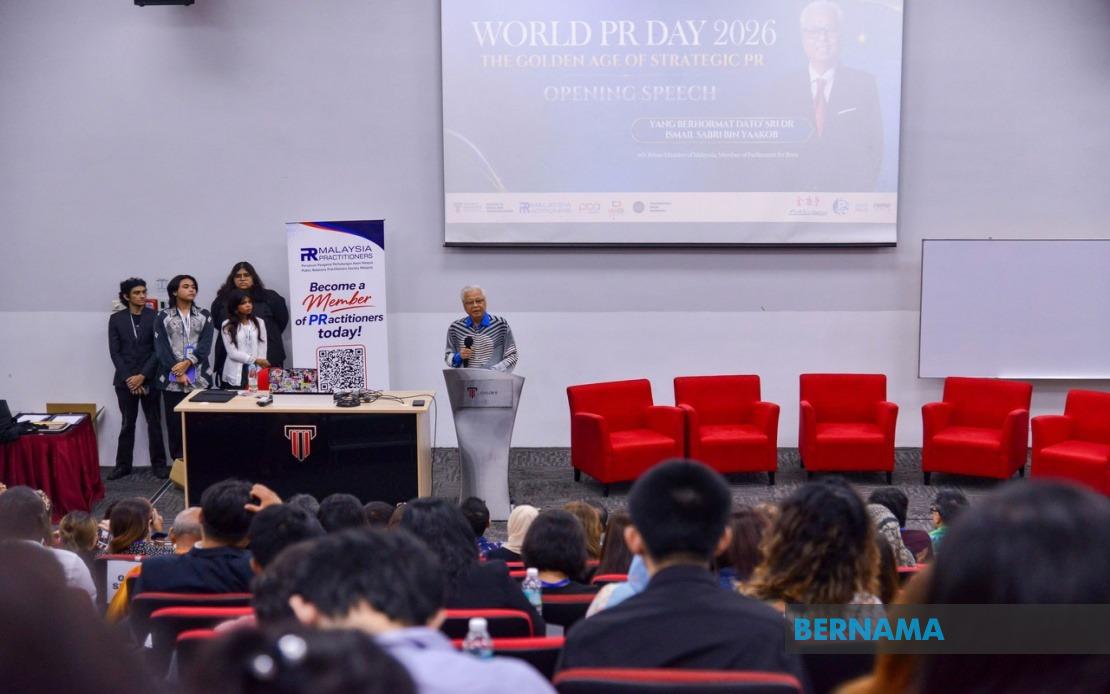
Datuk Seri Dr Ismail Sabri Yaakob has underscored the mounting importance of principled communication in contemporary organisational leadership, arguing that success in the modern era depends less on traditional competitive advantages and more on an institution's capacity to establish credible relationships with stakeholders. Speaking at Taylor's University in Subang Jaya during the launch of World PR Day 2026 celebrations, the former Prime Minister positioned integrity as the cornerstone of sustainable institutional trust, particularly as digital connectivity accelerates the velocity and reach of information flows across societies.
The distinction Ismail Sabri drew between economic competition and trust competition offers a conceptual framework for understanding shifts in how organisations maintain legitimacy. Whereas the twentieth century witnessed corporations and governments primarily competing on tangible output—cost, efficiency, market share—the current landscape demands proficiency in narrative construction and reputation management. An organisation's valuation now hinges not solely on measurable performance metrics but fundamentally on how transparently and authentically it communicates both triumphs and setbacks to stakeholders who possess unprecedented access to competing information sources.
The former leader's reflections on his tenure during the COVID-19 pandemic provide instructive grounding for these observations. The rapid succession of standard operating procedure revisions required near-constant media engagement to explain policy rationale and prevent public confusion. This intensive communication schedule, he suggested, illustrated that messaging during crisis transcends the mechanical task of policy announcement and becomes instrumental in maintaining social cohesion and institutional credibility. The pandemic exposed citizens across Malaysia to unprecedented volumes of government communication, creating both opportunity and vulnerability—clarity could reinforce public compliance, while contradictions or opacity could erode confidence at critical moments.
Ismail Sabri's characterisation of public relations professionals as having evolved beyond information distributors into strategic narrative architects reflects how professional communication practice has matured. Contemporary PR practitioners navigate increasingly complex environments where stakeholder expectations exceed simple factual transmission. They must anticipate reputational implications, manage competing narratives, and sustain organisational standing amid scrutiny from multiple constituencies—employees, customers, regulators, and the broader public. This expanded mandate requires both technical communication skills and sophisticated understanding of organisational strategy.
The challenge of artificial intelligence integration presents both opportunity and hazard for the communications sector. Ismail Sabri advocated for PR practitioners to develop technological competency, specifically the capacity to deploy AI tools for rapid sentiment analysis and public perception monitoring. Such capabilities could enhance organisations' capacity to detect emerging concerns and respond proactively. However, he simultaneously cautioned that technological adoption must remain anchored to human values and ethical principles, suggesting that efficiency gains from automation should not come at the expense of authenticity or truthfulness.
The proliferation of deceptive content represents perhaps the most acute contemporary threat to institutional communication credibility. Deepfake technology, artificially manipulated media, and deliberate falsehoods circulating at scale create an environment where distinguishing authentic information from fabrication demands increasing effort from already-taxed audiences. This phenomenon particularly concerns organisations attempting to communicate authentically—legitimate messaging must now compete not only against rival institutions but against increasingly sophisticated disinformation campaigns. For Malaysian organisations and government institutions, this environment intensifies the imperative to establish unquestionable credibility, as any perceived inconsistency or opacity can be weaponised by malicious actors.
Government regulatory responses to digital misconduct represent one policy avenue for addressing these challenges. Ismail Sabri expressed support for proposed AI Governance Bill initiatives aimed at establishing standards for technology use and combating fake news proliferation. Such legislative frameworks could establish guardrails around algorithmic systems, require transparency in AI deployment, and establish consequences for malicious deepfake creation. However, regulatory approaches alone prove insufficient—authentic institutional communication grounded in integrity provides the complementary foundation that technical standards cannot mandate.
For Malaysian organisations operating across public and private sectors, the implications warrant serious consideration. Regional competition increasingly occurs not merely for market share or investment capital but for perceived legitimacy and trustworthiness. Multinational corporations, government agencies, and civil society organisations all operate within audiences shaped by experiences of both institutional dishonesty and deliberate disinformation. In this context, organisations that consistently communicate with transparency, acknowledge limitations forthrightly, and align public messaging with actual institutional behaviour gain substantial competitive advantage. Conversely, those perceived as deceptive or inauthentic face accelerated reputational deterioration in environments where information travels instantaneously and narratives spread virally.
The Malaysian context specifically presents particular complexity. The region's diversity means organisations must navigate culturally distinct communication norms and expectations, building trust across communities with varying baseline assumptions about institutional credibility. Government agencies managing diverse constituencies must demonstrate equitable treatment and transparent decision-making processes. Private sector organisations must balance commercial imperatives with stakeholder interests in ways that appear authentic rather than merely performative. Civil society actors must maintain credibility without the resources available to larger institutions.
For communications professionals, Ismail Sabri's remarks suggest that technical mastery of emerging platforms and tools, while necessary, proves insufficient without foundational commitment to truthfulness and accountability. Professional development initiatives should emphasise ethical decision-making frameworks alongside technological competency. Organisations should invest in communication infrastructure that enables rapid, transparent, and consistent messaging rather than reactive crisis management. Leadership should understand that reputation represents accumulated trust built through consistent demonstration of integrity across extended time periods rather than episodic communication campaigns.
The 21st-century trust competition Ismail Sabri identified reflects genuine structural shifts in how modern societies evaluate institutional legitimacy. Malaysian organisations—whether government ministries, corporations, or civil society groups—cannot assume that historical reputation or hierarchical authority will sustain stakeholder confidence absent ongoing demonstration of integrity through communication practices. Those that embrace this reality and invest accordingly in authentic, transparent, and values-aligned communication positioning will likely emerge with strengthened institutional standing as digital environments continue evolving.

