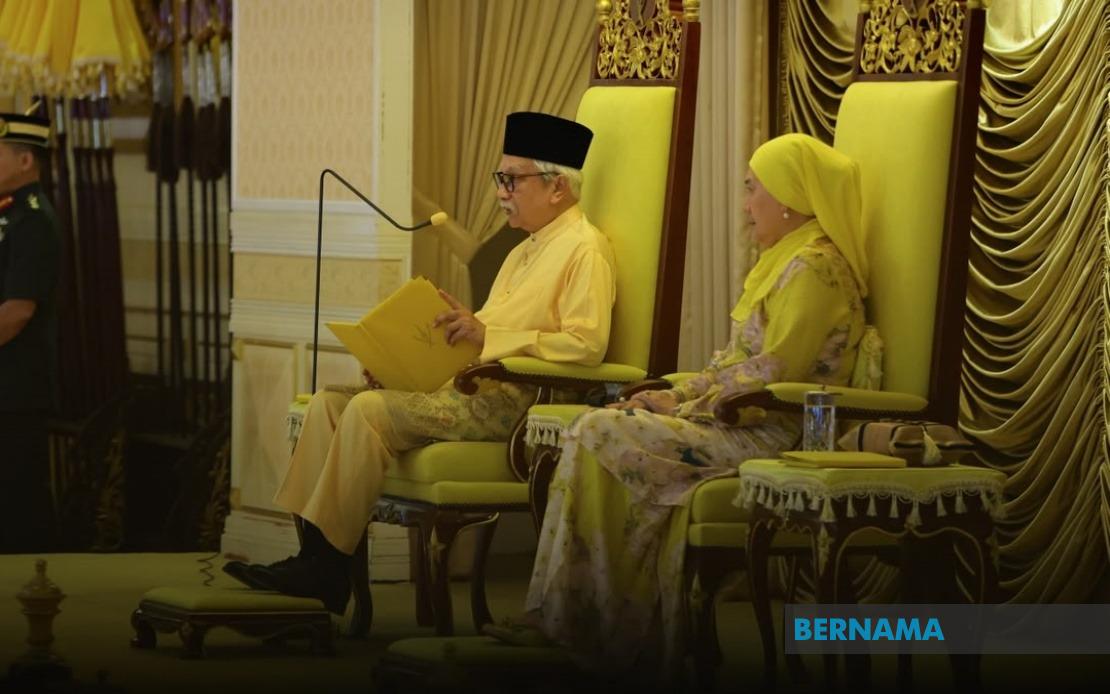
The Yang Dipertuan Besar of Negeri Sembilan, Tuanku Muhriz Tuanku Munawir, has issued a pointed reminder to members of the State Legislative Assembly that their primary obligation remains serving the interests of the state and its constituents rather than pursuing partisan or individual agendas. The remarks, delivered during the appointment and swearing-in ceremony of the Negeri Sembilan Menteri Besar at Istana Besar Seri Menanti, underscore the constitutional expectations placed upon elected officials at the state level.
In his address, the royal patron of Negeri Sembilan emphasised that those who secure electoral mandates inherit not merely political office but a significant institutional responsibility. This responsibility, His Royal Highness explained, extends beyond legislative voting and administrative oversight to encompass the sacred duty of channelling the genuine voices, genuine aspirations, substantive needs, and legitimate grievances of the electorate into the workings of state government. The framing positions elected representatives as conduits rather than principals—a distinction that carries profound implications for governance philosophy and accountability.
The core message articulated by Tuanku Muhriz reflects a classical understanding of representative democracy in which elected officials function as trustees for their constituencies. When policymakers prioritise personal advancement, factional loyalty, or ideological positioning ahead of demonstrable public benefit, they fundamentally breach this trust. The Yang Dipertuan Besar's intervention suggests that such breaches may be perceived as sufficiently endemic to warrant formal royal guidance, indicating ongoing institutional concern about the motivations driving some state legislators.
By explicitly stating that every policy proposal, planning initiative, and consequential decision must authentically reflect constituent aspirations and remain steadfastly directed toward tangible improvements in public welfare and sustained economic development in Negeri Sembilan, the royal address establishes a measurable standard against which legislative performance might be evaluated. This is not merely aspirational rhetoric but a constitutional reminder that elected positions exist to serve communities, not the reverse.
The timing of this pronouncement during a menteri besar swearing-in ceremony carries particular significance. Such ceremonies mark transitions in executive leadership and present optimal moments for reiterating foundational principles. By addressing the assembly collectively while the state's chief minister assumes office, Tuanku Muhriz signals that renewed commitment to constituent-centred governance must permeate all levels of state administration, from the chief executive downward through the legislative body.
In Malaysia's constitutional framework, sultans and Yang Dipertuan Besars function as custodians of institutional integrity and constitutional propriety. Their occasional interventions into political discourse, typically couched in dignified and non-partisan language, carry considerable moral and constitutional weight precisely because such intervention remains uncommon. When royal patrons address legislators on matters of principle and conduct, the message resonates beyond immediate political circles and reaches the broader public as a statement about enduring institutional standards.
For Malaysian observers, and particularly those in Negeri Sembilan, this royal guidance arrives amid periodic discussions about political defections, coalition-building complexities, and shifting loyalties that occasionally appear to prioritise factional interests over constituent concerns. The Yang Dipertuan Besar's unambiguous statement that loyalty must be directed toward state and people, superseding political or personal considerations, functions as a gentle but unmistakable correction to any prevailing tendencies toward misaligned priorities.
The broader implications extend beyond a single state assembly. Negeri Sembilan's experience with coalition dynamics, legislative arithmetic, and the occasional emergence of intra-party tensions mirrors challenges affecting state governments throughout Malaysia and the broader Southeast Asian region. Royal reminders about foundational democratic principles thus acquire relevance across multiple jurisdictions where elected representatives might benefit from recalibration of their institutional motivations.
For the newly-sworn Menteri Besar and the legislative assembly, Tuanku Muhriz's words establish the normative framework within which their collective work will be assessed—not merely through legislative productivity or budget allocations, but through the fundamental alignment between governmental actions and genuine public benefit. This standard applies equally to routine administrative decisions and major policy initiatives, creating a consistent expectation that public interest must remain paramount.
The constitutional monarchy's capacity to intervene through such principled guidance, without overstepping into executive or legislative territory, represents one of the enduring strengths of Malaysia's parliamentary system. The Yang Dipertuan Besar does not dictate policy or override legislative prerogatives, but rather reinforces the ethical and constitutional foundations upon which legitimate democratic governance must rest. In this instance, Tuanku Muhriz has reaffirmed that elected office, regardless of political colour or factional affiliation, fundamentally serves a higher purpose than personal advancement or partisan consolidation.

