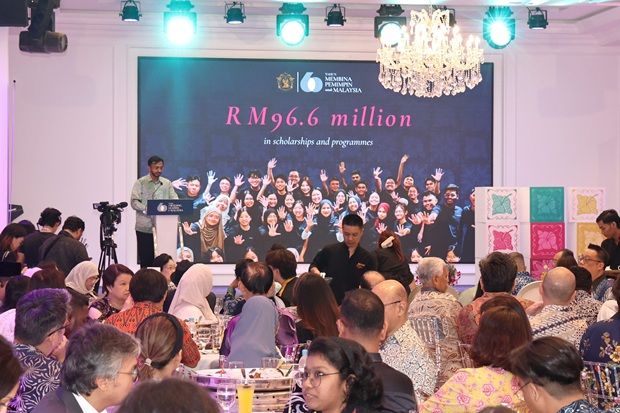
The Tunku Abdul Rahman Foundation reached a significant milestone with its 60th anniversary celebration on August 13 at Bangunan Sultan Abdul Samad, reflecting on six decades of commitment to expanding educational access for Malaysian youth. The occasion brought together government leaders, foundation officials, and notable alumni whose lives were transformed by the institution's support, underscoring the profound impact that strategic investment in human capital can have on national development.
The foundation's origins reveal a remarkable story of grassroots mobilisation and institutional vision. What began as a heartfelt tribute to Malaysia's founding Prime Minister, Tunku Abdul Rahman Putra al-Haj, took shape through a national fundraising initiative spearheaded by Utusan Melayu on the former leader's birthday. The resulting collection of more than M$60,170.20, equivalent to approximately RM380,000 in current currency values, demonstrated powerful public support for educational causes. This community-driven momentum proved instrumental in convincing the government to formalise the effort into a lasting institution.
Education Minister Tan Sri Mohamed Khir Johari's subsequent proposal to the Federal Government transformed what could have remained a temporary initiative into a permanent national institution through the Tunku Abdul Rahman Foundation Fund Act 1966. This legislative framework established YTAR as a body fundamentally aligned with Malaysia's post-independence priorities, particularly the urgent need to develop indigenous talent and build a professional class capable of steering the nascent nation through its formative years. By channelling resources towards students pursuing higher education both domestically and internationally, the foundation directly supported nation-building objectives that extended far beyond individual advancement.
Over six decades, the foundation has provided financial support to more than 12,000 Malaysian youths irrespective of ethnicity, religion, or background, distributing RM96.6 million in total disbursements. This expansive reach, as outlined by National Unity Minister Datuk Aaron Ago Dagang at the ceremony, reflects the foundation's evolution from a simple scholarship provider into a comprehensive institution identifying talent, opening pathways to opportunity, and nurturing potential across the Malaysian youth population. The breadth of its impact underscores how targeted educational investment can transcend individual beneficiaries to reshape entire sectors of society.
During the celebration, Ago Dagang emphasised an important contemporary message to Malaysia's business community, urging corporations to elevate education and talent development within their corporate social responsibility frameworks. His call reflects growing recognition that sustainable competitive advantage increasingly depends on partnership between public institutions and private enterprise in cultivating human resources. For Malaysian companies seeking long-term growth and regional competitiveness, collaborating with established foundations like YTAR offers strategic pathways to identify and nurture emerging talent while advancing national priorities simultaneously.
Foundation Chief Executive Officer Kularetnam Vijayakumar underscored a crucial philosophical principle underlying YTAR's endurance: the institution has never been the responsibility of any single individual but rather a collective undertaking of successive generations of Malaysians. This institutionalisation of purpose has enabled continuity beyond individual leadership changes, allowing the foundation to maintain its original mission despite shifting political landscapes and economic circumstances. The commitment to education as transformative power—a belief rooted in citizen initiative from the 1960s—remains as central to the organisation's work today as when the first scholarships were awarded.
Datin Sri Sharifah Menyalara Syed Hussein, granddaughter of Tunku Abdul Rahman and current chairperson, illuminated the late Prime Minister's philosophy regarding educational foundations. Tunku's belief extended beyond academic credentials to encompass character development and purposeful engagement in society, reflecting a holistic understanding of education's role in nation-building. Over six decades, the foundation has progressively expanded this vision, evolving from straightforward financial assistance into comprehensive talent development programmes that equip deserving youths with capital, opportunities, skills, and values necessary to construct meaningful futures. This progression demonstrates how institutional missions can deepen and mature while remaining true to foundational principles.
The ceremony honoured two pioneering scholarship recipients whose careers exemplify YTAR's transformative reach. Ch'ng Kim See, who received her scholarship in 1967 during acute financial hardship, subsequently became one of Malaysia's most distinguished librarians and a regional authority in Southeast Asian history and library science. Her narrative illustrates how timely educational support can redirect life trajectories, enabling individuals to overcome circumstantial barriers and ultimately contribute exceptional expertise to their nation. The scholarship arrived at a critical moment when she had exhausted other funding avenues, a phenomenon that underscores the unique positioning of institutions like YTAR in identifying and supporting talent that might otherwise languish underdeveloped.
Dr Zakaria Ali's path similarly demonstrates serendipitous conjunction of individual talent, timely intervention, and institutional support. An American instructor's recognition of his potential led to an application to Southwestern University in Austin, Texas, but financial constraints threatened to foreclose the opportunity. Fortuitously, the instructor's letters to the King, education minister, and prime minister prompted an interview process that ultimately secured YTAR funding for his studies abroad. Upon returning, Zakaria became one of Malaysia's pioneering figures in fine arts, building a multifaceted legacy as painter, writer, educator, and academic. His success demonstrates how institutional willingness to support talented individuals in pursuing overseas education served broader national interests by developing creative leaders who could establish entire fields within Malaysia.
Both Zakaria and Ch'ng exemplify a broader pattern among YTAR alumni: their subsequent careers span virtually every dimension of national development, from education and civil service through law, medicine, and frontline leadership. This diversity of contribution suggests that the foundation's true measure lies not merely in financial disbursements but in the cumulative talent pool it has helped activate across Malaysian society. These individuals collectively embody the belief system uniting successive generations of Tunku Scholars: conviction that investing in youth represents the most consequential investment any nation can make in its future.
Looking forward, the foundation has announced expanded opportunities for recognition and support, opening nominations for the 2026 Pingat Tunku Award beginning August 31 through September 30. Significantly, self-nomination now remains available for graduates of both public and private higher education institutions throughout Malaysia, democratising access to consideration and potentially identifying accomplished individuals who might not otherwise come to the foundation's attention. This procedural evolution reflects confidence that expanding nomination pathways will surface exceptional talent and continue enriching the foundation's impact into its seventh decade.
The 60th anniversary celebration ultimately vindicated Tunku Abdul Rahman's 1964 assertion that a nation's present and future depend substantially on its youth. The foundation he inspired has institutionalised this principle through systematic support for educational opportunity, creating generation after generation of Malaysian leaders. As the institution moves forward, maintaining this foundational commitment while adapting its methods to contemporary challenges positions YTAR to remain a cornerstone of Malaysia's long-term development strategy, demonstrating that visionary investment in human potential yields dividends extending far beyond individual beneficiaries to reshape national trajectories across decades.

