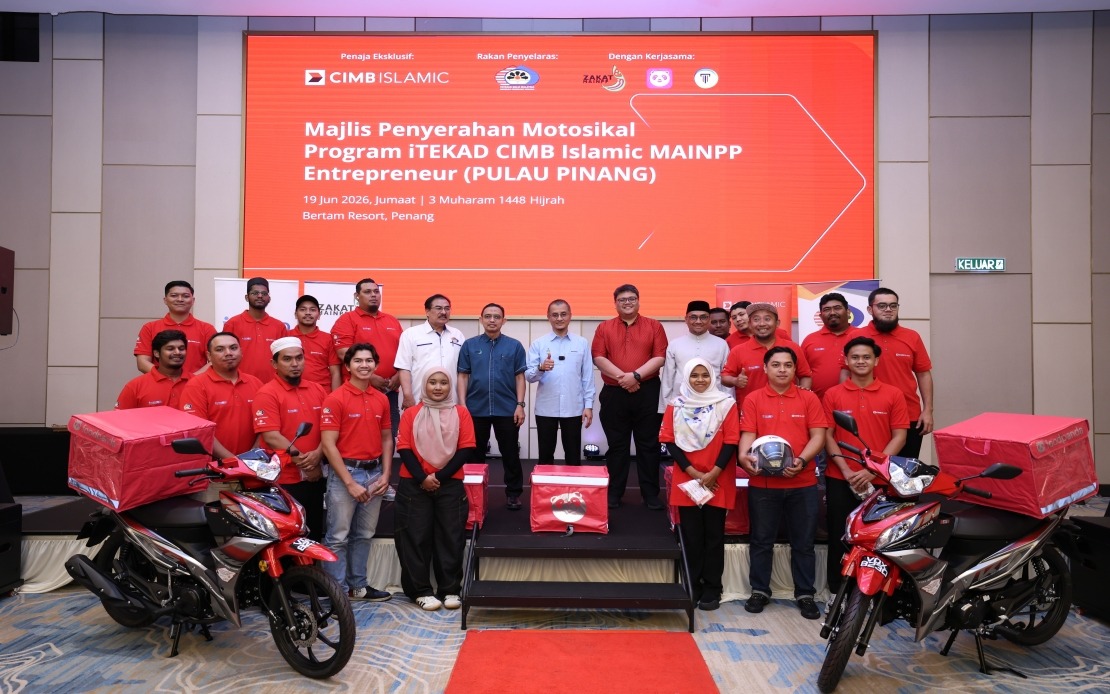
Twenty selected participants in Kepala Batas, Penang have received motorcycles as part of the iTEKAD CIMB Islamic-MAINPP Entrepreneur programme, a joint initiative designed to create sustainable income opportunities for lower-income Malaysians classified as asnaf. The handover ceremony, held at Bertam Resort, represents a significant milestone in addressing poverty through structured entrepreneurial support and asset distribution.
The programme emerged from a strategic partnership between CIMB Islamic Bank Berhad and the Penang Islamic Religious Council (MAINPP), channelling resources through Zakat MAINPP and involving implementation partners including the Malaysian Youth Foundation (YBM), Taylor's Community, and foodpanda Malaysia. This multi-stakeholder approach reflects a growing recognition in Malaysia's development sector that poverty alleviation requires coordinated effort across financial institutions, religious bodies, and private enterprises rather than isolated initiatives.
According to Penang Deputy Chief Minister I Datuk Dr Mohamad Abdul Hamid, who presided over the ceremony, the programme goes significantly beyond simply distributing assets. Each participant receives not only a motorcycle and delivery equipment but also comprehensive training modules covering fundamental financial management, workplace discipline, and practical entrepreneurship skills. This holistic approach acknowledges that sustainable livelihood generation depends on equipping recipients with knowledge and mindset shifts alongside material resources.
The financial architecture of the initiative demonstrates creative funding mechanisms. The programme operates through a RM400,000 seed fund structured as a matching grant, with CIMB Islamic Bank Berhad contributing RM200,000 from its Wakalah Zakat fund and Bank Negara Malaysia providing an equivalent RM200,000. This partnership between private banking, religious institutions, and the central bank illustrates how Malaysia's financial ecosystem can be mobilised toward social welfare objectives while maintaining Islamic principles around zakat distribution.
The selection process itself was rigorous, beginning with 151 applications submitted to Zakat MAINPP. Rather than distributing motorcycles broadly, programme administrators implemented a demanding evaluation framework that included formal interviews and a four-day intensive Entrepreneurship BootCamp held from May 31 to June 3, 2026. This residential training component allowed organisers to assess not merely paperwork credentials but actual entrepreneurial potential, resilience, and commitment among candidates.
The motorcycles and associated foodpanda delivery equipment connect recipients directly to the gig economy platform, providing immediate earning pathways. For Malaysian readers familiar with the rapid expansion of delivery services across the region, this linkage represents a pragmatic strategy for converting newly acquired assets into revenue within existing digital infrastructure. The partnership with foodpanda ensures that recipients move beyond simply owning transport to possessing integrated access to customer networks and income flows.
Datak Dr Mohamad framed the initiative within broader state-level policy architecture, specifically referencing alignment with Penang's Islamic Religious Development Agenda 2030 (APAI2030). This contextualisation matters because it demonstrates that asnaf development is not peripheral charity but central to official development planning in Penang. The agenda encompasses education, economic participation, family stability, and youth engagement—recognising that lifting communities requires addressing multiple life dimensions simultaneously rather than treating income generation in isolation.
The distinction between temporary relief and transformative support underpins the programme's design philosophy. Rather than one-time handouts, participants gain structured mentorship, access to financial literacy, and continuous support mechanisms designed to help stabilise their circumstances over medium-term horizons. This reflects international evidence that asset transfers accompanied by capability-building achieve more durable poverty reduction than unconditional cash or goods distribution.
For Malaysian policymakers and development practitioners, the iTEKAD model offers a replicable framework that other states and institutions might adapt. The combination of zakat resources, corporate banking partnerships, government-backed seed funding, and implementation through multiple qualified intermediaries creates institutional resilience. If one partner underperforms, others can compensate; if one component fails, the overall structure sustains functioning. This distribution of responsibility also reduces political risk, as outcomes depend less on any single actor.
The programme reflects shifting perspectives on poverty within Malaysia's Islamic development framework. Rather than viewing zakat as purely charitable, contemporary applications like iTEKAD treat zakat as development capital that builds recipient capacity and economic participation. This reframing aligns with Islamic principles around human dignity and self-sufficiency while meeting practical Malaysian development needs, particularly in Penang where urban economic pressures affect vulnerable populations.
Looking forward, the real measure of success extends beyond the handover ceremony. Tracking programme outcomes over twelve to twenty-four months—monitoring how many recipients sustain delivery businesses, achieve income targets, progress toward asset ownership, and ultimately transition from asnaf status—will determine whether the model genuinely breaks poverty cycles or simply provides temporary relief. Malaysian development agencies and financial institutions will likely scrutinise these metrics as they consider scaling similar initiatives nationally.
The programme also signals wider shifts in how Malaysian financial institutions approach social responsibility. CIMB Islamic Bank's deployment of zakat funds toward structured entrepreneurship rather than direct welfare aligns contemporary corporate strategy with religious obligation, potentially inspiring similar initiatives across the Islamic banking sector. For practitioners in Malaysia and Southeast Asia monitoring financial inclusion, such integration of profit-oriented banking with poverty alleviation represents an emerging model worth studying.