Violence erupted across Thailand's restive southern provinces on Friday, June 19, when two separate bomb attacks targeted law enforcement personnel within hours of each other, leaving a dozen officers injured and renewing concerns about security in a region plagued by decades of separatist unrest.
The first attack struck at 8.10am near the Ban Pulo Saniyae–Ban Sakai road in Thanto district, Yala province, where a coordinated group of assailants detonated an explosive device targeting border patrol police from a teacher protection unit. The blast inflicted injuries on six officers, with the severity of wounds varying significantly among those caught in the explosion. Initial emergency response saw all injured personnel transported to Thanto Hospital, the nearest medical facility, where medics conducted rapid triage to determine which cases required advanced care.
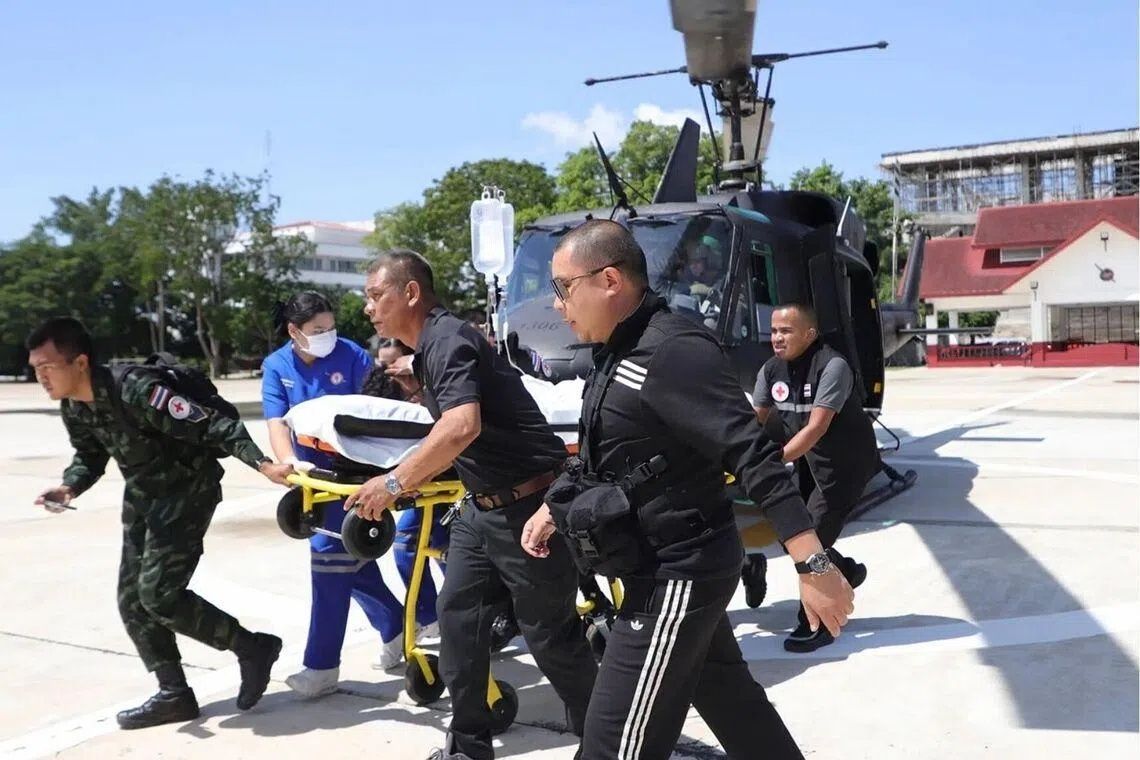
Two of the six officers sustained particularly serious injuries necessitating immediate intervention beyond local hospital capacity. Corporal Kittisak Saksang suffered extensive facial trauma caused by shrapnel fragmentation, while Corporal Poraphat Wongruaydee experienced severe thoracic injuries that compromised his respiratory function and mobility. The severity of their conditions prompted authorities to arrange emergency helicopter evacuation to the regional Yala Hospital, a decision reflecting the life-threatening nature of their wounds and the need for specialist surgical intervention unavailable at the district level.
Ryala Regional Hospital subsequently disclosed that Wongruaydee required urgent surgical procedures to address a haemothorax—blood accumulation within his pleural cavity—and to repair damage to his lungs sustained by the blast. The complexity of his injuries and the immediate need for intervention triggered a public appeal for blood donations of all blood types to support his surgery and recovery, underscoring both the severity of his condition and the blood supply pressures faced by regional medical facilities during mass casualty incidents.
Hardly three hours later, at 11.30am the same morning, a second bombing struck Pattani province, demonstrating the coordinated nature of the violence and the perpetrators' ability to execute simultaneous operations across multiple southern jurisdictions. This attack targeted officers from the Pattani Police Special Operations unit stationed at Ban Khuan Yi in Mayo district, as they were returning from establishing a security checkpoint—a routine operation that nonetheless exposed them to ambush.
The second explosion injured five additional officers, all of whom experienced chest injuries consistent with blast trauma. Sergeants Anuchit, Bunyawat, Wisitphon, Aphisit and Sumit were transported to Mayo Hospital for medical evaluation and treatment, adding to the overwhelmed regional health infrastructure already managing casualties from the earlier Yala incident. The clustering of injuries in the thoracic region across both attacks suggests the perpetrators deployed similar ordnance or utilised consistent blast engineering, indicating possible coordination by a unified operational command.
The sequential timing and geographic spread of the two bombings across provinces separated by considerable distance point to a sophisticated capability for coordination and execution. Such operational coordination typically characterises organised militant groups rather than spontaneous violence, though no claims of responsibility had emerged by the time of reporting. The targeting of police personnel, particularly those engaged in security checkpoint operations and teacher protection duties, reflects longstanding patterns of violence in the southern provinces where separatist movements have historically concentrated attacks on security forces and civil administration representatives.
Immediate security responses included deployment of explosive ordnance disposal teams and forensic personnel to both bombing sites to gather evidence, preserve the crime scenes, and begin the investigative process. Authorities instituted heightened security protocols in surrounding areas, recognising the potential for follow-up attacks or copycat incidents that sometimes characterise periods of elevated militant activity. Law enforcement agencies announced they were intensifying efforts to identify and apprehend the perpetrators through conventional investigative techniques, though the mobile nature of insurgent operations in the region presents significant challenges to rapid arrest.
The June 19 bombings represent a significant escalation in the simmering insurgency affecting Thailand's southernmost provinces, where decades of separatist conflict have claimed thousands of lives and displaced communities. The Yala and Pattani provinces form part of a historically Malay-Muslim region incorporated into Thailand through colonial-era border arrangements, and separatist movements have periodically attempted to reignite demands for autonomy or integration with Malaysia through armed campaigns. Recent years have witnessed fluctuating violence levels, with some periods marked by relative calm followed by sudden upsurges when militant organisations mobilise resources for coordinated operations.
For Malaysian observers, the violence serves as a reminder of the transnational security dynamics affecting the broader region. While the bombings occurred entirely within Thai territory, the cultural and religious connections between Thailand's Malay-Muslim population and Malaysian society create potential avenues for recruitment, financing, or logistical support across the border. Malaysian authorities have historically cooperated with Thai counterparts on counter-insurgency and counter-terrorism matters, recognising that instability in southern Thailand generates spillover effects including refugee flows and cross-border militant movements.
The twin attacks highlight persistent vulnerabilities in security infrastructure across southern Thailand despite enhanced policing measures and counter-insurgency operations maintained over the past two decades. The ability of militants to coordinate simultaneous operations suggests either that surveillance and intelligence collection remain inadequate for preventing attacks, or that the perpetrators possess sufficient operational security to evade detection despite intelligence efforts. The targeting of officers engaged in routine checkpoint and protection duties indicates that even ostensibly secure operations remain exposed to sophisticated assault techniques.
Regional governance and development challenges in Yala and Pattani provinces continue to underpin the grievances that fuel militant recruitment and sustain insurgent operations. Economic marginalisation, perceived discrimination in provincial administration, and disputes over religious and educational autonomy have historically motivated separatist political movements, creating the social foundation upon which armed groups build their operational bases. Addressing the violence therefore requires not merely enhanced security responses but also sustained engagement with underlying political, economic, and social drivers of conflict—a realisation that has slowly penetrated Thai policy-making over successive governments.
%22%2F%3E%3C%2Fpattern%3E%3C%2Fdefs%3E%3Crect%20width%3D%22100%25%22%20height%3D%22100%25%22%20fill%3D%22url(%23ph5k6avg)%22%2F%3E%3Crect%20width%3D%22100%25%22%20height%3D%22100%25%22%20fill%3D%22url(%23ph5k6avp)%22%2F%3E%3Ctext%20x%3D%2250%25%22%20y%3D%2250%25%22%20text-anchor%3D%22middle%22%20dominant-baseline%3D%22central%22%20fill%3D%22rgba(255%2C255%2C255%2C0.95)%22%20font-family%3D%22Georgia%2C%20'Times%20New%20Roman'%2C%20serif%22%20font-weight%3D%22700%22%20font-size%3D%22272%22%20letter-spacing%3D%22-0.02em%22%3EAnwar%3C%2Ftext%3E%3C%2Fsvg%3E)