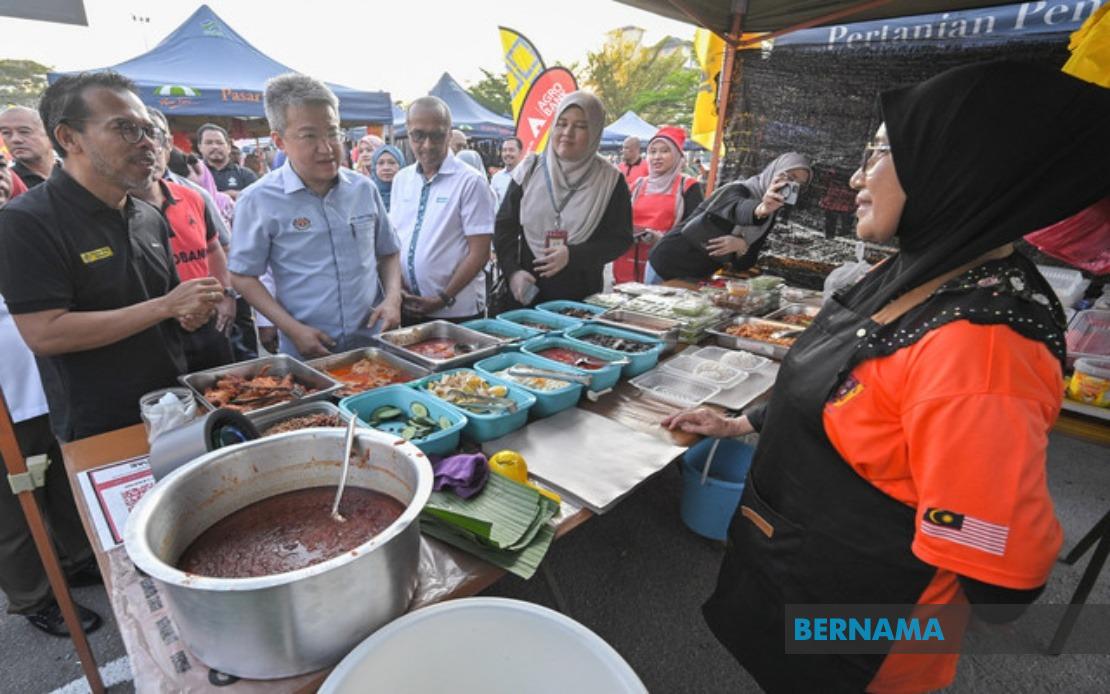
The Malaysian government is moving aggressively to democratise access to credit for the informal economy, committing RM9.8 billion through six key financial institutions to boost microfinancing for street hawkers and small entrepreneurs across the country. Deputy Finance Minister Liew Chin Tong unveiled the initiative during the "Mikro Kredit Turun Padang" programme at Dataran Puchong Permai Farmers' Market, signalling a renewed policy focus on ensuring that microtraders—traditionally excluded from conventional banking channels—have sustainable pathways to capital for business growth.
The scale of the commitment underscores how central microfinance has become to the government's inclusive economic agenda. Rather than relegating small traders to informal lending networks or unregulated moneylenders, the initiative pools resources from Bank Simpanan Nasional, Agrobank, Bank Rakyat, TEKUN Nasional, Majlis Amanah Rakyat, and the Companies Commission of Malaysia. This multi-institutional framework allows the government to leverage the comparative advantages of different lenders—BSN's retail reach, Agrobank's agricultural expertise, and TEKUN's track record in supporting micro-entrepreneurs—creating a more robust ecosystem for grassroots financing.
What sets this programme apart from conventional microfinance rollouts is its delivery model. By bringing financing agencies directly to farmers' markets and commercial hubs where traders operate, the government removes friction from the application process. The traditional barrier faced by hawkers has never been solely about credit availability; it has involved navigating bureaucratic procedures, gathering documentation, and travelling to distant banking halls—costs that disproportionately burden those operating on thin margins. The "Turun Padang" approach—literally translating to "going down to the ground"—flips this paradigm, positioning lenders as service providers who must meet applicants where they work.
Early results suggest the strategy is gaining traction. At the Puchong location alone, twelve traders have already secured approvals within what appears to be a compressed timeframe. The breakdown—seven from Amanah Ikhtiar Malaysia, three from BSN, and two from Agrobank—illustrates how different institutions are capturing portions of the market. This institutional diversity matters because it prevents bottlenecks and allows traders to find products tailored to their specific needs, whether they require seasonal working capital or longer-term equipment financing.
For Malaysia's informal sector, which remains substantial despite decades of formalisation efforts, this initiative addresses a persistent pain point. Hawkers and small traders generate significant economic activity and employment but have historically struggled to access formal credit at reasonable terms. High collateral requirements, documentation burdens, and lending officers unfamiliar with informal business models have created a structural exclusion. The RM9.8 billion commitment, combined with simplified application processes, aims to narrow this financing gap and prevent capable entrepreneurs from defaulting to predatory lending or foregone investment opportunities.
The programme also reflects a broader shift in how the Ministry of Finance approaches policy design. Liew emphasised that officials are actively gathering grassroots feedback from traders themselves, with the intention of feeding this intelligence into the budget formulation process and ultimately to the Prime Minister's office. This bottom-up approach contrasts with top-down policy-making and suggests that future allocations may be refined based on real-world implementation experiences. If traders identify specific bottlenecks—whether around collateral requirements, processing timelines, or product design—these insights could inform refinements in subsequent budget cycles.
The geographical rollout strategy also deserves attention. After testing the model at Taman Melawati, Kelana Jaya, and Bandar Tasik Permaisuri farmers' markets, the Puchong iteration represents the programme's continued expansion into new urban centres. This phased approach allows the government to identify operational improvements and scale up based on lessons learned rather than attempting a nationwide deployment that might collapse under its own complexity. Each market typically attracts hundreds of traders with varying financing needs, so the cumulative reach of this programme could eventually touch tens of thousands of borrowers across the Klang Valley and beyond.
For Southeast Asian policymakers observing Malaysia's approach, the programme offers a instructive case study in financial inclusion. The region faces similar challenges: millions of microtraders who lack access to formal credit, high rates of informal borrowing, and persistent wealth inequality rooted partly in capital constraints. Malaysia's willingness to commit substantial public resources—and to redesign delivery mechanisms rather than simply increasing loan availability—suggests that financial inclusion requires structural innovation, not just monetary injection.
The initiative also carries implications for Bank Negara Malaysia's regulatory and supervisory agenda. As microfinance expands through formal institutions rather than semi-regulated NGOs or illegal lenders, banking supervisors gain better visibility into informal sector credit flows and can more effectively monitor systemic risk. Simultaneously, the formalisation of microtrader financing creates audit trails and repayment records that can gradually improve credit assessment capabilities and reduce the information asymmetries that currently inflate borrowing costs for this segment.
Critical questions remain about programme sustainability and actual uptake. The RM9.8 billion represents a substantial but not unlimited pool; once deployed, replenishment will depend on political priorities and fiscal conditions. Additionally, the success of the initiative will ultimately rest on whether traders can service loans profitably—a function of business model viability, not just credit availability. If microtraders lack sufficient margins to cover interest payments while reinvesting in growth, even streamlined access will not solve the underlying profitability challenge.
Nevertheless, the government's willingness to tackle this problem through direct engagement with traders, institutional coordination, and process innovation demonstrates a maturing approach to economic development. For hawkers and small entrepreneurs watching their peers secure approvals at farmers' markets, the message is clear: formal finance is no longer exclusively the domain of registered companies and salaried professionals. The infrastructure for inclusive growth is being built incrementally, one market, one trader, one approval at a time.