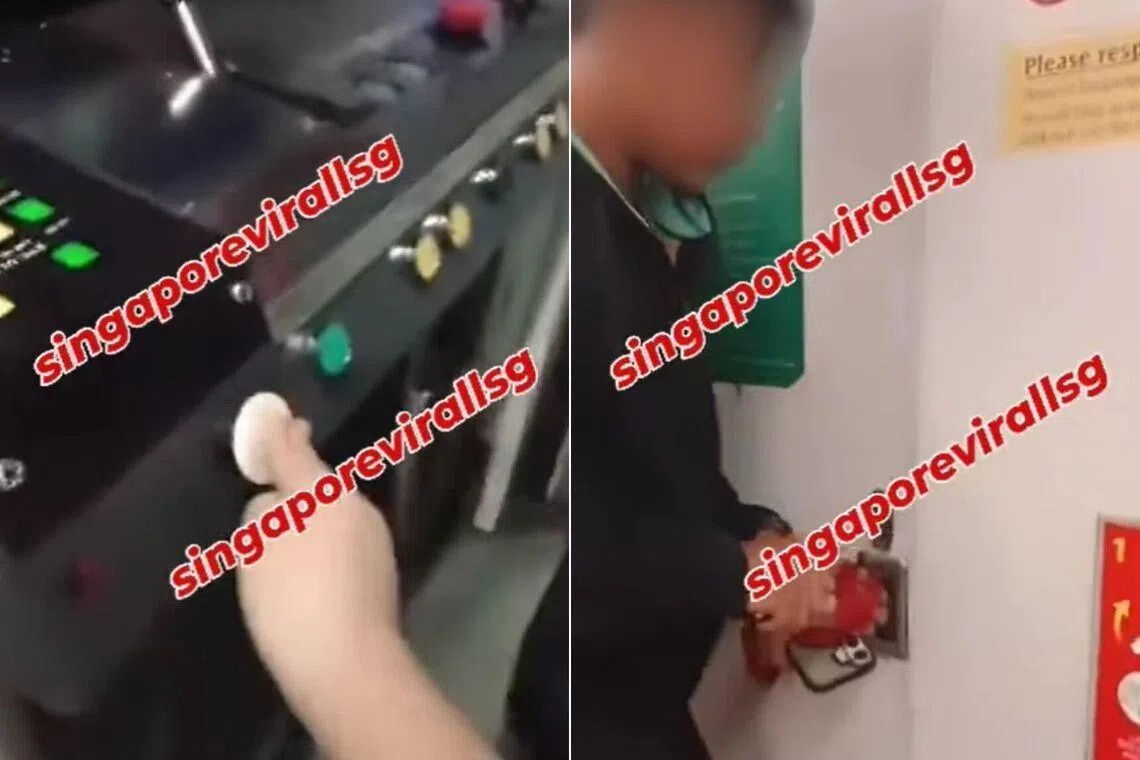
Two young boys have escaped formal prosecution after forcing their way into a restricted cabin aboard a Mass Rapid Transit train on Singapore's North-South Line in February, instead receiving conditional warnings from authorities. The incident, which occurred on February 21, has only recently drawn widespread public attention after video footage circulated across social media platforms, accumulating tens of thousands of views and generating significant online discussion about security at the city-state's rail network.
The viral video shows the two children, aged 11 and 12, using a tool to prise open the cabin partition door before accessing the restricted operational area at the rear of the train. Once inside the secured section, the boys repeatedly pressed what appeared to be a white button, with the video capturing the sound of a train horn being activated. The clip, posted to the singaporevirallsg Instagram account, garnered more than 281,000 views and was reposted over 200 times before authorities made their formal statement in late June, highlighting how rapidly such content spreads through social networks and the challenge rail operators face in managing public perception of security breaches.
The immediate consequence of the boys' actions was the triggering of an onboard alarm system, which functioned as intended by alerting the train captain in the front cabin to the disturbance. This mechanism allowed the driver to immediately contact SMRT's Operations Control Centre, the nerve centre responsible for monitoring and managing daily operations across Singapore's entire rail system. The quick notification enabled staff at the next station to be prepared for the arrival of the train and to investigate the incident promptly, preventing any potential escalation or further disruption to service.
Security personnel at the next station successfully identified the two boys when they alighted from the train, with their actions having been captured in full by the closed-circuit television system installed throughout the network. Police were subsequently called and a formal report was lodged on the same day as the incident. The investigation that followed involved cooperation between Singapore Police Force officers and the rail operator to establish the facts of the case and determine the appropriate response under prevailing legislation.
The police confirmed in late June that both boys had been administered conditional warnings under the Rapid Transit System Regulations, a statutory mechanism that allows authorities to issue formal cautions without proceeding to criminal prosecution. This decision was not made unilaterally by law enforcement; rather, it was reached in consultation with Singapore's Attorney-General's Chambers, the constitutional office responsible for overseeing prosecutorial decisions nationwide. The AGC carefully weighed the circumstances of the case, including the age of the offenders, the nature of their conduct, and the absence of any indication of malicious intent beyond juvenile mischief.
The conditional warning approach reflects a balance between accountability and the recognition that young offenders, particularly those in pre-teenage years, benefit from corrective guidance rather than formal criminal records that could prejudice their futures. Under this framework, the boys received a formal caution that, while not resulting in prosecution, serves as an official record of the incident and makes clear the seriousness of their actions. Should either boy commit a similar offence in future, such prior warnings would be taken into consideration by authorities when determining appropriate penalties.
SMRT Trains, the operator of the North-South Line and much of Singapore's rail infrastructure, has emphasised its stance on such breaches through a statement from president Lam Sheau Kai. The company views unauthorised incursions into restricted operational areas as presenting substantial hazards to both the individuals involved and the broader travelling public. The train cabin where the driver operates contains sophisticated control systems and safety equipment whose operation by untrained persons poses evident risks. Moreover, interference with these systems can trigger unexpected responses that disrupt normal train operations, potentially causing delays that cascade across the network and affect thousands of commuters.
For Malaysian observers and transport authorities, the Singapore incident underscores challenges that transit operators throughout Southeast Asia face in balancing accessibility with security. The region's rapidly expanding rail networks, including Malaysia's own LRT and MRT systems, employ similar operational protocols and face comparable vulnerabilities. The ease with which the boys accessed the restricted area despite physical barriers highlights the importance of complementary security measures combining technological safeguards with staff vigilance and passenger awareness campaigns.
The viral nature of the video also demonstrates how incidents at major transport hubs rapidly achieve regional and international exposure through social media, amplifying their significance beyond the immediate incident. Public confidence in rail safety depends partly on the perception that operators maintain rigorous security protocols, and viral videos depicting breaches can undermine this confidence even when the actual risk proves limited. Transport operators across the region must therefore address not only the physical security vulnerabilities that such incidents expose but also the communication strategies required to contextualise breaches and reinforce safety messages.
Malaysian transport authorities may draw several lessons from Singapore's response. The multi-agency coordination between police, the rail operator, and prosecutorial authorities demonstrates institutional effectiveness in handling such matters expeditiously. Additionally, the graduated response—investigation followed by proportionate sanction rather than automatic prosecution—reflects mature judgment about age-appropriate accountability. However, the incident also reinforces the necessity for continuous evolution of security technologies and training to stay ahead of creative attempts to breach secured areas, particularly as younger people become increasingly familiar with video creation and sharing.
The broader context of this incident reveals ongoing tensions inherent in operating modern rapid transit systems that must serve large civilian populations while maintaining stringent operational security. As urbanisation accelerates across Southeast Asia and rail networks expand to accommodate growing commuter volumes, finding sustainable approaches to security that do not excessively burden legitimate users remains a critical challenge. SMRT's response to this particular incident, balancing enforcement with proportionality, offers a measured example of how major operators can address lapses without overreacting in ways that might generate public backlash or excessive disruption.

