Singapore's police force has initiated charges against two Chinese nationals for their alleged involvement in a currency counterfeiting operation uncovered at one of the island's most prominent entertainment venues. The accused comprise a 33-year-old male and a 25-year-old female, both citizens of mainland China. Their prosecution marks another case in authorities' ongoing efforts to combat financial crimes that threaten the integrity of Singapore's monetary system and the broader regional economy.
The investigation commenced following an incident at Marina Bay Sands Casino during the early morning hours of August 24. A man attempted to exchange what appeared to be legitimate Singapore currency at the facility's cage counter, presenting S$150,000 that he wished to deposit into his gaming account. What might have been a routine transaction became the focal point of a criminal investigation when a vigilant cage cashier detected something amiss with one of the notes.
The suspicious currency bore an unmistakable marking that immediately raised red flags: the word "COPY" was printed directly onto the S$100 note. This elementary but telling detail prompted the cashier to escalate the matter immediately to police rather than process the transaction. The individual involved was subsequently taken into custody and escorted by officers to his accommodation at the hotel, where the investigation took a significant turn.
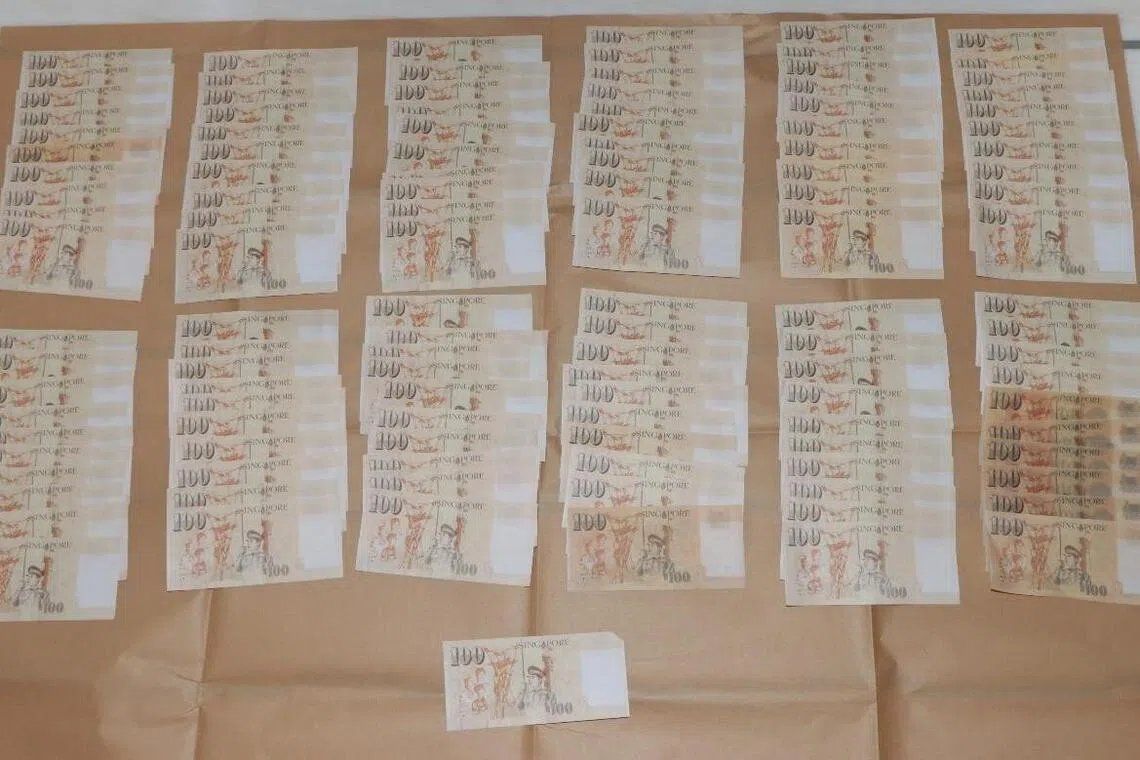
During the search of the hotel room, police discovered the female suspect attempting to flee the premises carrying a printer, a device integral to the counterfeiting operation. This piece of equipment would prove crucial to establishing the full scope of the conspiracy. When authorities conducted a thorough search of the room, they uncovered a cache of 121 counterfeit Singapore S$100 notes—equivalent to approximately US$78.78 per note at current exchange rates. The financial value of the counterfeit currency discovered amounted to S$12,100, representing a substantial sum despite the operation's apparent amateurish execution.
Beyond the fake notes themselves, investigators seized an array of implements used in the counterfeiting process. These included a bottle of ink, specialized paper stock, and a paper cutter, collectively comprising the basic toolkit required to produce fraudulent currency. The simplicity of the operation stands in contrast to more sophisticated counterfeiting rings, yet the attempt to pass fake currency through a major casino demonstrates a deliberate intent to profit from the scheme regardless of the unsophisticated methodology.
The pair now faces prosecution under Singapore's stringent counterfeiting legislation. They have been charged with engaging in a conspiracy to counterfeit Singapore currency notes, an offence that carries severe penalties reflecting the gravity with which authorities treat threats to monetary integrity. If convicted, both suspects face imprisonment of up to 20 years alongside substantial financial fines, penalties designed to serve as a powerful deterrent against such criminal activities.
For regional observers, particularly those in Malaysia and other Southeast Asian nations, this case underscores the vulnerability of currency systems to determined actors willing to employ basic technology. The speed with which the counterfeiting attempt was detected—within minutes of presentation—demonstrates both the effectiveness of casino security protocols and the relative ease with which amateur operations can be identified. However, the fact that 121 notes were successfully produced before detection also reveals gaps that more professional criminals might exploit.
Singapore's police force has seized the opportunity to issue a public advisory about counterfeit currency. Citizens and residents are urged to exercise caution when handling cash and to remain vigilant for any notes bearing unusual markings or suspicious characteristics. The message extends to immediate action: those who encounter suspected counterfeit notes should contact police on the emergency number 999 rather than attempt to circulate or dispose of the currency themselves. The public is also instructed to minimise physical handling of suspicious notes and to provide authorities with detailed descriptions of anyone attempting to pass counterfeit currency.
The incident carries implications beyond Singapore's borders. As a major financial hub and regional commerce centre, counterfeiting operations detected in Singapore often have connections to broader networks operating across Southeast Asia. The involvement of Chinese nationals, while not uncommon in regional crime statistics, may point to international dimensions of the operation that authorities could still be investigating. The sophistication level and funding sources for such schemes warrant attention from regional law enforcement agencies coordinating efforts to combat financial crimes.
For Malaysian readers and businesses, this case serves as a reminder of the importance of currency verification procedures in high-value transactions. While Singapore's casino security detected the counterfeit notes swiftly, retail and commercial establishments handling significant cash volumes must maintain similar vigilance. The case also highlights how digital payment systems and electronic transactions, increasingly prevalent across Malaysian commerce, offer protection against currency-based fraud that traditional cash-handling systems cannot provide.
The prosecution of these two suspects represents standard procedure within Singapore's robust legal framework, yet it also reflects broader regional challenges. Counterfeiting operations, despite advances in security features built into modern banknotes, continue to pose problems for monetary authorities across Southeast Asia. The case demonstrates that effective detection remains dependent on human observation and proper training of those handling currency in commercial settings, a principle applicable far beyond Singapore's borders.

