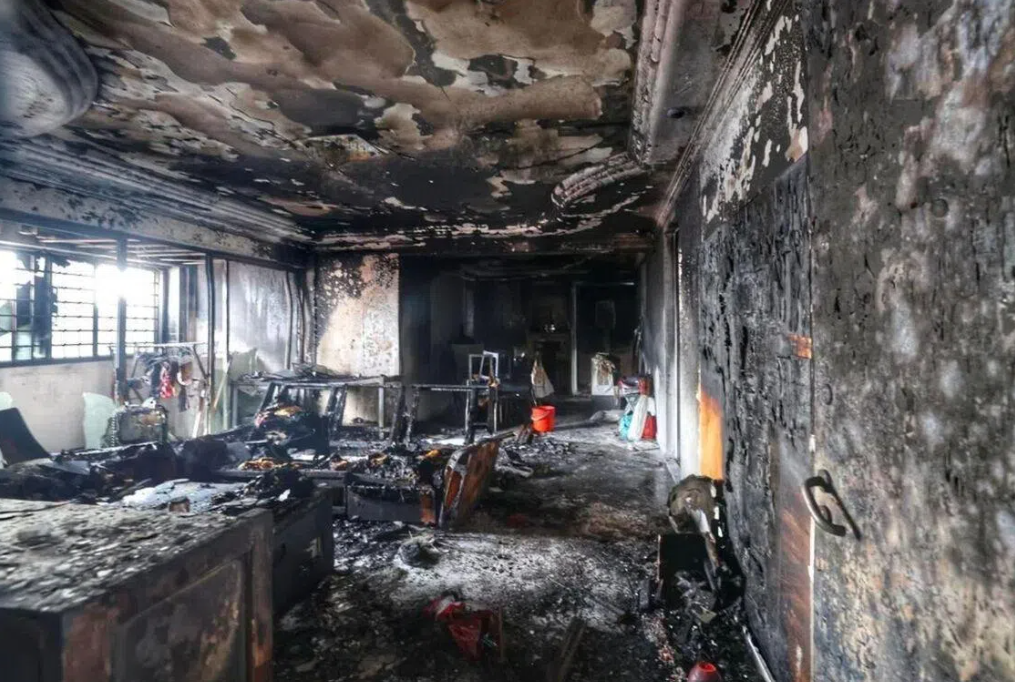
The Singapore Civil Defence Force responded to a residential fire in the early morning of June 17 at Block 842 Jurong West Street 81, where crews extracted two individuals from a 13th-storey unit engulfed in flames. The emergency call came through at approximately 3.35am, and firefighters discovered the living room fully ablaze upon arrival, forcing them to navigate through heavy smoke to combat the blaze using water jets. The rapid response prevented wider spread, though the entire family of four from the affected unit required hospitalisation at Singapore General Hospital, while nearby residents numbering around 40 were moved to safety as a precautionary step.
Preliminary investigation findings point to an electrical malfunction within the living room as the fire's origin. This determination carries particular weight in Singapore's residential safety landscape, where aging infrastructure in many public housing estates creates vulnerability to such incidents. The SCDF's assessment suggests that faulty wiring, overloaded circuits, or a defective appliance likely triggered the blaze, underscoring persistent risks within high-density housing blocks across the island.
Survey teams from Lianhe Zaobao who visited the site roughly twelve hours later documented extensive damage. The interior walls and ceiling bore heavy charring and blackening, while the unit's windows had shattered from heat exposure. Such visible destruction illustrates the fire's intensity and the potential for tragedy had evacuation been delayed. The family had been sleeping when the incident began, leaving them vulnerable and dependent on external intervention for survival.
A crucial element in this rescue narrative involves an 18-year-old neighbour residing directly above the affected flat. The young resident, who was awake at the early morning hour playing video games, detected smoke seeping through his windows and took immediate action. Upon investigating by descending to the floor below, he touched the door and found it dangerously hot. Rather than retreating, he began persistent knocking to alert occupants within the unit and others nearby. He then rushed back to his own home to urge his family to evacuate before alerting authorities.
Details emerging from interviews revealed the harrowing moments before emergency services arrived. A young woman from the burning unit appeared at the neighbour's door seeking towels, mentioning she needed them to address her father's injuries. Her appearance was striking and distressing—her hair had been singed by heat, and soot covered her face completely. Elsewhere in the unit, a man sustained severe burn injuries across his back and arms, the flesh turning a characteristic bright red that signifies deep thermal damage. These physical markers indicate the occupants had endured considerable heat exposure before being rescued.
The rapid spread of information through the residential community amplified the evacuation response. One resident from the 12th floor observed at least five fire engines deployed around the block's perimeter, demonstrating the scale of the emergency response mobilised. Such visible presence of multiple units likely reinforced residents' understanding of the gravity of the situation and expedited their willingness to leave their homes.
Beyond the immediate incident, the SCDF has taken the opportunity to reinforce public messaging regarding electrical fire prevention. Officials have emphasised the importance of avoiding circuit overloads by not plugging too many devices into single outlets. Equally critical is the practice of disconnecting appliances when they are not in use, a simple measure that prevents electrical components from overheating during standby periods. The agency specifically recommends using only appliances and plugs that bear the Safety Mark certification, a validation issued by Singapore's Consumer Product Safety Office that confirms compliance with safety standards.
Additional guidance from SCDF addresses the modern habit of charging electronic devices, particularly batteries and portable electronics, which present cumulative fire risk. Leaving such items charging unattended overnight or for extended periods without supervision multiplies the danger significantly. This advice resonates especially in Southeast Asian urban contexts where rapid adoption of smartphones, tablets, and other portable devices has created new household fire hazards that residents may not fully appreciate.
The incident arrives at a moment of growing concern about residential fire incidence across Singapore. The SCDF's annual statistics released in February revealed a troubling three-percent increase in fire incidents, rising from 1,990 reported cases in 2024 to 2,050 in 2025. More concerning still is that residential buildings accounted for precisely half of all fires—1,051 incidents—indicating that homes remain the highest-risk category for fire emergencies. This trend suggests that the Jurong West fire reflects a broader systemic challenge rather than an isolated occurrence.
For Malaysian readers and regional observers, the Jurong West incident offers instructive lessons in residential fire safety management within densely populated public housing contexts. Many Malaysian housing estates, particularly those administered by state housing corporations and the Federal Territory, share similar structural characteristics and resident demographics with Singapore's HDB flats. The negligence or ignorance of basic electrical safety practices that likely contributed to the Jurong West fire could readily occur in Malaysian settings, making the prevention messaging equally relevant across the Strait of Malacca.
The role played by the alert young neighbour underscores the importance of community vigilance in high-rise residential environments where professional emergency response, however swift, requires critical minutes to mobilise. Building a culture of mutual awareness and immediate reporting—particularly in early morning hours when occupants are most vulnerable—constitutes a form of collective safety that supplementary to official fire-fighting capabilities. This social dimension of fire prevention warrants greater emphasis across Southeast Asian housing authorities.
Looking forward, the incident will likely prompt Singapore's housing authorities to review electrical infrastructure assessments within aging HDB blocks and potentially accelerate programmes for electrical system upgrading and modernisation. The hospitalisation of four family members and the frightening escape of the others serves as a powerful reminder that electrical fires, though sometimes preventable through individual vigilance, can escalate with terrifying speed in high-rise environments where smoke spreads rapidly through ventilation systems and escape routes become compromised.