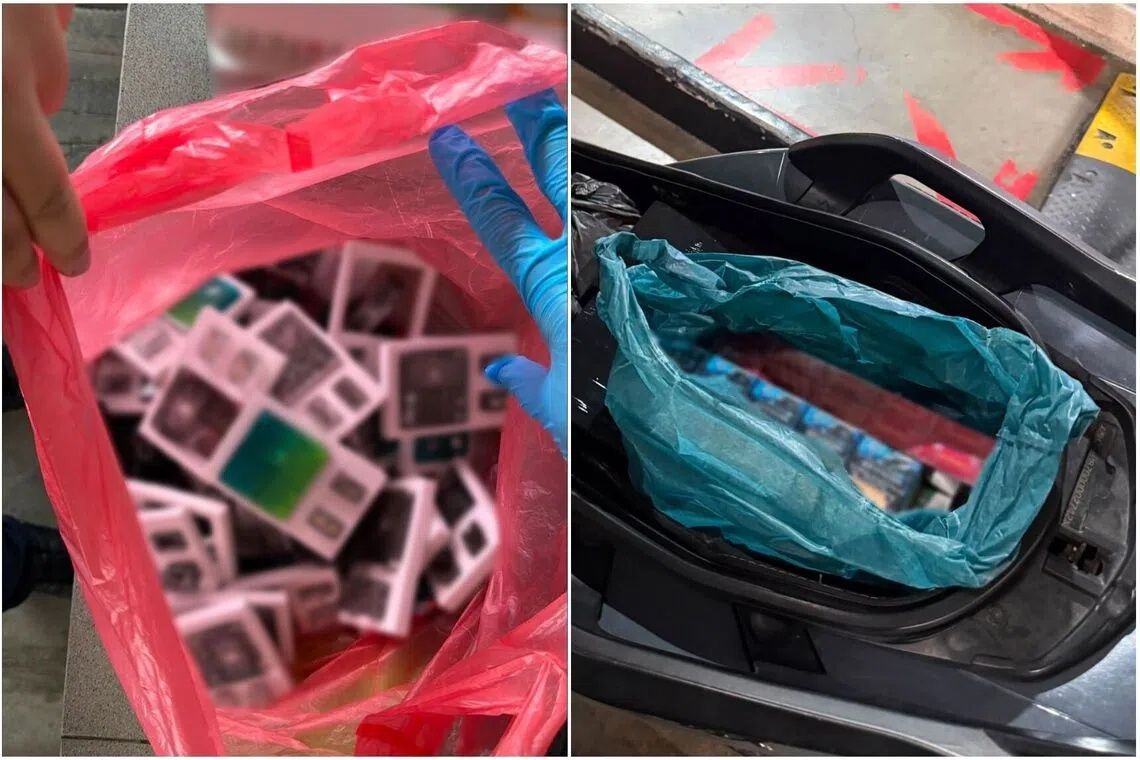
Singapore's Immigration and Checkpoints Authority (ICA) has apprehended two motorcyclists for attempting to smuggle substantial quantities of duty-unpaid cigarettes and vaping devices into the city-state through the busy Woodlands Checkpoint. The arrests, which occurred on August 3 and 4, underscore the persistent challenge border enforcement agencies face along the Malaysia-Singapore corridor, where illicit tobacco and nicotine products regularly cross undetected through both conventional and unconventional routes.
In the first enforcement action on August 3, ICA officers conducting enhanced inspections at Woodlands directed a Malaysia-registered motorcycle for additional screening. The subsequent search proved fruitful, yielding over 30 packets of duty-unpaid cigarettes alongside more than 60 vaping devices and related components. The smugglers had attempted to conceal their contraband within the motorcycle's storage compartment, a common hiding spot that officers have clearly grown accustomed to examining. The haul represented a significant quantity of illicit goods, suggesting this may have been an organized operation rather than opportunistic smuggling by a casual traveller.
Just one day later, on August 4, ICA officers repeated their success with another motorcycle interception, this time involving a Singapore-registered vehicle. The scope of this seizure exceeded the previous day's discovery, containing 25 cartons and 30 packets of duty-unpaid cigarettes, together with more than 60 vaping devices. The contraband had been distributed across multiple hiding locations within the motorcycle—tucked beneath the seat and stashed in the storage box—suggesting the smuggler had learned from common enforcement patterns and attempted to distribute the load to avoid detection.
The two individuals taken into custody represent different jurisdictional profiles. A 46-year-old Malaysian national was arrested in connection with the August 3 incident, while a 51-year-old Singapore resident was detained following the August 4 discovery. The involvement of a Singaporean resident in the smuggling operation highlights how such illicit networks often span both sides of the border, with participants leveraging their local knowledge and cross-border mobility to move contraband. Both suspects and the seized exhibits have been referred to Singapore Customs and the Health Sciences Authority for thorough investigation and potential prosecution.
The penalties governing such offences in Singapore are deliberately severe, reflecting the government's zero-tolerance approach to duty evasion and illegal vaping products. Individuals convicted of dealing in any capacity with duty-unpaid cigarettes—whether buying, selling, conveying, delivering, storing, or possessing—face fines reaching up to 40 times the evaded duty and tax amount, coupled with potential imprisonment of up to six years or both sanctions combined. The financial deterrent is particularly steep, as significant smuggling operations can result in penalties exceeding hundreds of thousands of dollars.
Beyond fines and imprisonment, Singapore authorities employ additional enforcement mechanisms to discourage participation in such schemes. Vehicles utilised to facilitate duty-unpaid cigarette offences are liable for forfeiture, meaning motorcycles and other transport used in smuggling operations become government property. This asset seizure strategy strikes at the economic viability of smuggling enterprises, raising the operational cost and risk profile for would-be smugglers planning cross-border movements.
The vaping dimension of these cases reflects Singapore's categorical ban on vaping products, a particularly stringent stance compared to many regional jurisdictions. Users apprehended with vapes face individual fines of up to $10,000, a substantial penalty for a single violation. Those engaged in the commercial supply of vaping devices encounter dramatically escalated consequences, with sellers liable for fines approaching $200,000 and imprisonment stretching up to six years. Smugglers caught importing vaping products face the stiffest penalties: fines up to $300,000 and jail terms reaching nine years.
Foreign nationals detained with vaping products face an additional enforcement tool: immigration-based restrictions. Those apprehended on multiple occasions with vapes may have their entry passes revoked and receive permanent re-entry bans to Singapore, effectively closing off the country as a destination or transit point. This immigration sanction extends the consequences beyond criminal penalties, affecting employment opportunities, business operations, and residential status for foreign offenders.
These enforcement actions at Woodlands Checkpoint form part of a broader pattern of cross-border smuggling activity along the Malaysia-Singapore frontier. The checkpoint, as the primary land border crossing between the two nations, processes hundreds of thousands of vehicles monthly, creating both opportunities and challenges for customs enforcement. Smugglers continuously adapt their methodologies—employing hidden compartments, distributing contraband across multiple locations, and leveraging both registered and unregistered vehicles—to evade detection systems.
The illicit tobacco trade particularly affects Singapore's fiscal interests, as the city-state maintains among Asia's highest cigarette duty and taxation regimes. This significant price differential between Singapore and neighbouring jurisdictions, particularly Malaysia, creates economic incentive for smuggling operations. The volume of seized duty-unpaid cigarettes in these recent cases—with combined seizures exceeding 55 packets and 25 cartons—suggests that even modest smuggling runs can yield substantial contraband quantities.
For Malaysian readers and businesses, these enforcement successes carry implications beyond immediate legal consequences. The ICA's enhanced screening protocols and increased vigilance at Woodlands indicate that border authorities are prioritising interception of these goods. Cross-border commuters and commercial operators should anticipate more thorough inspections, potentially extending travel times during peak periods. Additionally, the involvement of a Malaysian national underscores how participation in Singapore's illicit networks carries severe criminal exposure, with penalty provisions far exceeding those typically applied in Malaysia.
These arrests also reflect the coordinated approach between Singapore's immigration and customs authorities, combined with the Health Sciences Authority's involvement in vaping-related prosecutions. The multi-agency response demonstrates institutional commitment to disrupting smuggling networks at their source, rather than relying solely on terminal enforcement. As smuggling methods continue to evolve, particularly with concealment innovations and cross-border network coordination, border enforcement agencies must maintain constant operational adaptation to sustain interception effectiveness.

