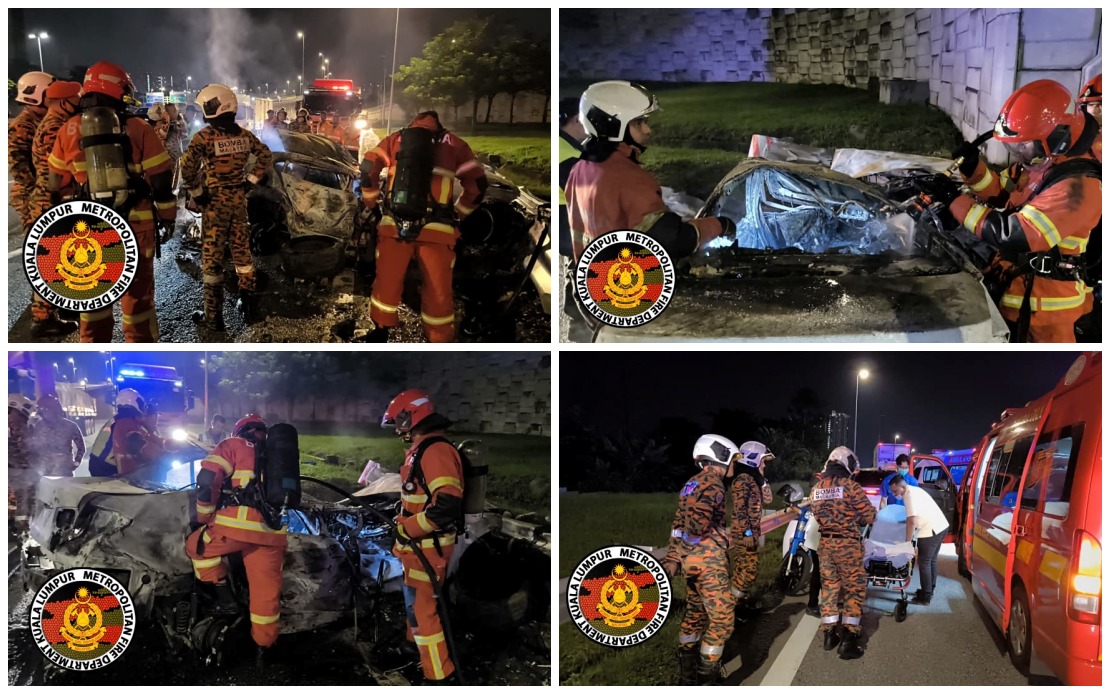
A tragic collision on one of Kuala Lumpur's busiest expressways has claimed the lives of two young Malaysian students in a blaze that erupted in the early hours of Thursday morning. The incident occurred on the Duta-Ulu Kelang Expressway (DUKE) near the Jalan Kuching exit ramp, where a BMW 328i Sport veered across the roadway and struck the left divider with such force that the vehicle became engulfed in flames. Police confirmed that both occupants trapped inside perished at the scene, while a third passenger miraculously escaped with only superficial injuries.
According to ACP Mohd Zamzuri Mohd Isa, head of the Kuala Lumpur Traffic Investigation and Enforcement Department, preliminary findings indicate that excessive speed contributed directly to the loss of control. The vehicle had been heading from Jalan Duta towards Selayang when the driver apparently misjudged conditions or lost grip on the asphalt, causing the car to skid violently across lanes before striking the concrete divider. The impact ruptured the fuel system, transforming what might otherwise have been a survivable accident into a catastrophic event within moments.
The two fatalities have been identified as a 22-year-old male driver enrolled at Queensland University of Technology in Australia and a 21-year-old male front-seat passenger studying at Sunway University in Malaysia. Both men were trapped within the vehicle as flames consumed it, making rescue impossible. The intensity of the fire has necessitated DNA analysis to formally confirm their identities, a process that underscores the severity of the thermal damage sustained during the collision. Their families now face the profound grief of losing young men at the threshold of their professional lives, with promising futures cut short by a moment of mechanical failure or human error.
The sole survivor in this tragedy was a 20-year-old Singaporean male student who occupied the rear of the vehicle. His escape, whether due to positioning, a partially opened door, or sheer fortune, has allowed police to gather vital eyewitness testimony about the final moments before impact. Medical staff at Kuala Lumpur Hospital treated his minor injuries, and he has become the primary source of information for investigators piecing together the sequence of events that led to the disaster. His account, combined with physical evidence and forensic analysis, will prove crucial in determining whether mechanical failure, driver error, or environmental factors precipitated the loss of control.
The investigation has been formally classified under Section 41(1) of the Road Transport Act 1987, which governs motor vehicle offences and traffic-related fatalities. Police teams have secured the scene and begun systematic examination of available evidence, including comprehensive CCTV footage from the expressway corridor. The early morning timing, when traffic volumes are typically reduced, may actually assist investigators by providing clearer video records of the moments preceding the crash. Technicians will review recordings to establish the vehicle's speed, lane position, and any signs of erratic driving before the collision.
The circumstances surrounding this crash reflect broader concerns about road safety on Malaysia's expressway network. High-speed corridors like DUKE facilitate rapid movement between urban centres but also enable dangerous driving behaviours. Young drivers operating powerful vehicles—particularly those unfamiliar with Malaysian road conditions or the specific characteristics of imported sports cars—may underestimate the risks of aggressive acceleration or cornering. The early morning hour suggests possibilities including driver fatigue, impaired judgment, or simply the reduced visibility and hazard perception that accompany night driving.
Beyond the immediate tragedy, this incident resonates particularly within Malaysia's university community and among expatriate student populations. Queensland University of Technology maintains a substantial cohort of Malaysian and international students in Kuala Lumpur and affiliated institutions, while Sunway University ranks among the nation's premier private institutions with thousands of enrolled undergraduates. The loss of two promising students serves as a sobering reminder to peer groups about mortality and the consequences of momentary lapses in judgment or awareness behind the wheel.
Police have appealed to the public for assistance in the ongoing investigation, specifically requesting that anyone with dashcam footage or direct knowledge of the incident contact the Traffic Police Station at Jalan Tun H.S. Lee or any nearby station. Such appeals often yield valuable corroborating evidence, particularly on expressway corridors where multiple vehicles typically traverse the same route within a narrow timeframe. Independent recordings may provide perspectives unavailable to stationary CCTV systems and could clarify the precise sequence of events.
The recovery of victims and treatment of the survivor have proceeded with appropriate urgency and sensitivity. The charred condition of the two fatalities has complicated identification procedures, necessitating the application of advanced forensic techniques. While DNA analysis requires time for completion, police have begun notifying next of kin and coordinating with consular authorities given the Singaporean passenger's nationality. The formal investigation will ultimately determine whether charges relating to rash or negligent driving should be considered, though such determinations must await completion of technical analysis and formal identification of the deceased.

