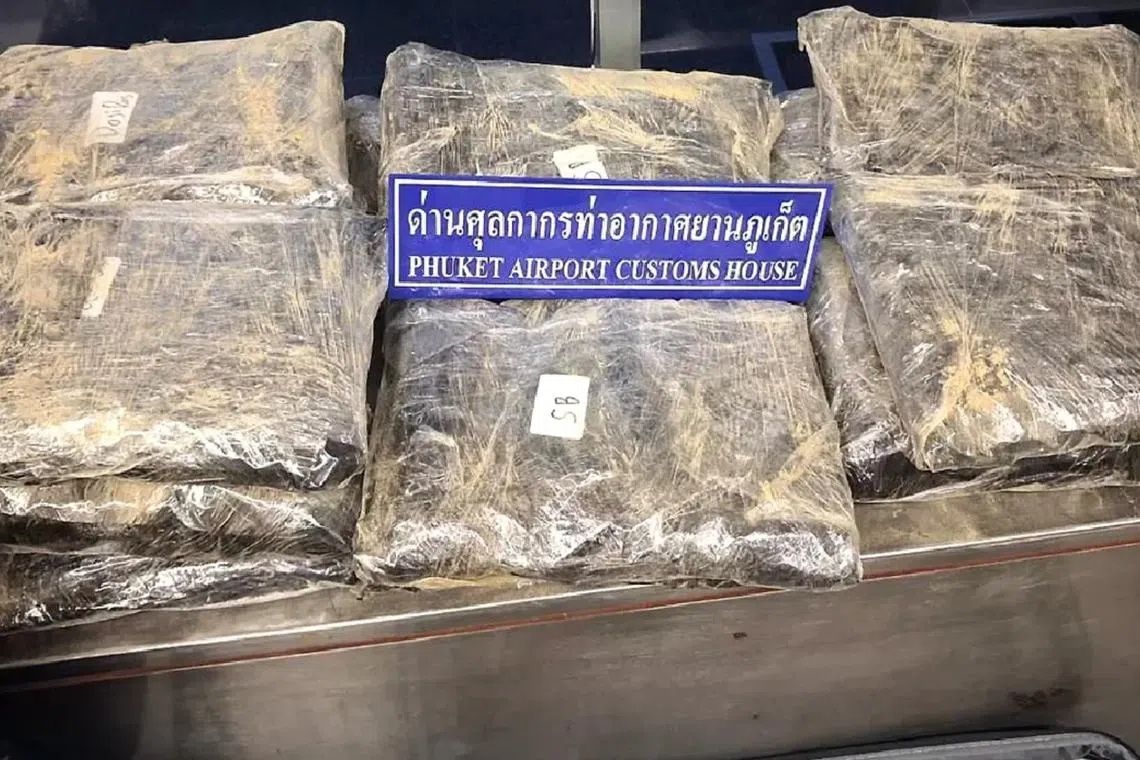
Customs enforcement officers at Phuket International Airport have apprehended two women in separate incidents on the same day after discovering cannabis flowers totalling more than 32 kilograms concealed in their checked luggage. The coordinated operation, conducted by officials from Phuket Airport Customs House working alongside personnel from Sakhu Police Station within the international departures terminal, represents an intensification of efforts to prevent controlled substances from leaving Thailand through commercial aviation channels. Both arrests occurred on Thursday, July 9, with authorities alleging that the women attempted to export the cannabis without completing mandatory customs procedures, a violation that has prompted stricter enforcement across the kingdom's key transit points.
The initial apprehension took place at approximately 11 in the morning when customs officers became suspicious of a black Pierre Cardin wheeled suitcase being prepared for departure. The bag belonged to 18-year-old Levannah Chelsea Guzman, a Filipino national, and inspection revealed fourteen vacuum-sealed packages containing cannabis flowers concealed within the luggage. The seized material, including all protective wrapping, totalled 14.5 kilograms and presented an unusually concentrated cache of the restricted botanical product. During the subsequent interview with authorities, Guzman confirmed ownership of both the suitcase and its illicit contents, establishing clear legal liability for the attempted exportation.
The charges filed against Guzman encompass multiple layers of Thai legislation reflecting the seriousness with which authorities treat such violations. Beyond the fundamental accusation of attempting to export goods without proper customs clearance—a breach of the Customs Act BE 2560 (2017)—the prosecutor also invoked the broader Narcotics Code framework that governs controlled substances throughout the country. Additional charges referenced the Protection and Promotion of Traditional Thai Medicine Wisdom Act BE 2542 (1999), a somewhat unusual provision that addresses cannabis within a medicinal and traditional knowledge context, alongside the Public Health Ministry's more recent notification issued in 2025 establishing specific regulations for controlled herbs. This multi-statute approach demonstrates how Thai law enforcement has developed comprehensive mechanisms to prosecute drug-related smuggling across various legal domains.
Less than two hours later, at approximately 1 in the afternoon, customs officers examining outbound luggage identified a suspicious green Swish Navy wheeled suitcase awaiting loading. The bag belonged to Penpitcha Phutsiang, a Thai national, and subsequent inspection uncovered a substantially larger quantity of contraband than the first case. Officers recovered sixteen vacuum-sealed packages of cannabis flowers that collectively weighed 17.6 kilograms, making this the more substantial seizure of the two incidents. When questioned, Phutsiang acknowledged ownership of the suitcase and all items discovered within it, providing authorities with admission of possession and intent that simplified the evidentiary requirements for prosecution.
The charges levelled against Phutsiang mirrored those applied in the Guzman case, indicating standardised prosecutorial practice when addressing airport-based cannabis exportation attempts. Both women now face the combined weight of customs violations and narcotics law infractions, with investigation and legal proceedings transferred to Sakhu Police Station for further development of their respective cases. The parallel charges suggest that Thai authorities view such smuggling attempts through a comprehensive lens that addresses both the breach of customs procedures and the underlying violation of drug control statutes, ensuring maximum legal consequences for those apprehended.
These arrests occur within a broader context of enhanced airport security measures that have been progressively implemented across Thailand's major international terminals. The increasing sophistication of smuggling attempts—evidenced by the vacuum-sealing technique and the selection of generic commercial luggage—has prompted customs authorities to expand their inspection protocols and train officers to identify suspicious packaging methods and luggage behaviour patterns. The timing of these two seizures suggests that intelligence gathering or random enhanced screening procedures may have flagged the departing passengers for closer examination, resulting in the discovery before the cannabis could exit Thai airspace.
For Malaysian readers and businesses with connections to Thailand, these developments underscore the escalating enforcement environment at Southeast Asian airports and the expanding scope of drug control initiatives across the region. The reference to the Public Health Ministry's 2025 notification indicates that Thai regulatory frameworks governing cannabis remain in active evolution, with authorities continuously updating and clarifying prohibited substances and export restrictions. This dynamic regulatory landscape creates potential confusion for travellers and businesses attempting to navigate cross-border movement of botanical materials, particularly given the varying legal status of cannabis and cannabis-derived products across different Southeast Asian jurisdictions.
The operational coordination between Phuket Airport Customs House and local police demonstrates the integrated approach now characterising drug interdiction at Thailand's aviation hubs. Rather than functioning as isolated checkpoint operations, customs and police agencies have established joint task forces that pool intelligence, coordinate surveillance, and share responsibility for investigation and prosecution. This collaborative model reflects international best practices and addresses the recognition that modern drug smuggling frequently requires cross-agency responses that move beyond traditional jurisdictional boundaries. The placement of officers directly within the departures terminal—rather than only at external checkpoints—allows for interception at the latest possible moment before luggage enters the aircraft.
The seizure of 32.1 kilograms of cannabis flowers at a single airport location within hours represents a significant disruption of what appears to have been an organised export operation. While the precise destination remained unstated in official accounts, the careful packaging and the coordination of two simultaneous departures suggest professional involvement rather than personal use scenarios. The geographic context is particularly relevant given Thailand's position as both a cannabis cultivation centre and a distribution hub with connections to regional and international markets. The attempted exportation through Phuket—a major international tourism and transit hub serving connecting passengers throughout Asia—indicates that smugglers continue to regard Thai airports as viable corridors despite intensified enforcement.
Moving forward, these arrests will likely contribute to Thai authorities' ongoing assessment of vulnerabilities in airport security protocols and their determination of optimal staffing levels and inspection intensities at departures terminals. The successful identification and seizure suggests that current measures possess adequate effectiveness when properly implemented, yet the very existence of smuggling attempts indicates that gaps or predictable patterns remain. Regional law enforcement agencies, including those in Malaysia, may receive enhanced alert information regarding smuggling methodologies, preferred packaging techniques, and identified smuggling networks operating from Thailand toward external destinations. The case exemplifies the continuous adaptation required in counter-narcotics operations as smugglers develop new concealment methods and routing strategies in response to enforcement pressures.

