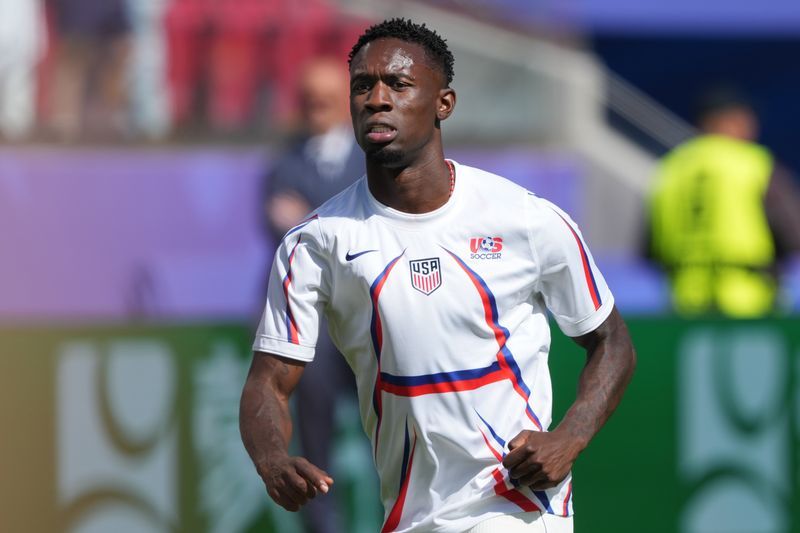
European football's governing body UEFA has launched a scathing critique of FIFA's handling of a controversial disciplinary case involving U.S. striker Folarin Balogun, asserting that the world's soccer governing body has fundamentally breached the sanctity of competitive sport. The row centres on FIFA's decision to suspend implementation of Balogun's red card suspension, a move that came after U.S. President Donald Trump directly intervened by contacting FIFA president Gianni Infantino to request a review of the case. UEFA responded with an official statement characterising the decision as "unprecedented, incomprehensible and unjustifiable," and pointedly warned that FIFA has "crossed a red line" by taking such action.
The underlying incident that triggered this diplomatic firestorm occurred during the United States' round of 32 victory over Bosnia, when Balogun was sent off following a VAR review for an off-the-ball incident in which he dragged his cleats down the back of defender Tarik Muharemovic's leg and onto his foot. The American forward, who has contributed three goals to his nation's World Cup campaign, would have faced automatic suspension from the team's subsequent round of 16 match against Belgium had the red card ban taken effect as originally determined. The original punishment represented standard disciplinary protocol for violent conduct offences in international football.
FIFA's response to Trump's direct intervention proved extraordinary in the context of modern football governance. Rather than either upholding the original suspension or rescinding the red card entirely, the world body adopted a middle-ground approach by suspending the implementation of the ban for one year on a probationary basis. This decision effectively allowed Balogun to participate in the crucial knockout match against Belgium, despite the disciplinary infraction standing on his record. The nuanced ruling sought to balance competing pressures but instead satisfied no constituency and generated widespread alarm among competing nations and football stakeholders.
UEFA's statement captured the depth of concern within European football about the precedent established by FIFA's accommodation of Trump's request. The European confederation emphasised that when the consistency and predictability of disciplinary rules can no longer be assured by those entrusted with their stewardship, the entire framework undergoes corrosion. UEFA stressed that once fans, players and federations lose confidence that regulations will be applied uniformly and without external political influence, the credibility of international competitions becomes fundamentally compromised. This concern extends beyond the immediate case to encompass the broader question of how FIFA manages its authority and independence.
The decision has prompted formal protest from Belgium's football federation, the Royal Belgian Football Association (RBFA), which conveyed its astonishment at FIFA's action in an official statement. The RBFA subsequently filed a formal appeal against the determination, arguing that FIFA's ruling placed Belgium at a competitive disadvantage by allowing an opponent's suspended player to participate in a direct fixture between the two nations. Belgium's perspective reflects the practical implications of the decision for teams competing in the tournament, since Balogun's availability could materially affect match outcomes and thus a team's World Cup trajectory.
The intersection of political pressure and sporting governance has long represented a tension point within international athletics, yet Trump's direct appeal to Infantino appears to have crossed thresholds that previously remained unchallenged at the highest levels of professional soccer. Precedent matters enormously in sports administration, where the principle of equal application under the rules serves as the foundation for legitimate competition. If political leaders can successfully petition for reconsideration of disciplinary decisions affecting their own citizens, the resulting system becomes vulnerable to selective enforcement and patronage rather than principled consistency.
For Southeast Asian and Malaysian readers closely monitoring international football developments, this controversy carries particular significance regarding how global sporting bodies maintain independence and integrity. The incident demonstrates vulnerabilities within FIFA's institutional structures that could theoretically extend to future decisions affecting other confederations and nations. Malaysia's own engagement with international football governance depends partly on confidence that FIFA operates according to transparent, uniformly applied principles rather than responding to political lobbying by powerful nations. The Balogun case thus raises broader questions about equity within the global football ecosystem.
The timing of Trump's intervention and FIFA's response also deserves scrutiny, as it occurred during a high-stakes tournament phase when disciplinary decisions carry maximum competitive weight. Rather than waiting for post-tournament review procedures or allowing the standard appeals process to operate normally, FIFA accelerated its decision-making in a manner that appeared responsive to external political pressure. This compressed timeline raised additional concerns among observers who questioned whether standard procedural safeguards received adequate attention before the determination was finalised.
FIFA spokesperson communications remain pending as of the reporting date, meaning the governing body has not publicly articulated its reasoning for the decision or responded to the mounting criticism. This silence in the face of substantial institutional criticism from UEFA and formal appeals from affected federations only compounds concerns about whether FIFA has sufficiently justified its extraordinary action. Transparent explanation of the decision-making process would normally constitute an essential element of sporting governance, particularly when controversial determinations invite accusations of political interference.
The broader implications extend beyond immediate tournament outcomes to encompass fundamental questions about FIFA's relationship with political authority and its capacity to function as an impartial arbiter of international football disputes. Should FIFA decisions prove vulnerable to political lobbying by powerful nations, the resulting asymmetries would create competitive unfairness and undermine the legitimacy of international tournaments. These concerns will likely dominate football governance discussions throughout the remainder of the World Cup and potentially influence future reforms to FIFA's disciplinary and appeals mechanisms.

