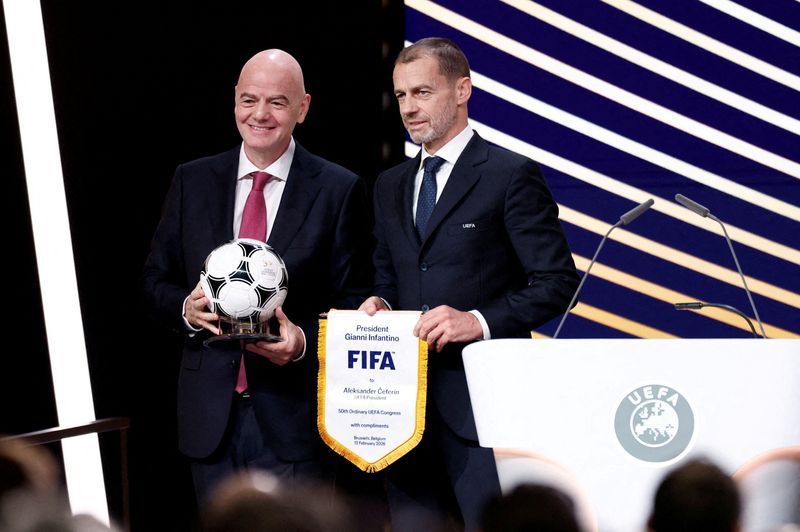
UEFA has escalated its dispute with FIFA President Gianni Infantino by requesting a US federal court to compel disclosure of documents and testimony from FIFA's Florida-based subsidiaries. The move, part of an ex parte application filed under American law, seeks materials that the European confederation argues are essential to building a criminal case against Infantino in Switzerland. The documents would support allegations of mismanagement related to a now-abandoned plan to transform FIFA's commercial rights into a new investment vehicle, a proposal that triggered unprecedented tensions within world football just weeks ago.
At the centre of the dispute lies FIFA Forward Enterprise, a subsidiary that would have consolidated commercial rights from men's and women's World Cups and the Club World Cup. UEFA alleges that Infantino developed this scheme in isolation, working with a restricted circle of advisers and investors while bypassing FIFA's established governance structures. The confederation contends that the FIFA Council, regional confederations, and member associations were all excluded from meaningful consultation during the proposal's development, which reportedly spanned more than a year before its public unveiling on 28 July.
The specific entities targeted by UEFA's court request are FIFA (AMERICAS), Inc. and FWC2026 US, Inc., both registered in Florida. UEFA argues these organisations hold critical documentation about how the FFE transaction was conceived, structured, valued, and approved. The confederation believes this evidence will prove instrumental in establishing whether Infantino and his associates acted improperly under Swiss law, specifically Article 158 of the Swiss Criminal Code, which addresses criminal mismanagement.
Infantino has maintained that FIFA Forward Enterprise represented a legitimate opportunity to strengthen football development funding globally. He framed the proposal as requiring majority approval from FIFA's 211 member associations and sign-off from the FIFA Council before implementation could proceed. However, UEFA's filing challenges this characterisation, asserting that FIFA's statutes explicitly grant the Council sole authority to determine how FIFA's commercial rights are promoted and monetised. This legal interpretation suggests that circumventing the Council represented a fundamental breach of FIFA's internal authority structures.
The proposed transaction involved Thrive Eternal, an investment vehicle controlled by Joshua Kushner and connected to Thrive Capital, which would have led an investor consortium. According to UEFA's legal documents, these external investors would have acquired permanent financial stakes in FIFA's commercial operations by paying $4.2 billion for what was valued at approximately $20 billion in total enterprise value. UEFA contends this valuation dramatically underpriced FIFA's actual commercial assets and that the transaction was never subjected to open auction or independent valuation processes.
The financial dimensions of this dispute carry particular significance for Malaysian and Southeast Asian football stakeholders. FIFA's commercial revenues ultimately flow back to member associations and regional confederations, which distribute funds to national federations and development programmes across Asia. Any arrangement that potentially diminishes the value of FIFA's commercial assets or transfers control to external investors could directly impact resources available for regional football development, infrastructure projects, and youth programmes throughout Southeast Asia.
Europe's threat to boycott FIFA competitions proved decisive in forcing Infantino's withdrawal of the proposal. UEFA's 55 member associations unanimously voted on 30 July to exclude themselves from FIFA competitions, including the World Cup, unless the scheme was scrapped. This extraordinary gesture—representing billions of dollars in broadcasting and sponsorship revenue—demonstrated the depth of European opposition and FIFA's vulnerability to coordinated confederation action. FIFA formally abandoned the proposal on 31 July, though questions persist about the decision-making process that generated it.
Despite suspending its threatened boycott following written assurances from FIFA that the project had been "irrevocably and permanently withdrawn," UEFA has made clear that institutional reform remains a central concern. The confederation has mandated its members to pursue every available institutional, political, and legal avenue to secure structural reforms and curtail presidential authority. UEFA has explicitly demanded an independent external review of the FFE proposal, arguing that FIFA cannot credibly investigate its own governance failures and expect the football community to accept the conclusions.
UEFA's criticism extends to FIFA's fundamental financial rationale for the proposal. The confederation points out that FIFA currently maintains billions of dollars in reserves that belong, in principle, to member associations. This raises a consequential question about why the FIFA President believed outside investors were necessary to expand development funding when FIFA possessed substantial capital already. This framing transforms the dispute from a technical governance question into a broader debate about FIFA's financial stewardship and the proper custodianship of global football's commercial assets.
Infantino's political position within FIFA remains complicated despite the FFE withdrawal. The president retains backing from the African and South American confederations, and Saudi Arabia's football federation issued a statement of support on Thursday, affirming confidence in Infantino's leadership and commitment to unity. However, UEFA has signalled that if Infantino pursues his planned candidacy for a fourth term in March 2027, the confederation will coordinate with partner confederations to present member associations with "a credible alternative" committed to implementing reforms. This prospect transforms the FFE episode from an isolated governance crisis into a potential inflection point for FIFA's presidential succession.
For regional observers, the conflict illuminates broader questions about power distribution within international sports governance and the capacity of confederations to enforce accountability. Southeast Asian national associations, as voting members of FIFA, hold theoretical influence over governance decisions, yet the FFE proposal's development occurred almost entirely beyond their purview. The episode suggests that major decisions affecting global football may be shaped by elite circles in Europe, Africa, and the Middle East, with developing football nations having limited visibility into processes that could significantly affect their funding and resources.
The legal proceedings now unfolding in both American and Swiss courts will likely take considerable time to resolve. UEFA's request for US court-compelled discovery represents an additional mechanism through which the European confederation seeks to establish facts that support its allegations of mismanagement. Even if Infantino ultimately faces formal charges in Switzerland, any trial would extend well beyond his anticipated re-election campaign, creating an unusual situation where a sitting FIFA president might simultaneously contest both criminal allegations and a presidential election.

