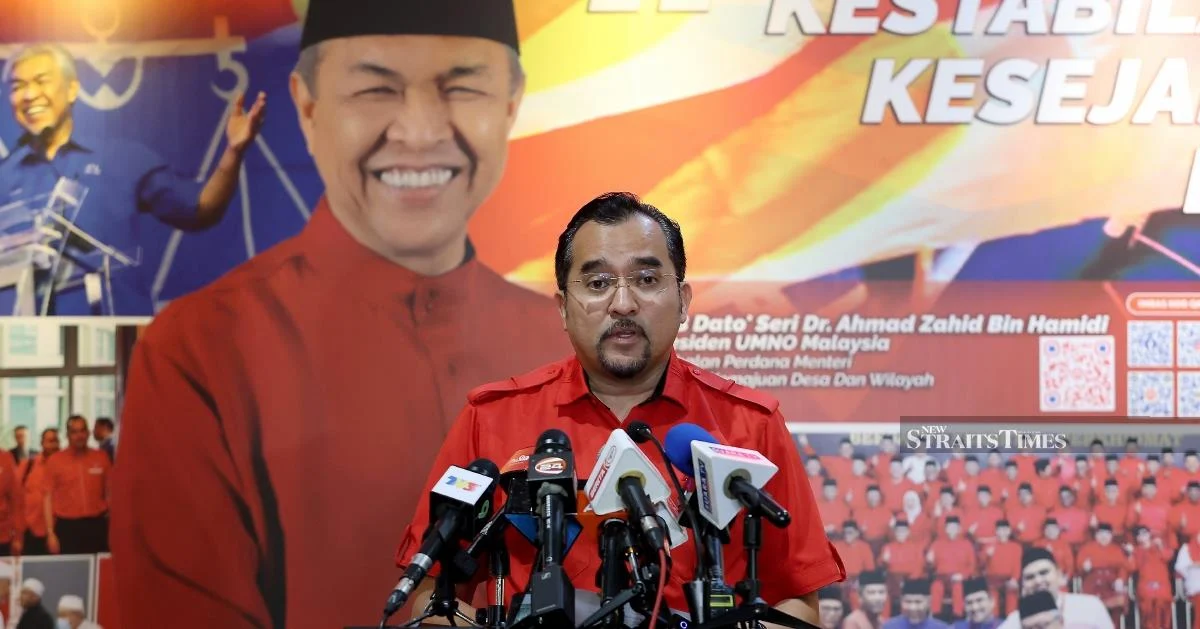
Umno's campaign strategy for the upcoming state elections in Johor and Negri Sembilan will centre on concrete policy proposals and tangible benefits for voters, rather than personal attacks or character assassination, according to the party's secretary-general Datuk Dr Asyraf Wajdi Dusuki. The commitment signals an attempt by the party to distinguish itself through a focus on governance and delivery, rather than engaging in the negative campaigning tactics that have marred previous electoral contests across Malaysia.
The statement comes as the country moves closer to simultaneous state elections in both Johor and Negri Sembilan, which have been positioned as important tests of Umno's relevance within the Barisan Nasional coalition and its broader political standing following a series of electoral setbacks and internal organisational challenges. For Umno, which has struggled to maintain its traditional voter base amid demographic shifts and rising urban dissatisfaction, a pivot towards substantive campaign messaging represents both a strategic choice and a potential acknowledgement that the party's core electoral coalition may be more responsive to governance narratives than to inflammatory political rhetoric.
The Johor state assembly is one of Malaysia's largest, and electoral outcomes in the state have historically provided important signals about the broader political direction of the peninsula. The state's significance within Umno cannot be overstated, as it represents a traditional stronghold where the party has traditionally enjoyed organisational advantages and deep community networks. Negri Sembilan, meanwhile, offers a more competitive battleground where Umno must mobilise effectively to retain influence and ward off challenges from opposition coalitions that have made incremental gains in recent state-level contests.
Datuk Dr Asyraf Wajdi Dusuki's public commitment to avoiding mudslinging appears designed to set a contrast with opposition parties and establish higher ground in what is expected to be a closely fought campaign. This framing also appeals to increasingly sophisticated urban and middle-class voters in both states who have demonstrated growing intolerance for personalised attacks and greater interest in specific policy platforms related to education, healthcare, economic opportunity, and environmental management. By emphasising policy substance, Umno may hope to attract swing voters who have drifted away from the party in recent electoral cycles.
The decision to focus on constructive campaign messaging also reflects broader conversations within the political establishment about the quality of democratic discourse in Malaysia. Previous state and federal election campaigns have been marked by increasingly acrimonious exchanges, with candidates and party leaders trading accusations on social media and at public rallies. A more disciplined, issues-focused approach could help restore public confidence in the electoral process and demonstrate that Malaysian political parties are capable of contesting elections on substantive grounds.
For Umno specifically, demonstrating campaign discipline carries additional weight given the party's recent governance struggles and internal fractures. By keeping campaign focus narrow and policy-oriented, party leadership can maintain message consistency across diverse candidate cohorts and reduce the risk of damaging statements from less-controlled party members or supporters that have previously created embarrassing headlines. The approach also provides party machinery with clear organisational directives that can be communicated efficiently through hierarchical party structures.
The commitment to clean campaigning does not occur in a vacuum, however. Both Johor and Negri Sembilan have active opposition coalitions that will also be formulating campaign strategies, and there remains uncertainty about whether all competing parties will similarly prioritise substantive discourse. Umno's unilateral commitment to avoiding personal attacks may therefore impose asymmetrical constraints on the party's campaign response capacity if opposition politicians engage in negative messaging. The party will need to calibrate how to respond to attacks without appearing to breach its own stated principles.
The significance of these elections extends beyond the two states themselves. Malaysian electoral observers view state-level contests as important laboratories for testing campaign messages and organisational strategies before potential federal elections. A successful campaign emphasising policy credentials and governance competence could provide Umno with valuable lessons and momentum that translate into federal-level political benefits. Conversely, a poorly executed campaign could further damage the party's standing among key demographic groups and reinforce perceptions of organisational weakness.
For voters in Johor and Negri Sembilan, the promise of policy-focused campaigning offers an opportunity to engage more substantively with candidates and party platforms around issues directly affecting their daily lives. This includes questions about state revenue allocation, development priorities, social service delivery, and economic diversification strategies. Voters across both states will be watching closely to see whether campaign rhetoric translates into coherent policy platforms that differentiate the competing political coalitions offering themselves for election.
The broader context of Malaysian politics suggests that efforts to elevate campaign discourse may face significant cultural and structural headwinds. Politicians and parties across the ideological spectrum have become accustomed to using inflammatory rhetoric as a means of mobilising core supporters and generating media attention. Shifting towards more measured, policy-oriented communication requires sustained discipline from party leaderships and consistent messaging throughout campaign periods. For Umno, demonstrating such discipline while maintaining competitive electoral appeal represents a significant strategic challenge that will test both party leadership commitment and organisational capacity during the crucial weeks ahead.