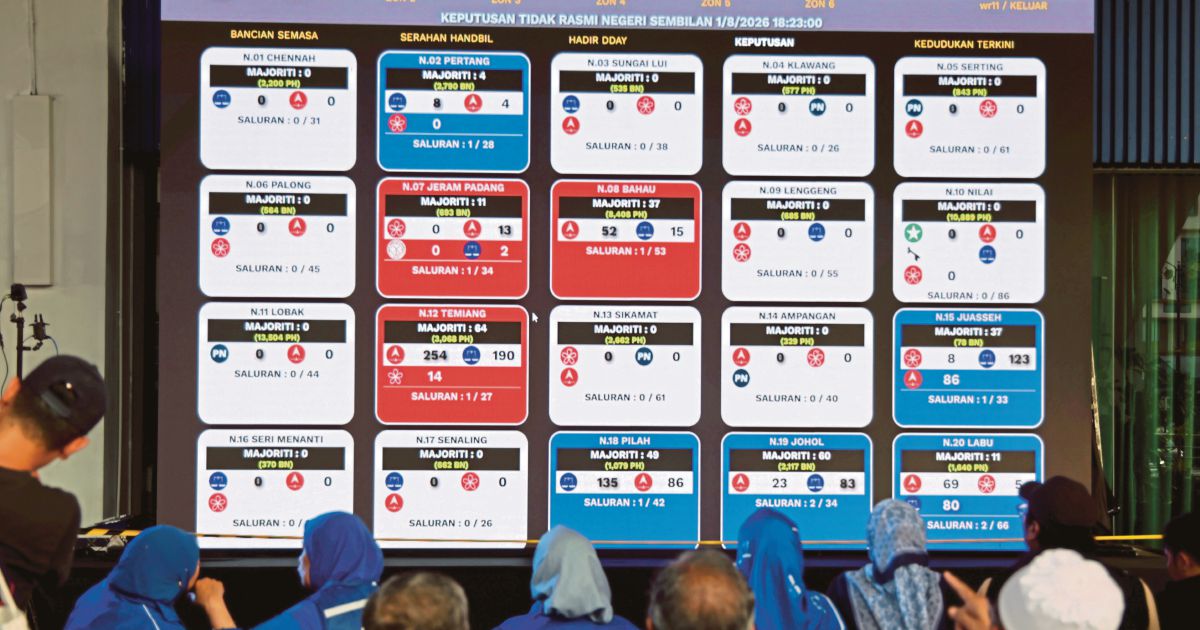
Umno's Datuk Dr Asyraf Wajdi Dusuki has declared that the combined Barisan Nasional and Perikatan Nasional alliance has captured enough seats to control the next Negri Sembilan state government, following the recent state election. The claim centres on the coalition securing 23 seats—a figure that would provide a working majority in the 36-seat state assembly, where 19 seats are conventionally required to form an administration.
The announcement underscores the ongoing realignment of Malaysian state politics, where traditional grand coalitions face pressure from newer political partnerships. Negri Sembilan's electoral outcome represents another chapter in the broader reconfiguration begun after the 2022 general election, when both major coalitions competed fiercely for control of state governments. The outcome matters not merely for Negri Sembilan's immediate governance but as a signal to voters elsewhere of where political power is consolidating in the Malay heartland.
Barisan Nasional, which held Negri Sembilan for decades, has sought to maintain its dominance even as some state governments have shifted to Pakatan Harapan or hung administrations requiring negotiated arrangements. Perikatan Nasional's participation in a formal coalition with Barisan at the state level marks a tactical shift from the national stage, where the two blocs have remained largely adversarial. This cooperation suggests pragmatic state-level politics sometimes override national rivalries, a pattern seen in other state governments where local interests dictate strange political bedfellows.
The 23-seat claim, if confirmed, reflects the contested nature of Malaysian election announcements in the hours after polling closes. Official tallies typically take longer to finalise, with returning officers verifying results constituency by constituency. Unofficial proclamations by politicians can prove premature if recounts, procedural challenges, or independent candidates' decisions to join different coalitions alter the arithmetic. Nevertheless, such early claims shape the narrative and set expectations for negotiations that follow election day.
Negri Sembilan has historically been Umno and Barisan stronghold, though recent elections have seen gradually tighter contests. The state's relatively small size—with only 36 assembly seats compared to larger state assemblies elsewhere—means every seat carries proportional weight. A coalition securing 23 seats would command a comfortable two-thirds super-majority in normal circumstances, providing stability for a five-year state administration and the ability to pass state constitutional amendments without opposition support.
The alliance configuration also reflects Perikatan Nasional's evolving strategy in peninsular heartland states. After leading governments in Kedah and Terengganu following the 2022 general election, the Islamist-leaning coalition has sought to consolidate support. However, its decision to work with Barisan—a coalition historically rooted in secular, establishment politics—highlights the flexibility of Malaysian political coalitions when state power is at stake. Such arrangements sometimes strain each bloc's internal coherence, with party members questioning whether state-level cooperation compromises their political identities.
Datuk Dr Asyraf's role in announcing the results reflects his prominence within Umno's Negri Sembilan machinery. His statement, though framed as unofficial pending government confirmation, carries weight as coming from a senior party figure with direct involvement in the state election campaign. However, the careful language of "claims" recognises that until official results are released by the Election Commission, such assertions remain aspirational rather than definitive.
The broader implications for Malaysia extend beyond this single state election. State elections remain crucial testing grounds for national coalition performance, offering voters opportunities to deliver messages about governance at a level closer to their immediate concerns. Negri Sembilan's result will be analysed alongside the ongoing political positioning ahead of future federal elections, particularly regarding whether Barisan and Perikatan can effectively cooperate at scale, or whether state-level pragmatism masks deeper national divisions.
Pakatan Harapan's performance in Negri Sembilan, notably absent from Asyraf's coalition claim, warrants attention. The opposition coalition has struggled to maintain state governments despite strong showings in the 2022 general election, losing Melaka and Johor to Barisan and facing tight contests elsewhere. A significant setback in Negri Sembilan would further erode Pakatan's grip on state-level governance outside its core strongholds of Selangor and Penang, potentially dampening its momentum heading toward the next general election.
State elections also influence national coalition stability. If Barisan and Perikatan's Negri Sembilan cooperation proves smooth and productive, it might embolden further collaboration at the federal level or in other states. Conversely, if tensions emerge during state governance negotiations or actual administration, the experience could discourage deeper national coalition experiments. Malaysian political coalitions remain inherently fragile, dependent on managing divergent interests among member parties, and state-level outcomes significantly shape whether such arrangements appear viable or merely expedient.
The formation of the next Negri Sembilan government will depend not only on final official results but also on post-election negotiations and potential defections. Malaysian politics has demonstrated repeatedly that seat numbers alone do not determine governments; the willingness of elected representatives to commit to coalitions—and remain committed—ultimately decides who holds office. Asyraf's announcement, therefore, represents an opening gambit in what could become complex negotiations if the final arithmetic proves tighter than claimed.

