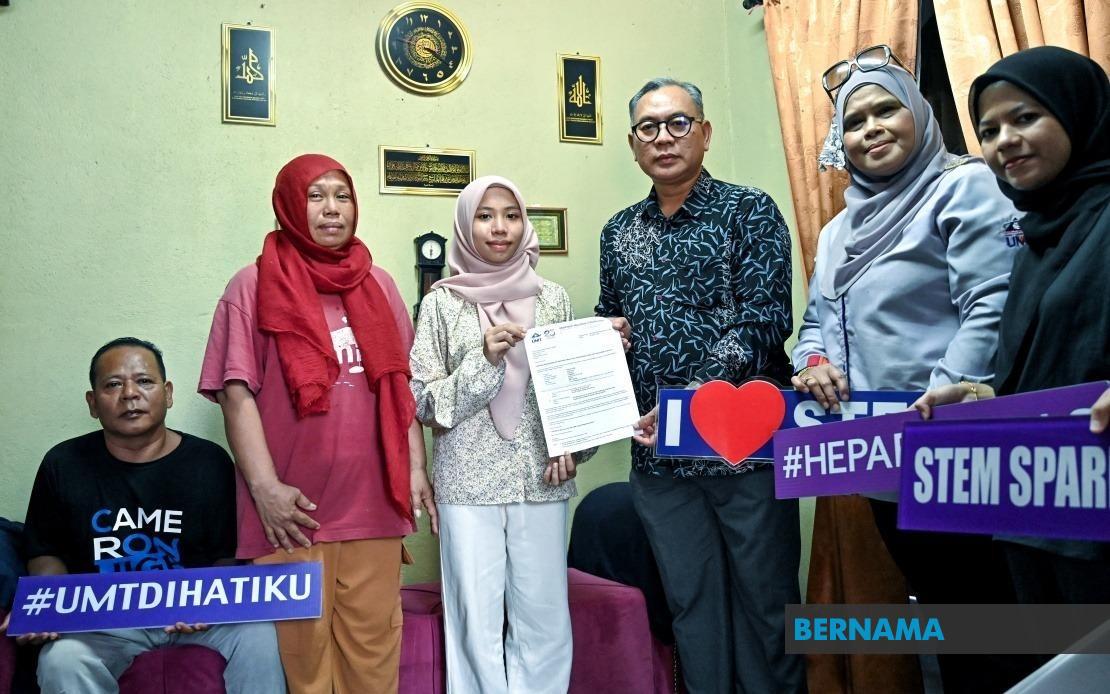
An 18-year-old student from Parit Jawa in Perak was on the verge of abandoning her university dreams after receiving an admission offer, only to find her family unable to shoulder the financial burden of registration and course fees. That changed when Universiti Malaysia Terengganu intervened, transforming what could have become another lost opportunity into a pathway toward a tertiary education and career in maritime sciences.
Nurul Amira Abdul Hamid had secured her place at UMT to pursue the one-year STEM Foundation programme, with plans to transition into a Bachelor's degree in Science specialising in Nautical Science and Maritime Transportation. Yet the prospect appeared destined to remain unfulfilled when domestic circumstances made it impossible for her to proceed. Her father, Abdul Hamid Othman, 58, was grappling with health problems while her mother, Asmah Che Ros, 53, worked solely as a homemaker. As the youngest of three siblings, Nurul Amira made the pragmatic decision to seek employment rather than add financial strain to her household.
After completing her SPM (Sijil Pelajaran Malaysia) examination with three A grades—a commendable achievement in itself—she accepted a position at a local goods store earning RM1,300 monthly, dedicating her wages to supplementing family income. This decision reflected both responsibility and resignation to circumstance. However, rather than simply accepting this outcome, she reached out directly to UMT to explain her predicament, a step that proved decisive. The university's response demonstrated institutional commitment to accessibility in higher education, a concern that resonates throughout Malaysia's push toward inclusive development.
UMT provided Nurul Amira with the Al-Ikhlas Scholarship worth RM500, complemented by additional financial support mechanisms tailored to her situation. Beyond these direct monetary grants, the university covered RM400 in procedural fees and arranged living allowances throughout her academic journey. This multi-faceted approach recognised that genuine accessibility requires more than tuition waivers; it demands sustained support addressing the full spectrum of a student's needs from accommodation to daily expenses. Nurul Amira expressed deep gratitude for the intervention, acknowledging that without these measures she would have forgone higher education entirely.
The experience reflects broader tensions within Malaysia's educational ecosystem. While the nation boasts a developed university system with multiple quality institutions, financial barriers remain formidable obstacles for capable students from economically marginalised families. This phenomenon becomes particularly acute in states like Terengganu, where economic opportunities outside the public sector remain limited compared to more industrialised regions. When talented young people are forced to choose between school fees and family survival, the nation loses not merely individual potential but collective economic capacity and social mobility.
UMT's vice-chancellor, Prof Dr Mohd Zamri Ibrahim, articulated an institutional philosophy centred on proactive outreach rather than passive assistance. He explained that the university deliberately engages with struggling students and their families, seeking them out before they abandon their aspirations entirely. This approach inverts traditional models where students must navigate bureaucratic systems alone; instead, UMT staff facilitate connections between need and available resources. The vice-chancellor issued an open invitation to prospective and enrolled students facing financial difficulties, assuring them that universities must take responsibility for identifying and supporting such cases.
The university has extended assistance to more than 10 students from economically disadvantaged backgrounds during the current year, suggesting this represents not an isolated act of charity but rather an emerging institutional priority. Living allowances form a critical component of this support architecture, enabling students to concentrate on academic work rather than scrambling for part-time income. This distinction matters significantly; research consistently demonstrates that students working excessive hours whilst studying experience reduced academic performance and increased dropout rates. By providing comprehensive support covering both direct educational costs and living expenses, UMT increases the likelihood of successful degree completion.
For Malaysian policymakers and other educational leaders, the UMT example raises important questions about scaling and systematising such initiatives. While individual university efforts prove valuable, they remain constrained by institutional budgets and capacity. National scholarship programmes and government funding mechanisms must expand substantially to address the structural barriers preventing economically disadvantaged students from accessing quality higher education. Countries competing in increasingly knowledge-based global economies cannot afford to leave talent underdeveloped simply because families lack financial resources.
Nurul Amira's case also underscores the particular importance of support for students entering technical and scientific fields. Malaysia's strategic emphasis on developing expertise in maritime industries, renewable energy, biotechnology, and advanced manufacturing depends fundamentally on cultivating talent pools from all demographic segments. Losing a capable student from a low-income background who excels in mathematics and science represents not merely a personal tragedy but a national resource loss. The maritime and nautical sciences field specifically addresses growing regional demand for trained professionals as Southeast Asia expands port operations, shipping logistics, and ocean resource management.
Looking forward, Nurul Amira's trajectory will likely inspire both her peers facing similar circumstances and UMT's leadership to deepen commitment to accessibility initiatives. Her success will demonstrate that investment in disadvantaged students yields concrete returns through degree completion and subsequent career contributions. Moreover, her story circulates important messaging: financial hardship need not terminate educational ambitions if students take initiative in communicating their situations and if institutions respond with genuine commitment to finding solutions. This reciprocal responsibility—where students advocate for themselves and universities respond deliberately—creates pathways that pure government funding alone might not establish.
The broader implications extend beyond individual success to shape perceptions of institutional character and social responsibility. Universities increasingly compete not only on academic rankings and research output but on their demonstrated commitment to social mobility and inclusive excellence. UMT's approach of actively seeking out and supporting disadvantaged students positions the institution as genuinely invested in national development rather than merely serving already-privileged populations. As Malaysian higher education evolves, such institutional choices will increasingly define reputational standing and societal trust. The investment in students like Nurul Amira represents not expenditure but investment in human capital formation and social equity simultaneously.

