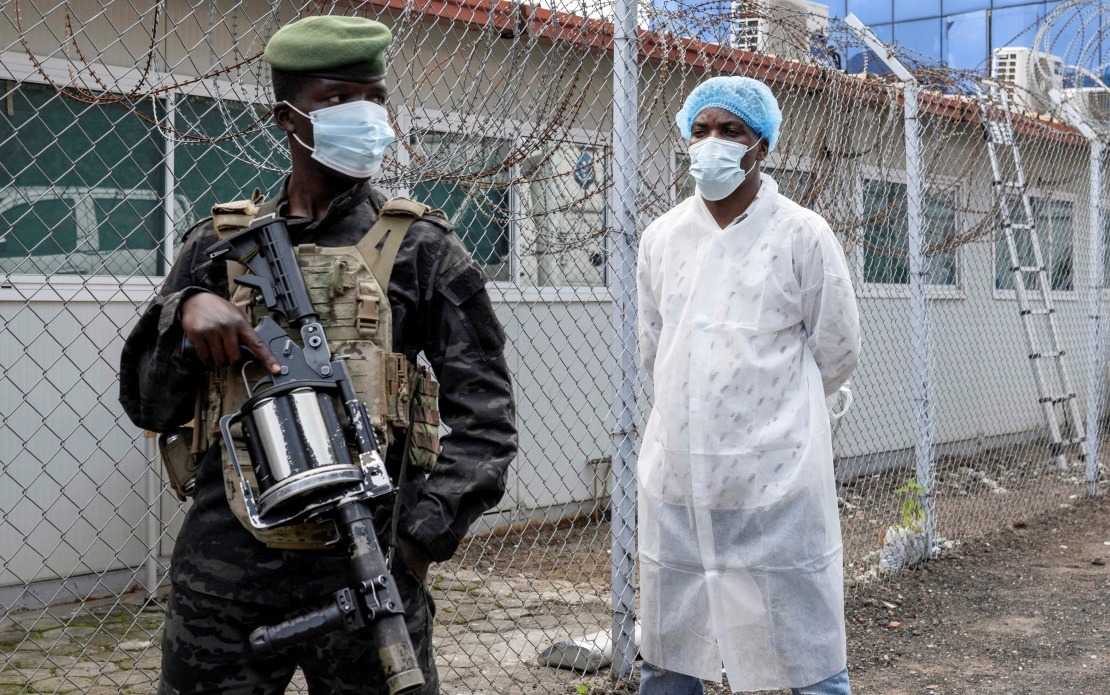
Cultural burial traditions are sabotaging efforts to contain Ebola in the Democratic Republic of Congo, with the UN migration agency warning that the transport of infected bodies across provincial boundaries represents one of the outbreak's most intractable transmission challenges. Since the virus was first detected on May 15, the country has documented more than 2,100 confirmed infections and over 828 fatalities, yielding a case fatality rate of 37.5 per cent—a grim testament to the disease's lethality and the fragility of response measures in the affected regions.
The geographic footprint of the outbreak now encompasses five provinces: Haut-Uele, Ituri, North Kivu, South Kivu and Tshopo, reflecting a troubling escalation in the disease's reach. International Organisation for Migration Regional Director Frantz Celestin detailed the trajectory of expansion during a video briefing, noting that cases have surged by approximately 70 per cent in the fortnight preceding his statement, with an average of more than 40 new infections recorded daily. This accelerating pace underscores how traditional practices—particularly the movement of bodies to ancestral burial grounds—circumvent containment protocols and enable continued viral transmission across disparate communities.
The persistence of these funeral customs reflects deep-rooted cultural values and community autonomy that public health authorities have struggled to redirect or modify. Burial teams deployed to manage bodies according to safe protocols face considerable resistance from residents, including coordinated opposition and physical attacks that endanger health workers and impede their operations. The challenge extends beyond logistical barriers: it reveals a fundamental disconnect between top-down health directives and community decision-making structures that prioritise kinship obligations and ceremonial observance.
Data collected during surveillance operations reveals the scale of body movement that circumvents official monitoring. Border crossing checkpoints and entry points into designated health zones intercepted 105 bodies during the tracking period, a figure that likely represents only a fraction of the total number transported clandestinely across provincial lines. Each untraced corpse carries the potential to seed new infection clusters in receiving communities, where funeral attendees—often numbering in the hundreds—gather in close proximity without protective measures, creating ideal conditions for exponential viral spread.
Community resistance manifests not only as passive non-compliance but as active violence directed at response personnel. In Bunia, the capital of Ituri province, a cemetery funeral descended into chaos last month when youths attempted to prise open a coffin during burial of an Ebola victim. The incident resulted in serious injuries to four Red Cross volunteers, exemplifying the hazards confronting those attempting to execute safe-burial protocols. Such episodes discourage participation in containment efforts and reinforce suspicion towards external health interventions among populations already sceptical of government authority.
Franctz Celestin highlighted that roughly 60 per cent of documented deaths occur within communities rather than health facilities, indicating that the majority of fatal cases remain outside clinical supervision. This distribution reveals deficiencies in early detection capabilities, surveillance infrastructure, and timely treatment access—systemic vulnerabilities that funeral-driven transmission exacerbates. When individuals sicken and perish in household settings, their families are left to manage corpses without guidance or oversight, defaulting to traditional burial practices that expose extended networks to lethal viral loads.
Médecins Sans Frontières characterised the outbreak as the third-largest and fastest-growing Ebola epidemic documented to date, achieving this distinction within merely two months of recognition. The causative agent, the Bundibugyo virus species, carries a mortality burden that distinguishes it among filovirus variants. The speed of escalation mirrors patterns observed in previous large outbreaks but compressed into an alarming timeline, suggesting that transmission networks have achieved sufficient density and connectivity to sustain rapid case multiplication despite intervention attempts.
The geographic expansion documented by the World Health Organisation—from 36 affected health zones to 42 within a single week—demonstrates that containment efforts have not yet arrested the outbreak's momentum. Each newly affected zone represents a fresh frontier for transmission, populated by residents unfamiliar with the virus, unprepared for its arrival, and potentially harbouring pre-existing resistance to external health authorities. The addition of six zones in seven days signals that the epidemiological situation is deteriorating faster than public health responses can adapt.
For Malaysian and broader Southeast Asian observers, the Congo outbreak underscores vulnerabilities that transcend geography. Funeral rites and body transport occur across the region's diverse communities, and the tension between cultural imperatives and biosecurity protocols exists wherever viral threats emerge. The Congo case demonstrates that disease control strategies must reckon with community agency and cultural legitimacy rather than treating them as obstacles to overcome through coercion. Developing effective responses requires negotiating respectful alternatives that accommodate cultural values whilst reducing transmission risk—an approach that demands sustained dialogue and institutional humility from health authorities.
The financial and human costs of this outbreak will extend far beyond mortality figures. Protracted outbreaks drain scarce health resources, displace routine medical services, and inflict psychological trauma on affected populations. For fragile health systems across Africa and beyond, the Congo experience illustrates how epidemiological crises interact with social fragmentation and institutional weakness to produce cascading catastrophes. Southeast Asian governments monitoring the situation would be prudent to invest in community health literacy, establish trust frameworks with local leaders and cultural custodians, and develop adaptive protocols that can incorporate traditional practices into containment strategies before the next viral threat materialises in their own territories.

