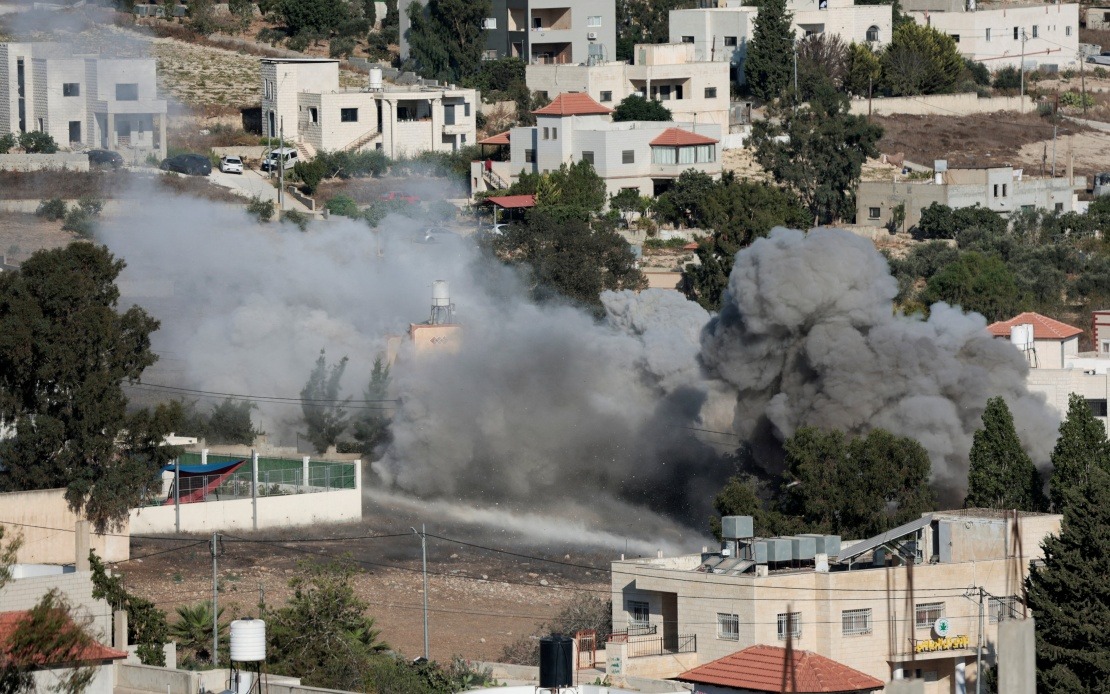
The United Nations Human Rights Office operating in the Occupied Palestinian Territory has issued a stark warning about the mounting severity of violence perpetrated by Israeli settlers against Palestinian residents, according to statements released on Thursday. The office has urged Israeli authorities to take decisive action to remove settlers engaged in violent activities, halt the unlawful seizure of Palestinian land, and stop the expansion of colonial settlements that are fundamentally altering the demographic and territorial landscape of the region.
The documentation released by the UN body points to a troubling pattern of escalation that began in November 2025 with the establishment of an Israeli colonial outpost near Qusra, a village situated south of Nablus in the central West Bank. Following this development, settlers systematically expanded their control over territory adjacent to the village, using force and intimidation as primary instruments of territorial acquisition. The resulting climate of fear has been marked by repeated assaults on Palestinian civilians, forced entry into homes, property destruction, livestock theft, and deliberate arson attacks targeting both residential structures and religious facilities, including a local mosque.
Among the most egregious incidents documented is an episode of collective punishment targeting Palestinian families in the Ras al-Ain area of Qusra. In July, settlers deliberately cut off water and electricity supplies to three Palestinian homes, a tactic designed to render the properties uninhabitable and force abandonment. The situation deteriorated dramatically on August 9, when settlers sealed all access routes to these residences, erected barriers between the homes and blocked residents from entering or exiting the area. This confinement trapped approximately fifteen individuals, including at least two children, in conditions of severe deprivation without access to basic utilities, food supplies, or medical assistance.
Rather than intervening to protect Palestinian civilians, Israeli security forces present at the location refused to respond to requests for assistance from the trapped families. Additionally, military personnel actively prevented humanitarian access by blocking paramedics, international solidarity activists, and journalists from reaching the affected households. This pattern of non-intervention combined with active obstruction suggests a tacit endorsement of settler actions by state security apparatus, effectively making occupying authorities complicit in the suffering of Palestinian civilians. Even after soldiers removed the physical barriers on August 12, they stopped short of removing the settlers themselves, allowing the intimidation campaign to continue unabated.
For Malaysian and Southeast Asian readers, this situation illuminates the mechanisms through which territorial disputes can escalate into systematic displacement campaigns. The deliberate deprivation of essential services represents a form of environmental coercion rarely documented in contemporary international conflicts. The separation of utilities and food supplies from civilian populations echoes historical strategies of siege warfare, yet occurs in a modern occupied territory with international oversight mechanisms theoretically in place. The apparent immunity of perpetrators raises critical questions about enforcement mechanisms within international humanitarian frameworks that Southeast Asian nations have ratified.
The UN Human Rights Office has characterized these actions as criminal acts undertaken with either explicit support or deliberate tolerance from Israel as the occupying power. The systematic nature of the violence, combined with the apparent strategy of rendering Palestinian communities unable to sustain themselves, creates what international law recognizes as forced displacement—a serious violation of the Geneva Conventions. The office emphasizes that time is critically running out for the three families facing imminent risk of permanent removal from their ancestral lands, a development that would further fragment Palestinian territorial continuity in the West Bank.
This documentation arrives in the context of an International Court of Justice determination affirming that all Israeli settlements in the West Bank lack legal standing under international law. The court has mandated that Israel must terminate all colonial activities, withdraw settler populations from occupied territories, and end its occupation of the West Bank in contravention of international legal principles. Yet despite these determinations, the documented pattern of settler violence continues with apparent impunity, suggesting a gap between international legal pronouncements and their implementation in occupied territories.
The UN Human Rights Office has outlined specific legal obligations that Israel must observe as an occupying power. These requirements include preventing attacks by settlers, conducting genuine investigations into violent incidents, and ensuring meaningful accountability for individuals responsible for committing, supporting, or permitting such attacks. Critically, any penalties imposed must be proportionate to the severity of violations committed. Current enforcement appears inadequate, with documentation suggesting that settlers operate with de facto protection from prosecution.
For Malaysia and other regional nations balancing diplomatic relationships with various international actors, this situation presents a test case for applying universal humanitarian standards. The case demonstrates how easily occupation frameworks can facilitate systematic pressure on civilian populations when accountability mechanisms fail. Southeast Asian countries, many of which have historical experience with territorial disputes and occupation, can draw instructive lessons from the documented failures of international oversight in preventing civilian harm. The absence of meaningful consequences for perpetrators creates perverse incentives for further escalation of violence.
The escalation documented at Qusra and surrounding areas represents a microcosm of broader Palestinian-Israeli tensions in the occupied territories. While formal peace negotiations have stalled, settlers continue implementing what appears to be a ground-level strategy of territorial consolidation through force. The involvement of security forces in either facilitating or ignoring settler violence suggests state-level coordination rather than spontaneous civilian action. This distinction carries significant implications for how international law should assess and respond to occupation dynamics throughout contested territories globally.
The immediate humanitarian situation facing the three Palestinian families remains precarious. Without urgent intervention, they face either capitulation to settler demands through abandonment of their homes, or continued confinement in deteriorating conditions. The psychological toll of such prolonged intimidation, combined with physical deprivation, constitutes what legal scholars recognize as a coercive environment incompatible with human dignity. International pressure, whether through formal diplomatic channels or civil society mobilization, may represent the only mechanism available to prevent irreversible displacement in this specific case.

