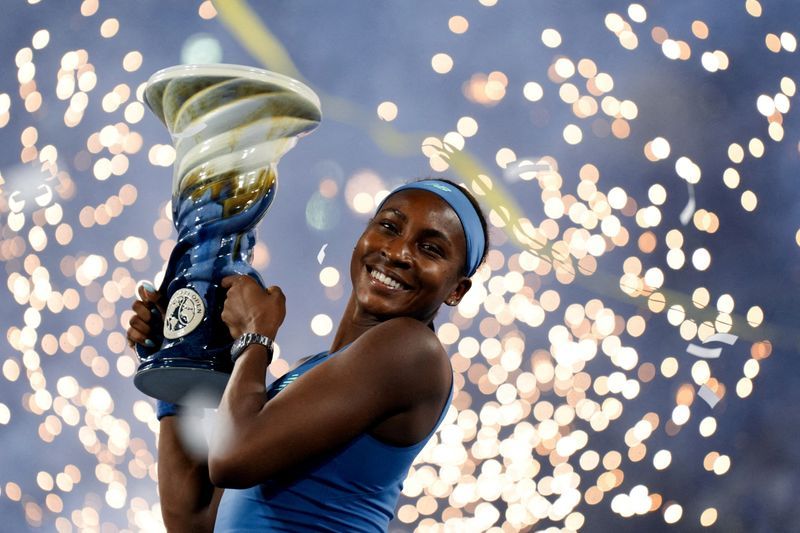
The women's singles draw at the US Open this year presents an unusually fragile hierarchy at the top, with defending champions and presumed frontrunners both facing significant obstacles as the tournament begins on Sunday. The upheaval has created genuine space for former titleholders Coco Gauff and Iga Swiatek to stake their claims for another trophy at Flushing Meadows, marking a departure from the predictable narrative that typically surrounds this event.
Top seed Aryna Sabalenka's campaign has been derailed by a woefully inconsistent second half of the season that threatens her bid for an unprecedented third consecutive US Open crown. The Belarusian player, who dominated early in 2024 to secure the Australian Open and Madrid titles, has since struggled to convert crucial moments when it matters most. Her inability to win significant matches since completing the Sunshine Double represents a dramatic reversal of form that leaves her vulnerable to the field. The possibility of becoming only the third woman in the Open Era to achieve a three-peat at Flushing Meadows—and the first since Serena Williams' run between 2012 and 2014—now seems considerably diminished.
Compounding the vulnerability at the top is the injury concern surrounding second seed Elena Rybakina. The Kazakhstani player's premature exit from Cincinnati with a leg injury has cast substantial doubt over her ability to compete at full strength during the fortnight. Such physical setbacks at this stage of the season carry particular significance, as players rarely recover quickly enough to perform optimally in subsequent tournaments. Her absence from contention effectively opens a corridor through the draw that was previously thought sealed.
Gauff, seeded fourth and ranked fourth in the world, arrives in New York with a refreshed confidence that stems from tangible recent achievements. The American sensation captured her maiden title of 2024 in Cincinnati with a performance that suggested her oft-criticised serving motion has finally clicked into place. Her progress to the semi-finals in Toronto further validated her upward trajectory heading into the final major of the calendar year. For the 20-year-old, the boisterous New York crowd represents an additional advantage; American audiences have consistently demonstrated affection for Gauff, and the energy at Flushing Meadows typically provides home players with an intangible lift that opponents must overcome.
Analysts covering the sport have taken note of Gauff's resurgence. ESPN commentator and former world number four Mary Joe Fernandez observed that Gauff stands out as the player currently executing the highest calibre of tennis among the field. Her ability to leverage her native-crowd advantage, combined with demonstrated form on hard courts—the surface on which the US Open is contested—positions her among the tournament's most genuine contenders. For a nation that has failed to produce a women's finalist at any of this year's first three major championships, Gauff's presence offers redemption, as does fellow American Jessica Pegula, ranked third.
Swiatek's narrative, meanwhile, reflects a player who has navigated substantial adversity to recalibrate her preparation. Poland's six-time major champion arrived in North America facing considerable domestic criticism for her disappointing performances throughout 2024. The 23-year-old had reached no higher than the quarter-finals at any of the year's first three majors, a record that fell short of expectations for someone of her pedigree. Yet her victory in Toronto earlier this month marked a turning point, suggesting that her self-acknowledged impatience and desperation for results had been replaced by a steadier, more measured approach. She acknowledged to reporters that the journey has been bumpy this season, and that she sometimes pursued victories prematurely before her game had sufficiently recovered.
The contrast between Sabalenka's decline and Swiatek's resurgence is particularly striking. While the world number one has lost big leads in recent events and struggled to close out matches, Swiatek has demonstrated the capacity to compete at the highest level when it matters most. Her performance in Canada, which included a straight-sets victory over a previously dangerous Rybakina, showed that she possesses both the quality and mental fortitude to navigate a demanding schedule. Ranked eighth, she represents excellent value as a contender, particularly given that she has historically performed well at the US Open.
Beyond these primary contenders, a diverse array of challengers lurks throughout the draw, each carrying the capacity to mount a surprising run. Russian teenager Mirra Andreeva has established herself as a serious force after capturing her maiden major title at Roland Garros earlier in 2024. Czech player Linda Noskova provided a surprise breakthrough at Wimbledon last month, signalling that the next generation of talent is emerging. Perhaps most compellingly, Alexandra Eala of the Philippines recently demonstrated her credentials by defeating both the four-time major winner Naomi Osaka and Pegula to secure the Washington WTA 500 title, an achievement that cannot be dismissed as a fluke.
Osaka, the two-time US Open champion from 2018 and 2020, carries her own storyline as she continues her comeback following maternity leave. Though she has not claimed a title since winning the 2021 Australian Open, her presence in last year's semi-finals and recent consistent performances suggest she remains capable of generating a deep run. The New York audience has historically shown considerable affection for Osaka, and that emotional connection could prove decisive during tight moments.
The structural openness of this year's women's draw has prompted experienced observers to reassess their predictions. Patrick McEnroe, an ESPN commentator with decades of professional insight, stopped short of declaring the tournament completely wide open but acknowledged that as many as six to eight different players possess realistic championship credentials. This represents a significant departure from typical US Open dynamics, where two or three clear frontrunners usually dominate the narrative. The combination of injuries, inconsistent form, and emerging talent has created genuine unpredictability, making this edition of the tournament particularly compelling for followers of women's professional tennis.
For Malaysian and Southeast Asian readers, Eala's breakthrough carries particular resonance, as it demonstrates that Asian players are increasingly capable of competing at the highest echelons of professional tennis and capturing prestigious titles. Her victories over established champions suggest that the geographic distribution of major championship success may be gradually shifting. As the tournament unfolds this week, all eyes will be on whether Gauff and Swiatek can capitalise on the vulnerability at the top, or whether one of the alternative contenders will capitalise on the fractured hierarchy.

