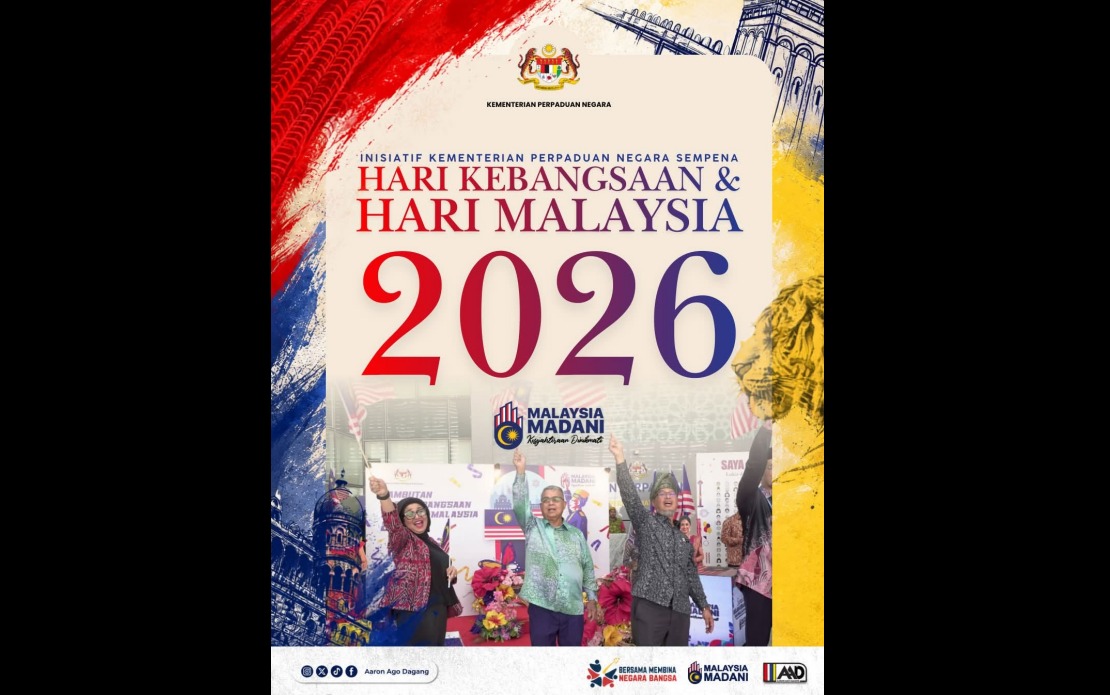
The National Unity Ministry has unveiled an ambitious calendar of 11 programmes designed to deepen public engagement with Malaysia's national story during the 2026 celebrations of National Day and Malaysia Day. The slate of activities represents a comprehensive approach to nation-building that stretches beyond ceremonial observances, embedding cultural awareness and patriotic values into structured public participation across multiple demographics and interest groups.
Minister Datuk Aaron Ago Dagang unveiled the initiative in a statement outlining the ministry's vision for these dual national occasions. The programmes encompass a diverse range of activities that blend educational content with festive celebration, reflecting the ministry's recognition that building national cohesion requires engagement strategies tailored to different audience segments. By spanning from children's events to heritage exhibitions and oratory competitions, the ministry is attempting to create multiple entry points through which Malaysians at various life stages can engage with themes of unity and national pride.
Among the centrepiece activities is the 2026 National Unity Integration Movement, which promises to be the flagship programme anchoring the year's patriotic agenda. Complementing this is Malaysia's Merdeka Children Celebration, positioned to capture the enthusiasm and formative years of younger citizens at a time when national identity and values are actively being constructed. These two initiatives signal the ministry's deliberate focus on generational continuity, ensuring that understanding of independence and nationhood transfers meaningfully to the next cohort of citizens.
The ministry's planned Exhibition on Independence will provide historical context and archival material that helps the public reconnect with the events and personalities that shaped Malaysia's emergence as a nation. This educational component addresses a persistent challenge in Malaysian civic life—the tendency for independence history to fade from public consciousness in the decades following 1957. By creating dedicated exhibition space, the ministry acknowledges that passive knowledge of historical facts differs fundamentally from engaged learning that sparks reflection on contemporary relevance.
A dedicated programme honouring Tun Abdul Razak represents a specific investment in recognising Malaysia's founding leadership. The former Prime Minister's role in consolidating the young nation and establishing foundational institutions makes him a symbolic figure whose legacy can anchor discussions about state-building and the frameworks that have enabled Malaysia's stability. Elevating his commemoration to formal ministry programme status suggests an intentional effort to maintain historical memory around key figures whose contributions might otherwise recede from everyday public awareness.
The Pesta Bola Merdeka Exhibition taps into the cultural significance of this longstanding sporting tradition, linking national celebration to a sporting institution that carries deep historical meaning for Malaysian football fans. By integrating this exhibition into the broader 2026 calendar, the ministry recognises that patriotic sentiment and national identity are not confined to formal ceremonies or academic contexts but flow through cultural and sporting channels that resonate authentically with Malaysian society.
Night at the Museum and the Rukun Negara Oratory Competition expand the reach into evening programming and formal discourse respectively. The museum initiative creates opportunity for reflection outside typical daytime constraints, while the oratory competition channels national themes into a format that privileges articulate expression and intellectual engagement. Together, these activities reflect sophisticated understanding that unity and patriotism require both emotional resonance and intellectual grounding.
Datak Aaron Ago Dagang framed these initiatives explicitly within the context of nation-building aspirations centred on strengthening national identity and cultivating belonging. His emphasis on embracing Malaysia's diversity of ethnicities, religions, cultures and regions directly addresses one of the central challenges in a plural society—ensuring that celebrations of nationhood feel inclusive rather than exclusionary to communities with different historical narratives and identities. The ministry's explicit commitment to diversity within unity messaging suggests awareness that patriotism in Malaysia cannot rest on a singular narrative but must accommodate multiple legitimate perspectives within an overarching framework of shared citizenship.
The programming calendar reflects implicit recognition that the gap between formal independence in 1957 and 2026 spans nearly seven decades, creating generational distance from the founding moment. Younger Malaysians have no living memory of colonial administration or the independence struggle, meaning that connection to national identity must be actively cultivated through contemporary programming rather than assumed from historical proximity. The breadth of the ministry's initiative responds to this temporal reality by creating diverse mechanisms through which different cohorts can access and internalise Malaysia's national story.
For Malaysia's plural society, such comprehensive unity programming carries particular significance. The 2026 celebrations occur at a moment when social cohesion faces persistent pressure from competing narratives around identity, religion and governance. The ministry's decision to make explicit commitment to diversity central to the messaging, rather than treating it as peripheral, suggests institutional recognition that national unity cannot be asserted through top-down pronouncements but must be demonstrated through concrete programming that values and incorporates all communities.
The ministry's stated commitment to keeping appreciation of history, heritage and the Rukun Negara central to nation-building reflects understanding that abstract principles require constant reinforcement through cultural programming and public commemoration. The Rukun Negara, as Malaysia's national philosophical foundation, remains frequently cited but less consistently taught or discussed in accessible public forums. Embedding it within 2026 celebrations through multiple channels—exhibitions, oratory competitions, and thematic programming—represents an attempt to move it from symbolic statement toward lived understanding.
Regionally, Malaysia's approach to marking national anniversaries through carefully structured cultural programming offers potential lessons for other Southeast Asian nations navigating questions of national identity, social cohesion and historical memory. The ministry's strategy of pairing celebratory events with educational components and inclusive messaging demonstrates one model for reconciling patriotic sentiment with pluralistic values—a challenge increasingly relevant across the region as nations grapple with population diversity and competing historical narratives.

