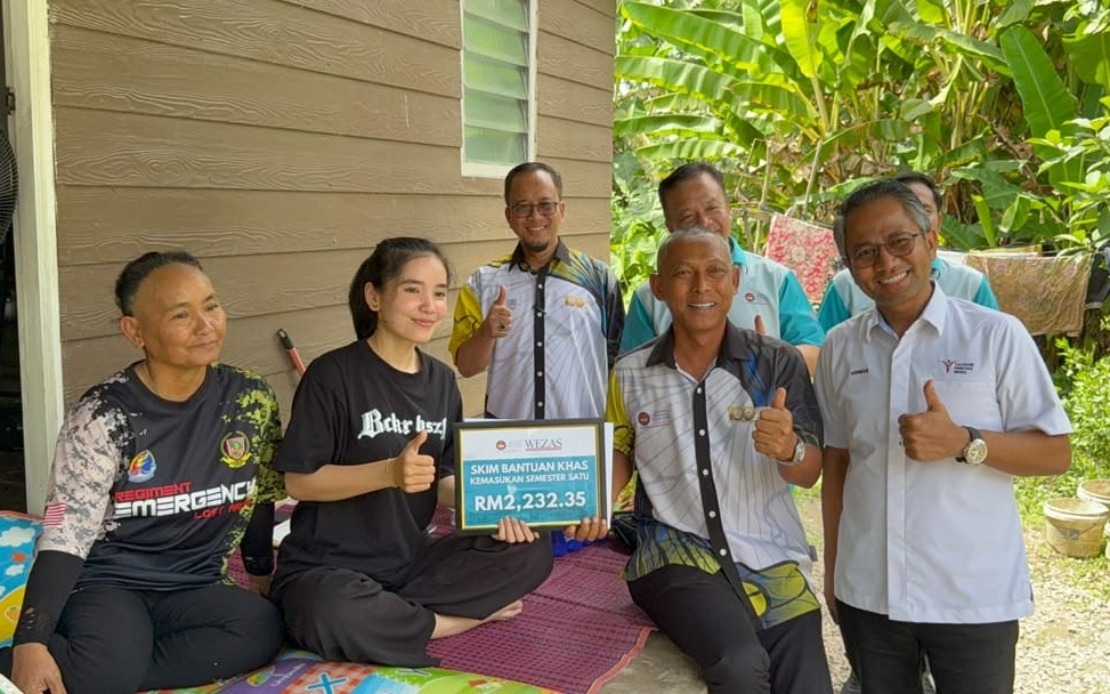
Three promising students have received crucial financial assistance from Universiti Pendidikan Sultan Idris (UPSI) and Malaysia's Higher Education Ministry, allowing them to overcome financial barriers and pursue tertiary education. The breakthrough came for STPM outstanding achiever Lovely Sabana Augustine, who will enrol at UPSI's Faculty of Human Sciences, alongside two other deserving students who faced comparable economic hardships.
The assistance programme proved timely for Lovely Sabana, whose situation caught public attention after her appeal for help with registration fees and essential study materials circulated widely on social media. The Tumpat, Kelantan resident faced genuine obstacles to beginning her academic journey, as her single mother works as a school cleaner earning approximately RM800 monthly while also serving as a Malaysian Volunteer Corps Department member. Lovely Sabana's father, a former military serviceman, passed away in 2017, leaving the family to navigate financial uncertainty. With three siblings to support, her mother's modest income made university preparation costs prohibitively difficult.
Two additional students benefited from the same collaborative initiative. Siti Nurdianis Nordin, who will study at the Faculty of Management and Economics, comes from a household where her mother relies on unstable daily wage employment. Similarly, Muhamad Ilias Danish, bound for the Faculty of Languages and Communication, lost his father and now contributes to household expenses while preparing for tertiary study. Each student received RM1,500 to address registration fees and basic necessities before enrolling on 13 September.
The funding structure reflected coordinated support from multiple institutions demonstrating commitment to disadvantaged learners. UPSI's Centre for Waqf, Endowment, Zakat, Khairat, and Sadaqah (WEZAS) contributed RM500 per student, while Yayasan Perkasa Siswa (YPS) provided the remaining RM1,000. This partnership mechanism illustrates how Malaysian higher education bodies increasingly recognise their responsibility toward financially vulnerable but academically capable candidates.
Hirman Awang, director of the Department of Higher Education's Student Affairs Division, characterised the assistance as evidence of Malaysia's commitment to preventing financial circumstances from barring talented individuals from university access. He emphasised that YPS positions itself as a protective mechanism for student welfare, with each RM1,000 contribution intended to strengthen morale and address foundational expenses before campus registration. The intervention particularly matters as education increasingly requires upfront expenditure that low-income families struggle to manage simultaneously with other obligations.
UPSI's institutional response revealed proactive identification mechanisms for students facing hardship. Deputy Vice-Chancellor for Student Affairs and Alumni Prof Dr Norkhalid Salimin noted that the university deliberately monitors prospective students' circumstances, particularly those from economically disadvantaged backgrounds. Through UPSI's Student Affairs and Alumni Department (JHEPA) and WEZAS, the institution maintains early-warning systems designed to flag those requiring assistance before educational opportunities slip away unnoticed.
Norkhalid emphasised that financial support represents merely one dimension of UPSI's broader commitment to student wellbeing. The assistance programme explicitly aims to communicate institutional presence and reliability from day one of the academic relationship, signalling that the university remains invested in student welfare beyond classroom instruction. This messaging carries significance for vulnerable students who may otherwise feel unsupported or marginalised within tertiary education settings.
The collaborative framework connecting UPSI, YPS, and the Department of Higher Education through JPT demonstrates Malaysia's deliberate structural approach to equity in higher education. Rather than treating student financial hardship as an isolated challenge, the partnership positions assistance as systematic strategic intervention woven into institutional operations. This approach acknowledges that talented individuals from economically constrained households require coordinated support spanning financial aid, institutional recognition, and sustained engagement.
For Malaysian readers, this initiative carries broader implications for tertiary education accessibility. Numerous qualified secondary school graduates face post-examination uncertainty not because of academic insufficiency but because registration and preparation costs function as practical barriers. The UPSI programme suggests growing recognition that financial obstacles disproportionately affect capable students from lower-income households, potentially representing wasted human capital and unfulfilled individual potential. Each student assisted represents not merely personal success but community and national gain through expanded talent utilisation.
The public attention surrounding Lovely Sabana's situation—her appeal gaining traction through social media—highlighted how digital platforms increasingly facilitate connection between individuals in need and institutions capable of providing support. This visibility mechanism may encourage other universities and government bodies to develop similarly proactive identification systems. However, the incident also underscores that too many deserving students likely remain unknown to potential benefactors, suggesting need for more formalised, accessible systems for identifying and supporting financially disadvantaged high achievers.
Moving forward, the three students' university journeys will provide insights into whether early financial assistance translates into sustained academic success and graduation outcomes. The programme's genuine value emerges not merely from initial RM1,500 disbursement but from ongoing institutional commitment to monitoring progress and providing continuing support through inevitable future challenges. UPSI's positioning of assistance as foundational to sustained relationship-building suggests recognition that student success requires extended engagement rather than one-time intervention.
The broader educational policy context in Malaysia increasingly emphasises inclusive access to tertiary study. This UPSI initiative aligns with national objectives to expand higher education participation while ensuring that economic factors do not determine educational outcomes. As demand for university places remains intense and competition fierce, removing financial barriers for verified high achievers becomes both ethical imperative and practical investment in human resource development. The three students represent expanded capacity utilisation within Malaysia's educational system, contributing ultimately to workforce productivity and economic development.

