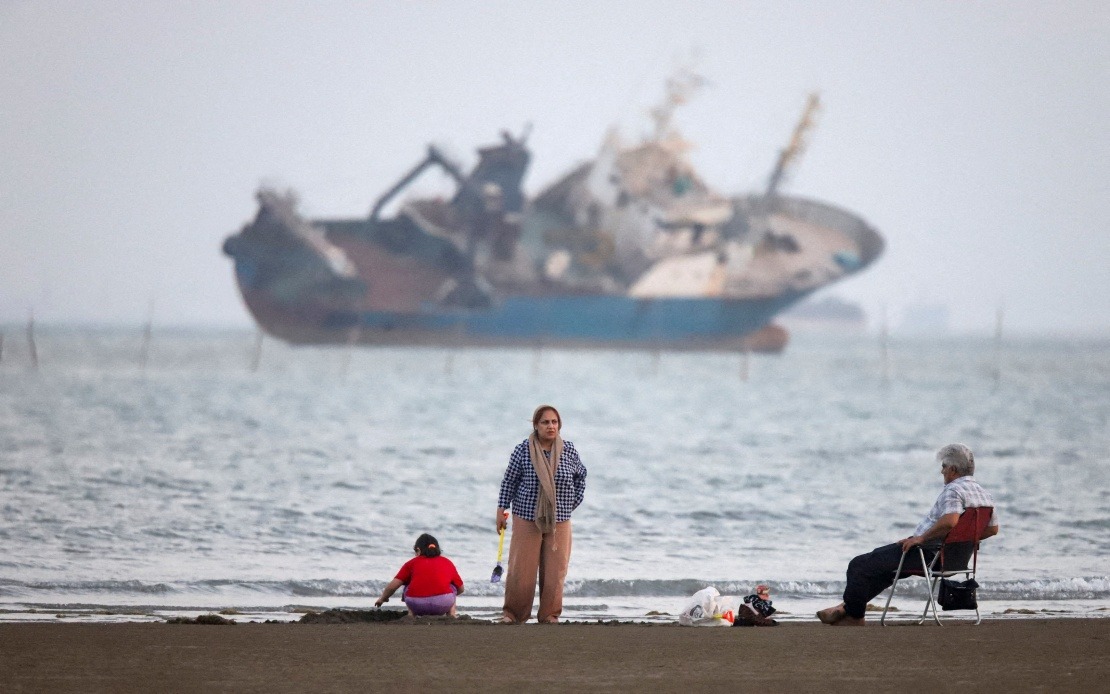
The United States Treasury Department has escalated pressure on Iran by announcing a new round of sanctions targeting individuals and financial entities allegedly connected to Tehran's government and military apparatus. The action, unveiled on Friday, represents Washington's response to recent hostile incidents involving attacks on three commercial vessels transiting the Strait of Hormuz, one of the world's most strategically important shipping corridors through which roughly a third of seaborne oil passes daily.
The Office of Foreign Assets Control, the Treasury's enforcement arm responsible for administering American economic sanctions, designated Ali Ansari as a sanctions target, alleging his connections to Mojtaba Khamenei, the son of Iran's Supreme Leader, and the Islamic Revolutionary Guard Corps, the country's elite military force. This designation carries serious consequences, effectively freezing any assets Ansari may hold within US jurisdiction and prohibiting American entities from conducting business with him. The targeting of individuals connected to the Supreme Leader's family represents an unusually pointed measure, reflecting the severity with which Washington views recent maritime developments.
Beyond individual actors, the Treasury moved against what it characterized as "shadow exchange houses" operating across Iranian cities. Three entities were added to the Specially Designated Nationals List: Mohammad Darbani and Partners Exchange, Mohsen Khandan and Partners Exchange, and Lavasani and Partners Exchange. All three operate as general partnerships based in Iran and reportedly function as informal financial intermediaries outside conventional banking channels. These so-called shadow exchanges typically facilitate currency conversions and money transfers while operating with minimal regulatory oversight, making them attractive to entities seeking to circumvent international financial restrictions. Their designation signals Washington's intent to disrupt Iran's ability to move money internationally and maintain economic activity despite existing sanctions regimes.
The sanctions architecture extended beyond Iranian territory when Treasury designated Smart Global Limited, a holding company registered in Saint Kitts and Nevis in the Eastern Caribbean. The agency claimed this entity maintains ties to Ansari and serves as a vehicle for concealing Iranian financial interests within jurisdictions considered friendlier to such operations. The use of offshore companies to obscure ownership chains has long been a staple of sanctions evasion, allowing designated individuals and entities to maintain economic activity through intermediaries. This particular case illustrates how financial networks exploiting Caribbean jurisdictions can facilitate Iranian economic operations despite international restrictions.
Iran's Foreign Minister Seyed Abbas Araghchi responded sharply to the sanctions announcement, accusing the United States of violating a memorandum of understanding between the nations. Writing on the social media platform X, Araghchi contended that Iran has upheld its commitments while American officials have deviated from agreed terms, specifically referencing what he characterized as a violation of "Para 9 of the MoU." His statement implied that Washington had made earlier commitments regarding sanctions and that the latest action constitutes a breach of faith. Araghchi emphasized that meaningful progress between the nations requires reciprocal compliance, suggesting Iranian willingness to negotiate if American officials respected prior agreements.
The Strait of Hormuz incidents that precipitated these sanctions represent a dangerous escalation in regional maritime tensions. The attacks on commercial shipping underscore how geopolitical friction in the Middle East directly threatens global trade flows and energy security. For Southeast Asian nations, including Malaysia, such disruptions carry immediate economic implications, as the region depends heavily on stable energy supplies and predictable shipping lanes for its trade. Any prolonged closure or disruption of the Hormuz passage would dramatically increase shipping costs and energy prices across Asia, rippling through supply chains and consumer prices throughout the region.
The timing of these sanctions reflects broader uncertainties surrounding American foreign policy toward Iran. The dispute over the memorandum of understanding suggests unresolved disagreements about the scope and implementation of whatever diplomatic arrangement exists between Washington and Tehran. The lack of a comprehensive, formal nuclear deal comparable to the Joint Comprehensive Plan of Action that collapsed in 2018 means current relations operate within a more ambiguous framework, where both sides accuse each other of violations and retaliation cycles become self-reinforcing.
Sanctioning financial intermediaries and exchange houses represents a shift in tactical approach that complements traditional measures targeting military or nuclear-related activities. By targeting money flows and banking relationships, Washington attempts to constrain Iran's economic capacity more broadly, making it harder for government and military entities to fund operations and maintain international commerce. These financial sanctions prove particularly effective when supported by other nations that recognize them as legitimate, though their impact diminishes if major trading partners ignore the designations and facilitate Iranian access to international markets anyway.
For Malaysia and other Southeast Asian economies, understanding these sanctions dynamics proves crucial for conducting legitimate international business. Malaysian companies must carefully navigate compliance requirements when dealing with Iranian counterparts or potentially sanctioned entities, as violations of American sanctions can result in penalties even for non-American firms. The expanding nature of these designations means that due diligence requirements for any Iran-related transactions have become increasingly complex and demanding.
The broader strategic context involves competing visions for Middle East stability and Iran's regional role. The United States seeks to constrain Iran's capabilities and influence, viewing it as a destabilizing force in an already volatile region. Iran, conversely, views itself as responding to external aggression and defending legitimate interests, with recent maritime incidents presented as defensive reactions rather than unprovoked attacks. This fundamental disagreement about causation and responsibility makes de-escalation difficult without intervention from other regional powers or international diplomatic frameworks.

