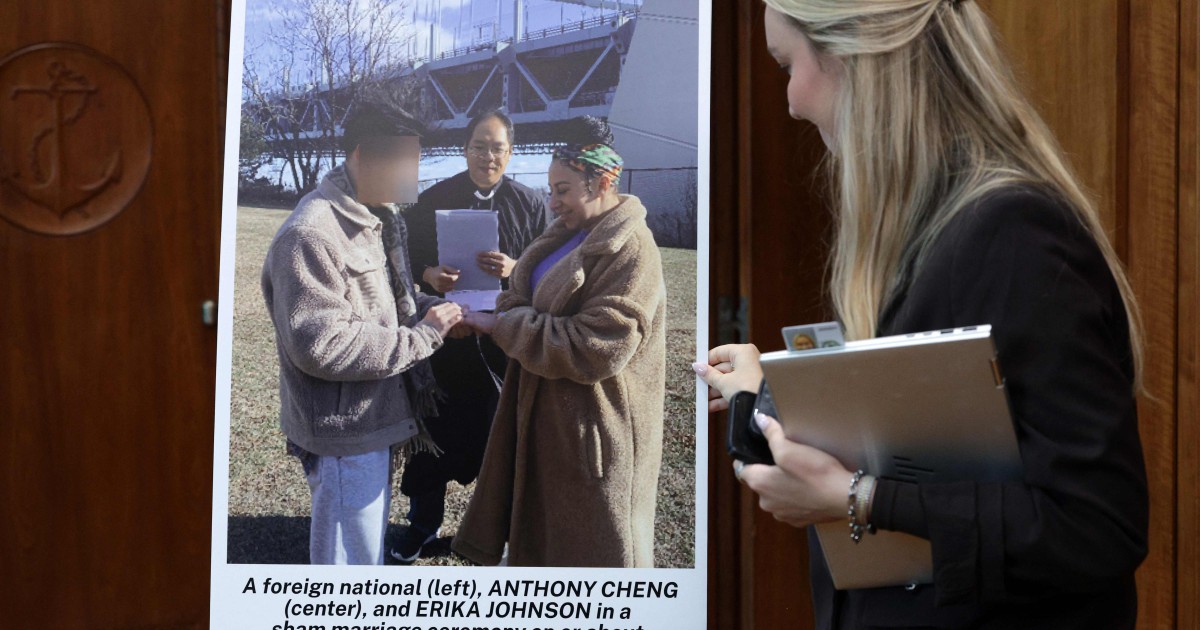
Federal prosecutors in the United States have brought charges against eleven individuals allegedly operating one of the nation's largest marriage fraud networks, marking an intensified crackdown on immigration schemes during an era of tighter border enforcement. The Department of Justice revealed on Wednesday that the criminal enterprise operated for over a decade, facilitating roughly 1,000 fraudulent unions designed to circumvent standard immigration procedures and grant predominantly Chinese nationals legitimate pathways to American residency.
The scale of the operation underscores vulnerabilities within the US immigration system that unscrupulous actors have long exploited. By arranging counterfeit marriages between immigration applicants and complicit American citizens or permanent residents, the alleged conspiracy offered participants a seemingly legitimate route to legal status—one that typically bypasses the more rigorous requirements of employment-based or family-sponsored visas. The scheme represents a particularly brazen form of fraud, as it leveraged the legal institution of marriage itself to manufacture false claims of familial relationship, a category that receives preferential processing within US immigration law.
According to court filings, the criminal network operated across multiple states and international borders, suggesting a sophisticated operation with compartmentalized roles and established financial networks. Investigators documented how the scheme collected fees from Chinese nationals—typically ranging into thousands of dollars per fraudulent marriage—while compensating American citizens involved in the fake unions. This pricing structure, combined with the volume of transactions, points to a highly organized criminal enterprise generating substantial proceeds from exploitation of immigration regulations.
The timing of these prosecutions coincides with a significant policy shift within the incoming Trump administration, which has prioritized stricter immigration enforcement and announced plans to curtail various forms of legal immigration including so-called birth tourism. The administration's hardline stance on border security and legal immigration pathways has likely accelerated investigations into existing fraud schemes, as law enforcement agencies mobilize resources to enforce what officials characterize as a more coherent immigration framework. This convergence of aggressive prosecution and executive policy signals a broader recalibration of how federal authorities intend to manage immigration moving forward.
For Malaysian observers, this prosecution offers perspective on immigration challenges facing the United States and other developed nations that attract significant numbers of international migrants. Malaysia itself has grappled with marriage fraud and other immigration-related crimes, though typically in different contexts involving foreign workers and spousal visa schemes. The scale of this American operation—1,000 fraudulent marriages sustained over ten years—demonstrates how even wealthy, developed nations with sophisticated law enforcement capabilities can struggle to police their immigration systems effectively against determined organized crime groups.
The criminal penalties faced by the charged individuals could prove severe, as immigration fraud involving marriage constitutes a federal crime carrying potential prison sentences and fines. Prosecutors will likely argue that the defendants knowingly participated in a scheme that undermined the integrity of immigration adjudication, harmed Americans used in the fake unions, and allowed individuals to gain status they would not otherwise qualify for under legitimate pathways. Conviction records from previous marriage fraud cases suggest federal judges tend to impose meaningful custodial sentences, particularly when defendants operated schemes involving dozens or hundreds of fraudulent unions.
The implications extend beyond those facing criminal charges. The prosecution will likely trigger immigration enforcement action against the estimated 1,000 individuals who obtained status through these fraudulent marriages. The Department of Homeland Security typically moves to revoke visas and initiate deportation proceedings once marriage fraud becomes evident, potentially uprooting families and disrupting lives built in the United States over years. Chinese nationals who obtained permanent residency through the scheme may face particular vulnerability, as they often cannot easily return to China if deported.
Regional migration networks throughout Asia may face increased scrutiny as a result of this case. Chinese immigration intermediaries—individuals who facilitate illegal immigration for substantial fees—operate across Southeast Asia, including through Malaysia. While this particular conspiracy focused on marriage fraud rather than other smuggling methods, its exposure could prompt broader law enforcement cooperation among Asian governments and the United States regarding immigration crimes. Malaysian authorities, alongside counterparts in Thailand and the Philippines, may receive enhanced intelligence sharing from US agencies about suspected networks operating in their jurisdictions.
The case also highlights the broader phenomenon of marriage fraud within Asian immigration communities, where fees for fraudulent unions have become an established underground service. The relative wealth disparity between developed nations and countries like China, combined with restricted legal immigration pathways, creates persistent demand for alternatives. As long as legitimate immigration channels remain constrained and expensive, organized crime groups will continue devising mechanisms to circumvent these restrictions, even as law enforcement agencies become more adept at detecting and prosecuting them.
For potential American employers and family members of Chinese nationals, this prosecution underscores the risks involved in participating in or facilitating any form of immigration fraud. The thirteen-year lifespan of this particular operation suggests that even long-running schemes eventually attract law enforcement attention. The Justice Department's decision to bring charges against all identified participants signals determination to hold accountable not merely the scheme's organizers but also peripheral players, potentially deterring others from involvement in similar activities.

