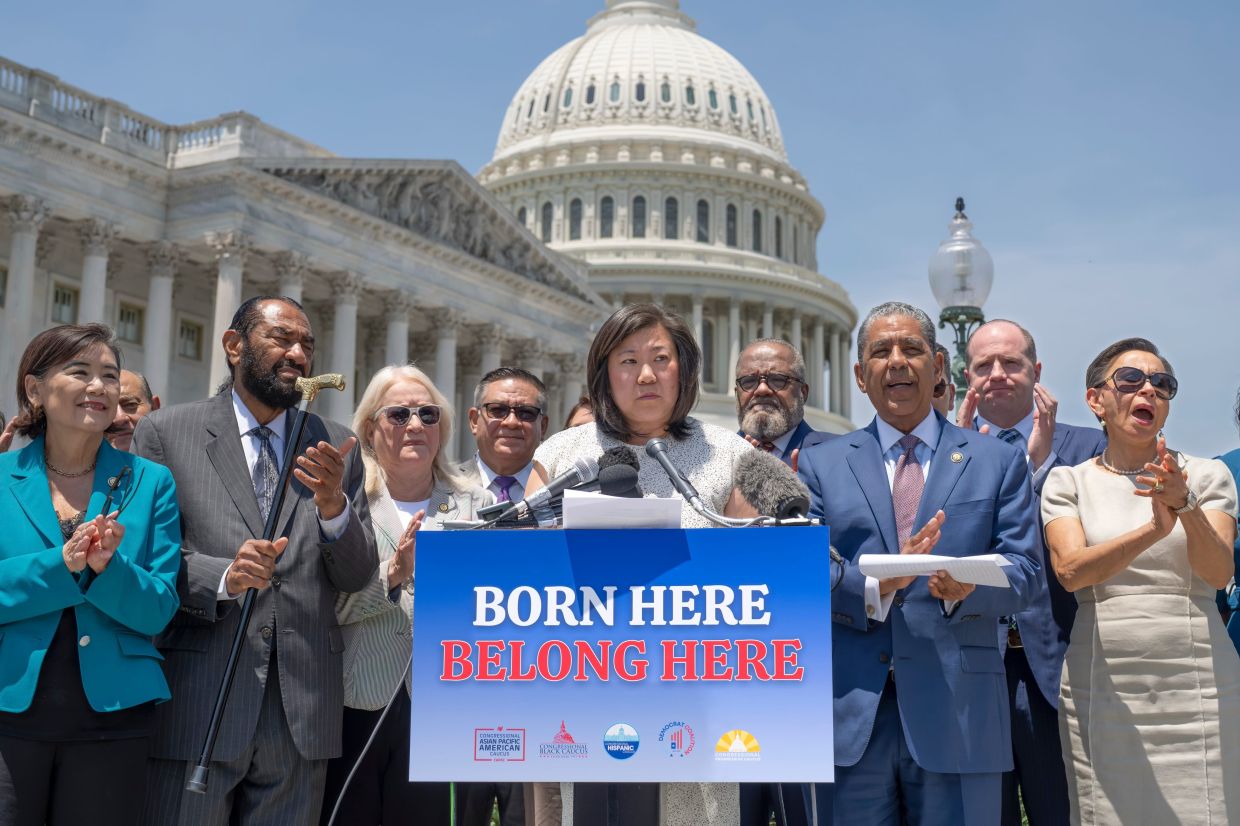
The US Supreme Court has delivered a significant setback to President Donald Trump's immigration agenda by rejecting his executive order that sought to eliminate birthright citizenship for children born to undocumented parents or those on temporary visas. In a 6-3 decision in Trump vs Barbara, the court reaffirmed that children born on American soil are entitled to US citizenship regardless of their parents' immigration status, a principle embedded in the 14th Amendment and reinforced through more than a century of jurisprudence.
Trump's assault on birthright citizenship represented one of the cornerstone policies of his second term, with the administration signing the controversial executive order in early 2025. The directive was notably expansive in scope, targeting not only undocumented immigrants but also millions of lawfully present immigrants pursuing permanent legal status. The order would have affected parents on prestigious work visas including H-1B and L-1 categories used for skilled professionals, as well as those holding dependent, student, temporary labour, and achievement visas—all classifications considered "lawful but temporary" under US Citizenship and Immigration Services regulations. Only children with at least one citizen parent would have retained automatic birthright citizenship under the proposed rules.
Chief Justice John Roberts anchored the majority opinion in historical constitutional understanding, writing that "citizenship, then and now, was the right to have rights – to freely participate in our political community. The Framers of the Fourteenth Amendment extended that promise to 'every free-born person in this land'. We keep that promise today." The 14th Amendment's Citizenship Clause, ratified in 1868 immediately following the Civil War, was deliberately designed to overturn the legal disabilities imposed on formerly enslaved people and ensure that birth on American soil conferred full membership in the political community.
The legal foundations for birthright citizenship trace to the 1898 Supreme Court case Wong Kim Ark, a landmark decision arising from the Chinese Exclusion Act era. Wong, born in San Francisco to Chinese immigrant parents, had been denied re-entry to the United States after visiting China when federal officials claimed he was not a citizen because of his parents' status. The Supreme Court's affirmation that nearly all persons born on American soil possess citizenship rights proved transformative, surviving both the repressive Jim Crow era and this latest constitutional challenge. Descendants of Wong Kim Ark acknowledged the enduring significance of his case, with Norman Wong reflecting that his great-grandfather "was one man, only a cook, and yet he stood up for what was right, and I believe that it has made a difference."
Trump responded to the defeat with characteristically combative rhetoric, initially extending congratulations to Chinese President Xi Jinping and China for their "massive Birthright Citizenship WIN," an oblique reference to his failed order. He subsequently described the ruling as "too bad" for the country while asserting that legislative action could circumvent constitutional protections. "We can easily make it up in Congress through Legislation," Trump wrote on social media, claiming that "no long and unwieldy Constitutional Amendment is necessary." He then urged Congress to "start TODAY" on ending birthright citizenship, pledging his "Complete and Total Support" for legislative efforts to overturn the judicial decision.
The Trump administration had consistently emphasised birth tourism as a justification for restricting birthright citizenship, with allegations particularly directed at Chinese nationals. Solicitor General D. John Sauer, Trump's lead counsel before the Supreme Court, told the justices in April oral arguments that "uncounted thousands of foreigners from potentially hostile nations have flocked to give birth" in the United States, characterising birthright citizenship as having "spawned a sprawling industry of birth tourism." This framing transformed what had traditionally been a marginal policy concern into a focal point of anti-immigration rhetoric throughout Trump's campaign and early presidency.
Critics contended that the administration deliberately exploited anxieties surrounding birth tourism to obscure the executive order's primary target: lawfully present immigrants. The policy would fundamentally have altered the status of millions of professionals, students, and family members temporarily residing in America while pursuing pathways to permanent residence and citizenship. Asian-American advocacy organisations recognised the disproportionate implications, with Stop AAPI Hate emphasising that birthright citizenship had enabled the growth and political empowerment of communities of colour. "Because of this right, the Asian-American community and other communities of colour have been able to grow in size and political power – and that is precisely why the Trump administration attempted to end it," the organisation stated.
Krish O'Mara Vignarajah, president of Global Refuge, a non-profit working with refugees and displaced persons, characterised the ruling as a victory for fundamental democratic principles. Vignarajah noted that birthright citizenship had weathered previous challenges including the Chinese Exclusion Act and Jim Crow-era restrictions, only to face what he called an attempt to "essentially turn the maternity ward into a customs checkpoint." The stakes extended beyond symbolic questions of constitutional fidelity to practical implications for immigration enforcement and the rights of vulnerable populations.
Undeterred by the Supreme Court's decision, the Trump administration doubled down on birth tourism prosecutions as an alternative enforcement strategy. The US Department of Justice issued a memo directing federal prosecutors to prioritise investigations of alleged birth tourism schemes, with Colin McDonald, a senior Justice Department official, declaring that the agency would "zealously protect the sanctity of United States citizenship by investigating and prosecuting those who fraudulently exploit our immigration system." McDonald cited the 2024 case of Michael Wei Yueh Liu and Jing Dong, a husband-and-wife team sentenced to 41 months each in prison for operating a birth tourism operation that charged Chinese clients tens of thousands of dollars for assistance with births in the United States.
The Supreme Court decision carries particular resonance for Southeast Asian readers given the region's substantial diaspora communities in the United States and increasing cross-border migration patterns. The ruling affects not only undocumented migrants but also the millions of skilled professionals, students, and family members from Asia working or studying legally in America. Malaysia, Singapore, and other regional economies depend heavily on emigrant remittances and diaspora networks, making the stability of immigrant status determinations significant for broader economic and social ties between Southeast Asia and the United States.
Moreover, the court's refusal to adopt Trump's restrictive interpretation of the 14th Amendment carries implications for how other democracies understand birthright citizenship and immigration rights. The 6-3 decision, while preserving the constitutional status quo, reflects ongoing ideological tensions within the American judiciary that will likely resurface in future immigration litigation. For multinational corporations recruiting talent from Southeast Asia, the affirmation of birthright citizenship may provide modest reassurance regarding the stability of employment-based visa categories, though the political momentum behind Trump's agenda suggests further legal and legislative battles remain inevitable.
The ruling ultimately represents a temporary constitutional check on executive immigration power, yet the Trump administration's demonstrated commitment to birth tourism prosecutions and renewed congressional advocacy signals that birthright citizenship will remain contested political terrain. The 1898 principle that Wong Kim Ark established—that birth alone confers rights—has survived another existential challenge, but its defenders cannot assume permanence in an era of shifting judicial composition and populist immigration politics.

