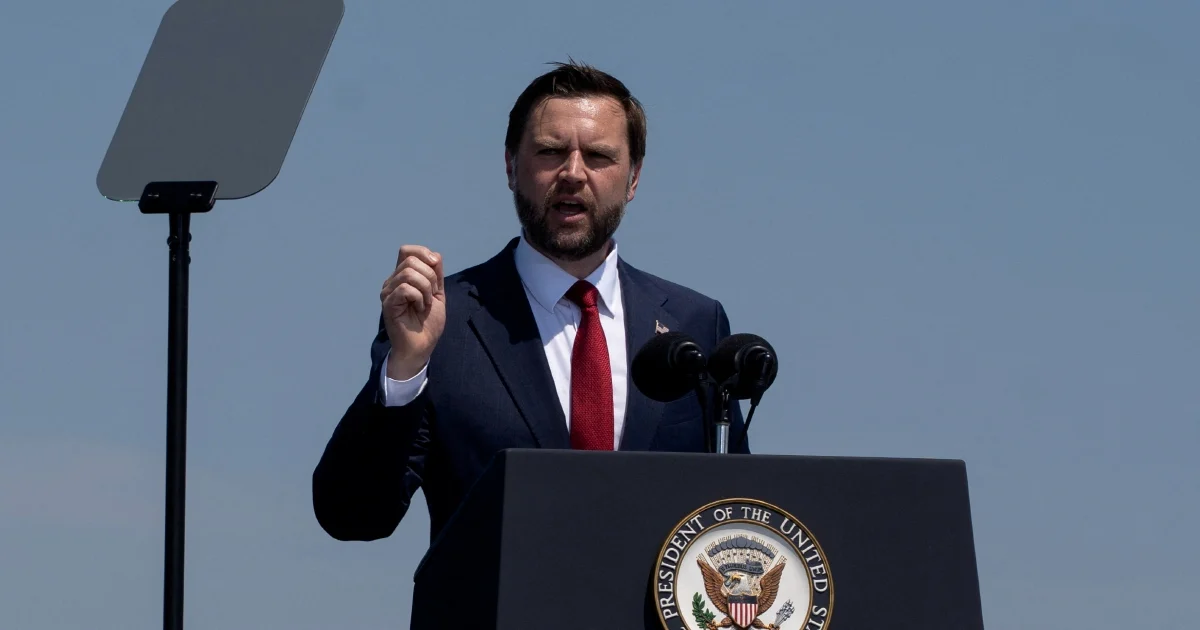
United States Vice President JD Vance has delivered a blunt assessment of Britain's political trajectory, characterising the nation as having been fundamentally let down by successive administrations over an extended period. Speaking in London, Vance articulated a view increasingly common among international observers and domestic critics—that Westminster has systematically failed to address the structural challenges confronting British society and the economy. His remarks signal American attention to the direction of British politics at a moment when both nations are reassessing their geopolitical priorities and domestic reform agendas.
The American vice president's intervention into British political discourse comes amid significant transition in London. With a new administration about to assume office, international figures are keenly watching whether Britain's incoming leadership can reverse what many perceive as years of stagnation, fractious governance, and policy paralysis. Vance's comments suggest the incoming American administration views the prospect of renewed British reform with genuine interest, potentially signalling closer alignment on key policy areas between Washington and the next British government.
Vance's framing of Britain's predicament as a leadership crisis rather than a systemic one reflects a particular political perspective gaining traction among centre-right and reform-minded observers. This diagnosis implies that structural problems facing the UK—whether relating to economic productivity, public service delivery, or regulatory efficiency—stem primarily from failures of vision and execution at the highest levels rather than from deeper institutional or constitutional deficiencies. Such an assessment would appeal to those advocating for executive-driven transformation over lengthy parliamentary deliberation.
The timing of Vance's remarks carries significance for Malaysia and other Southeast Asian nations observing British politics. Britain's capacity to reform and revitalise its economy bears implications for regional trade relationships, investment flows, and the broader Western engagement with Asia-Pacific. A revitalised British economy pursuing renewed commercial engagement with Asian partners could reshape regional trade patterns, while continued British political dysfunction might lead to further retrenchment from global commitments.
British voters have indeed signalled profound frustration with their leadership class across multiple elections and referendums over the past decade. The 2016 Brexit referendum, the subsequent three prime ministerial changes within five years, cost-of-living crises, and persistent economic underperformance relative to peer nations have collectively eroded public confidence in Westminster's ability to navigate contemporary challenges. Vance's comments implicitly acknowledge this reality while projecting optimism that new leadership might reverse the pattern.
The incoming British administration inherits a daunting agenda. Public services, particularly the National Health Service, face immense pressure. Economic growth has lagged comparable economies. Investment in infrastructure and skills development requires substantial commitment. Regional inequalities persist. Social cohesion has frayed over divisive political battles. Against this backdrop, Vance's hope that the next prime minister can deliver meaningful structural change reflects both sympathy for Britain's predicament and perhaps some scepticism about whether cosmetic adjustments will suffice.
Vance's intervention also reflects broader American strategy under the incoming administration to engage with allied nations on shared reform agendas. Rather than simply accepting the status quo, the American approach appears to involve active encouragement of structural transformation in key partners, perhaps viewing this as strengthening the Western alliance through revitalised economies and more dynamic governance. This collaborative approach to systemic reform could influence how Washington engages with other traditional allies grappling with similar governance challenges.
For Malaysia and the broader Southeast Asian region, Britain's political trajectory matters in several respects. As a permanent UN Security Council member, a major economy, and a historical power with substantial ongoing interests in Asia, Britain's internal strength or weakness affects its engagement capacity across the region. A Britain successfully executing structural economic and institutional reforms could become a more active, innovative partner in regional initiatives. Conversely, continued political dysfunction in London might lead to further withdrawal from global commitments, diminishing Britain's role in shaping regional order.
The reference to voters' appetite for structural change highlights the degree to which conventional politics and incremental policy adjustments have lost credibility in contemporary Britain. Electorates increasingly demand transformative solutions to persistent problems—whether in service delivery, economic productivity, or quality of life. Incoming governments face immense pressure to deliver visible, substantial change rather than marginal improvements. Vance's remarks implicitly recognize this new political reality, acknowledging that half-measures and traditional approaches no longer satisfy public expectations.
The next British government will require not only a clear reform programme but also the political capital and parliamentary arithmetic to implement substantial changes. Coalition or minority government scenarios could constrain the executive's capacity to execute transformative legislation. Vance's hopeful tone suggests American optimism that political conditions exist for decisive action, though whether this optimism proves justified will depend on parliamentary dynamics and public appetite for potentially disruptive reforms.
America's interest in Britain's renewal also reflects transatlantic security and economic considerations. A stronger, more dynamic British economy and a stable, well-functioning British political system serve American interests broadly. The incoming American administration appears signalling that it expects and hopes the British government will seize this opportunity for renewal, delivering the structural improvements that voters have been demanding across years of political turbulence and economic disappointment.

