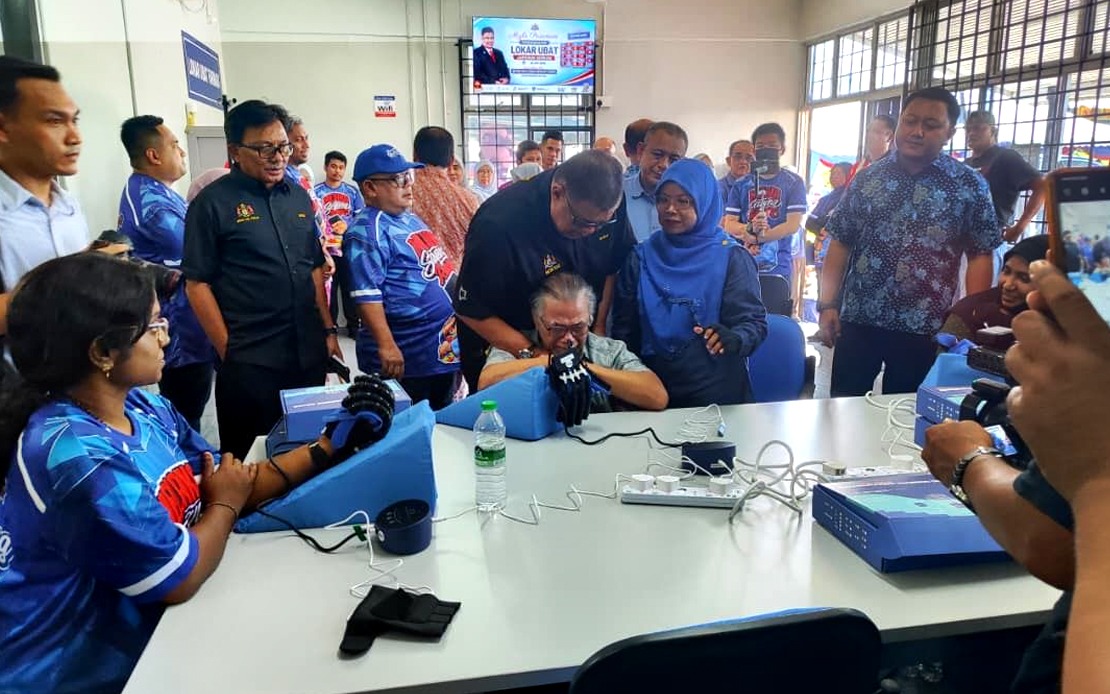
Universiti Teknikal Malaysia Melaka (UTeM) has officially opened the MADANI Community Rehabilitation Centre and Gymnasium in Serkam, Jasin, marking a significant step towards making advanced recovery technology accessible to ordinary Malaysians. The facility, which was inaugurated by Melaka Chief Minister Datuk Seri Ab Rauf Yusoh as part of the Public University Community Empowerment Programme, represents a convergence of academic research, government funding, and grassroots community engagement in addressing rehabilitation needs across the state.
The centre emerged from funding provided through the Finance Ministry's UniMADANI 2024 Grant, a programme designed to translate university innovations into tangible community benefits. Rather than remaining confined to laboratory settings, UTeM researchers have channelled their technological breakthroughs into a working rehabilitation hub that serves stroke survivors, trauma patients, and individuals struggling with mobility impairments and muscular weakness. This model addresses a genuine gap in Malaysia's healthcare infrastructure, where specialised rehabilitation services remain concentrated in urban centres and private facilities, often beyond the financial reach of ordinary households.
The technological arsenal deployed at the centre reflects years of engineering development by UTeM's research teams. The Roboglove system guides patients through structured hand rehabilitation protocols, offering precise feedback and progressive resistance to rebuild fine motor control and grip strength. The Assistive Lower Limb Chair (ALLC) automates lower limb exercise routines, allowing physiotherapists to monitor and adjust treatment intensity while reducing the physical burden on healthcare staff during repetitive therapy sessions. An exoskeleton system complements these innovations by enhancing the biomechanics of movement training, enabling patients to execute exercises that would otherwise be impossible during early recovery phases.
The collaborative structure underpinning the centre demonstrates how Malaysian universities can function as nodes within broader social infrastructure networks. UTeM coordinated with the Serkam State Constituency Development and Coordination Committee (Japerun) Office, the Kampung Pulai Village Development and Security Committee, the Social Welfare Department, and the Social Security Organisation (PERKESO) to create an integrated service model. This multi-stakeholder approach ensured that the facility would be embedded within existing community governance structures rather than operating as an isolated institutional project, enhancing sustainability and local ownership.
According to UTeM Vice-Chancellor Prof Datuk Dr Massila Kamalrudin, the centre is positioned as a prototype for scaling technology-based rehabilitation across Malaysia. She articulated the institution's strategic objective: to demonstrate that innovation transfer from universities to communities remains feasible and beneficial when proper collaborative frameworks exist. The implication extends beyond Melaka—the centre serves as a blueprint for similar initiatives in other states, potentially reducing geographical disparities in access to modern rehabilitation infrastructure.
The health implications of this facility are substantial for Southeast Asia's ageing demographic realities. As Malaysia's population ages and non-communicable diseases including stroke increase in incidence, the demand for rehabilitation capacity will intensify. Public healthcare systems, already stretched thin in many states, lack sufficient physiotherapy personnel and equipment to meet this growing burden. Technology-enabled rehabilitation centres can partially address this bottleneck by augmenting human therapist capacity, enabling each specialist to oversee more patients simultaneously while maintaining quality oversight through automated systems.
The economic dimension merits consideration as well. Private rehabilitation services in Malaysia typically cost between RM150 and RM500 per session, creating financial barriers for working-class and middle-income families managing long-term recovery journeys. A public facility anchored within a university framework can subsidise or eliminate patient costs while simultaneously generating research data on technology efficacy. This dual benefit—improved patient access coupled with evidence generation—creates a compelling justification for continued public investment in similar initiatives.
Associate Professor Dr Mariam Md Ghazaly, who led the project conceptually and administratively, embedded the centre within UTeM's broader commitment to community-engaged research. Her leadership signalled institutional priorities: that technical excellence derives meaning when channelled toward tangible social problems rather than remaining abstract scholarly contributions. This orientation increasingly resonates within Malaysian universities as funding bodies and governments emphasise translational research outcomes measurable beyond academic publications.
The MADANI initiative itself—encompassing this rehabilitation centre alongside broader university-community engagement efforts—reflects policy recognition that public universities possess underutilised resources and expertise relevant to grassroots development challenges. By establishing visible community benefits, universities strengthen their social legitimacy and secure political support for sustained funding, while simultaneously positioning their researchers as problem-solvers rather than disconnected academics.
For Malaysian policymakers and administrators overseeing healthcare expansion in other states, the UTeM model offers practical guidance. Identifying anchor institutions with relevant technical capacity, securing ring-fenced funding through competitive grant mechanisms, establishing multi-agency governance structures, and maintaining long-term commitment despite political transitions all represent critical success factors. The Melaka facility demonstrates these principles in operation.
Looking forward, the centre's effectiveness will depend substantially on utilisation rates and clinical outcomes data. Whether stroke survivors and injured workers actually access the facility in significant numbers, whether they experience measurable functional improvements, and whether the technology proves sustainable under operational conditions will determine whether this becomes a replicable model or remains a well-intentioned demonstration project. Comparative research between technology-assisted and conventional rehabilitation pathways would strengthen the evidence base for expansion.
UTeM's investment in this facility ultimately reflects deeper institutional positioning within Malaysia's evolving innovation ecosystem. As the country aims to transition toward high-value economic activities and improved living standards, universities increasingly shoulder responsibility for converting intellectual property into societal benefit. The MADANI Rehabilitation Centre illustrates this transition in tangible form—research outcomes that improve quality of life for vulnerable populations while demonstrating the practical returns on public higher education investment.

