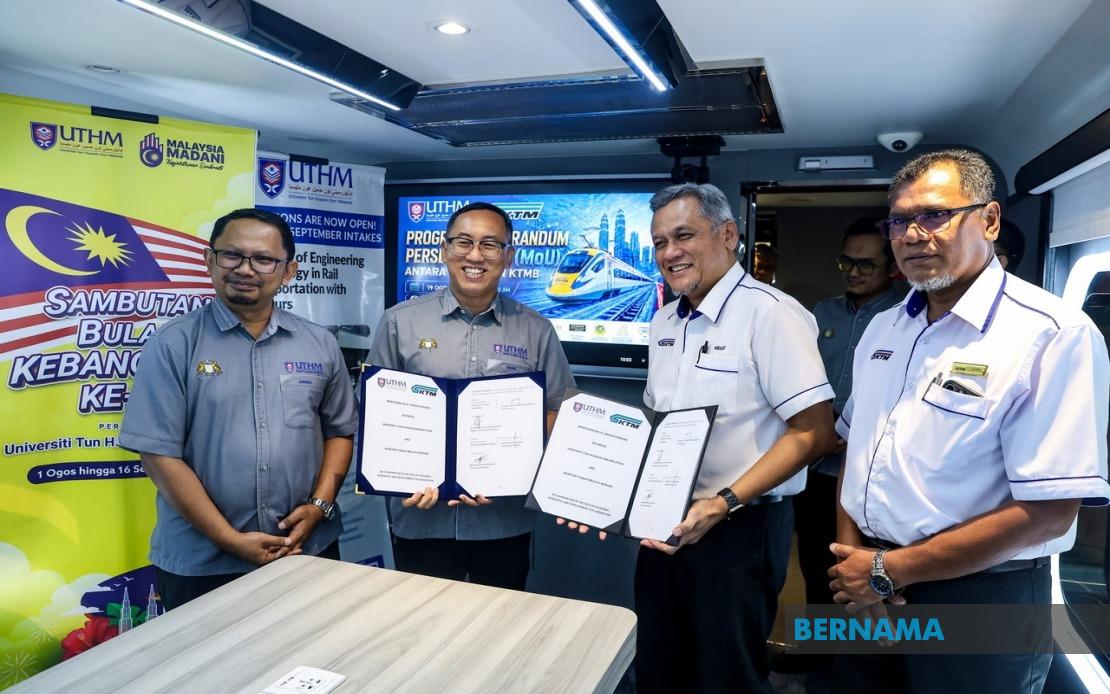
Universiti Tun Hussein Onn Malaysia (UTHM) and Keretapi Tanah Melayu Bhd (KTMB) have formalised a strategic partnership designed to accelerate talent development within Malaysia's rail sector through integrated academic and industrial engagement. The three-year agreement, extending from October 2026 to July 2029, represents a significant expansion of the institutions' existing ties and reflects growing recognition that bridging the gap between classroom learning and operational reality is essential for producing industry-ready professionals.
The partnership was officially documented during a ceremonial exchange aboard a KTMB chartered train travelling between Kluang Station and KL Sentral, an event staged to coincide with the launch of Rel Merdeka 69 and Malaysia's 69th National Month Celebration at UTHM. Prof Dr Mas Fawzi Mohd Ali, UTHM's vice-chancellor, and Megat Khairulazhar Khairodin, KTMB's chief corporate officer, representing their respective institutions, underscored the importance of sustained collaboration in a sector critical to the nation's infrastructure and economic competitiveness.
The foundation for this expanded cooperation was laid in 2019, when both institutions first recognised the mutual benefits of integrating academic rigour with practical railway operations. That initial agreement already yielded measurable success, particularly through UTHM's Bachelor of Rail Transportation Engineering Technology with Honours programme, which has produced nearly 200 graduates who have successfully transitioned into industry roles. Notably, the programme's reputation has extended beyond Malaysia's borders, with graduates securing positions in neighbouring Singapore and as far afield as Saudi Arabia, demonstrating the international calibre of the qualification and the global demand for Malaysia-trained rail professionals.
At the heart of the renewed arrangement lies work-based learning (WBL), a pedagogical approach that fundamentally transforms how engineering students engage with their discipline. Through WBL, UTHM undergraduates gain direct, supervised exposure to KTMB's operational environment, affording them intimate familiarity with the technical systems, safety protocols, and real-world constraints that define railway operations. This immersive experience proves invaluable in bridging the often-significant distance between theoretical concepts taught in lecture halls and the pragmatic problem-solving demanded in actual rail environments. Students encounter genuine operational challenges, from infrastructure maintenance to scheduling optimisation, and develop the adaptability and contextual awareness that employers consistently identify as critical gaps in fresh graduates.
Beyond undergraduate preparation, the collaboration establishes a framework for joint research and development activities that leverage complementary institutional strengths. UTHM brings advanced research facilities, academic expertise in emerging rail technologies, and the intellectual infrastructure for innovation, while KTMB contributes operational data, field experience, and an understanding of pressing technical challenges facing Malaysia's rail network. This combination creates conditions for generating practical solutions to infrastructure and technical problems that might otherwise remain confined to theoretical literature. The partnership explicitly targets areas such as rail engineering innovation, maintenance technology, and systems optimisation where collaborative research could yield tangible improvements to service delivery.
The agreement also encompasses competency development and formal academic consultation extending into KTMB's own training ecosystem. Through KTM Academy (MyRA), the partnership facilitates curriculum development and review for diploma, bachelor's, and postgraduate programmes specifically designed for rail transportation engineering. This ensures that KTMB's internal talent pipeline benefits from current academic thinking and reflects evolving industry requirements. Significantly, KTMB has already committed five staff members to pursuing master's degrees in rail-related fields at UTHM, signalling the company's determination to strengthen its internal capacity whilst demonstrating confidence in the university's research and teaching capabilities.
Prof Mas Fawzi explicitly linked the partnership to UTHM's broader strategic vision, articulated through the Global Technopreneur University 2030 (GTU2030) framework. This institutional aspiration emphasises integrating knowledge, technology, innovation, and entrepreneurship into talent development processes that directly address industry and societal needs. The KTMB collaboration exemplifies this philosophy in action, demonstrating how technical education can be restructured to nurture not merely engineers but innovation-oriented professionals capable of driving sectoral advancement and identifying entrepreneurial opportunities within established industries.
The partnership agenda includes regular industry forums, academic study visits, and structured competency development activities that maintain momentum and ensure sustained alignment between institutional goals and evolving industrial needs. These mechanisms provide regular touchpoints for identifying emerging skill gaps, validating curriculum relevance, and fostering informal networks between students, academics, and rail professionals that often prove as valuable as formal learning structures themselves.
From KTMB's perspective, the arrangement provides access to UTHM's technological infrastructure and research capabilities to address operational and technical challenges that might otherwise require external consulting or lengthy internal investigation. The railway operator gains a strategic asset in the form of an academic partner invested in understanding its specific operational context and committed to generating solutions aligned with its practical constraints and financial parameters.
The timing of this renewal reflects Malaysia's broader strategic priorities regarding infrastructure development and workforce preparation. As the nation pursues rail network expansion and modernisation, particularly through initiatives like the Klang Valley Double Tracking project and future high-speed rail corridors, the demand for technically sophisticated professionals will intensify. By institutionalising the connection between UTHM and KTMB, both organisations are positioning themselves to contribute meaningfully to these national objectives whilst building a domestic talent pipeline capable of sustaining long-term sectoral growth.
The partnership also carries symbolic importance, demonstrating that Malaysia's leading technical university and national rail operator recognise their interdependence and commit to joint progress rather than operating in isolation. In an era when skills shortages constrain national development, such institutional collaboration provides a replicable model for other university-industry partnerships seeking to produce graduates who combine academic grounding with practical readiness and strategic alignment with national infrastructure priorities.

