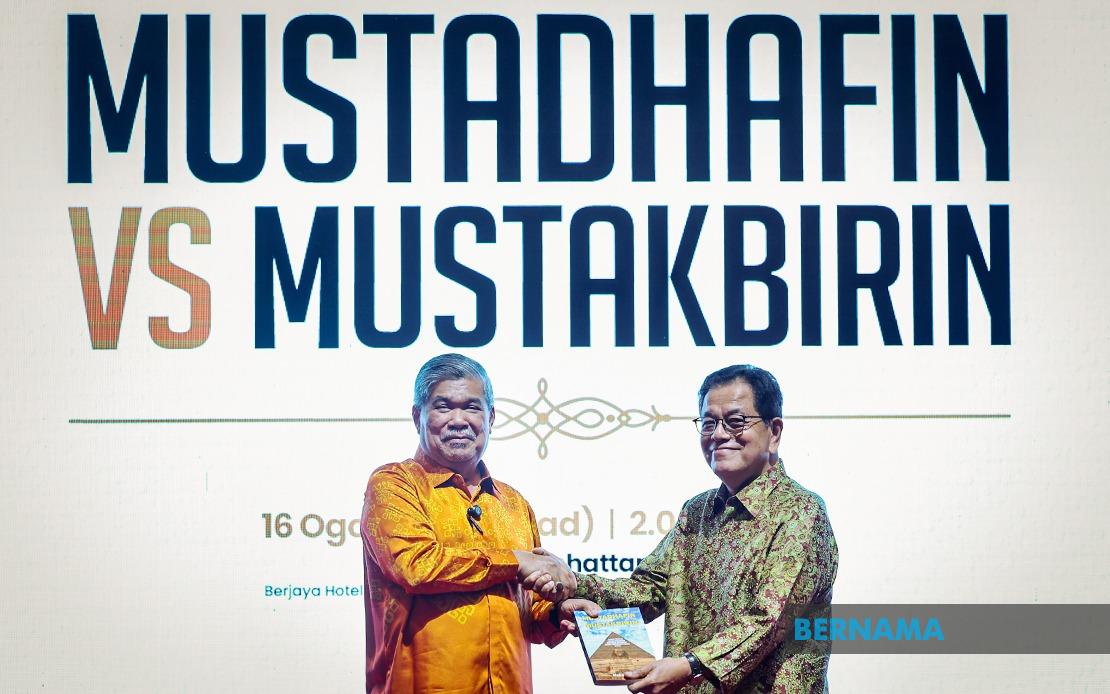
Datuk Seri Mohamad Sabu, president of Amanah, has issued a stern warning against the Malaysian public's tendency to accept allegations without scrutiny, cautioning that such credulity reinforces 'asabiyyah'—a psychological state where individuals instinctively defend their own group regardless of fault while dismissing others' positive contributions. The Agriculture and Food Security Minister made these remarks following the launch of his book in Kuala Lumpur, highlighting a persistent problem in contemporary Malaysian political discourse where claims spread with little regard for verification.
The core challenge, Mohamad explained, lies in the fundamental asymmetry between how facts and falsehoods circulate in public discourse. Whilst substantiated information requires careful examination, patience, and intellectual effort to comprehend fully, accusations and suspicions propagate with remarkable speed and ease, particularly through social media platforms where algorithms reward sensationalism over nuance. This structural disadvantage means that misinformation often gains dominance in the public consciousness before truth has the opportunity to marshal its arguments. The phenomenon has become increasingly acute in Malaysia's polarised political environment, where digital communication enables rapid amplification of unverified claims.
As a concrete illustration of this problem, Mohamad pointed to the recurrent allegation that the Democratic Action Party operates as a communist organisation and that political cooperation with DAP equates to endorsing communism. Rather than accepting this claim at face value, he challenged observers to examine the actual evidence: does DAP's documented history, stated ideology, and observable conduct genuinely support such a characterisation? This questioning approach represents the analytical rigor Mohamad advocates the public should apply systematically to political allegations. For Malaysian voters, this distinction matters significantly, as cooperation agreements between political parties shape coalition governments and policy direction.
The minister drew upon his personal history to illustrate the importance of independent verification. From childhood, he said, he adopted a practice of resisting the impulse to uncritically absorb information delivered to him, instead preferring to investigate circumstances directly rather than passively accepting circulating propaganda. This methodological approach—essentially treating all claims as provisionally uncertain until independently verified—reflects a disciplined intellectual habit that he argues contemporary Malaysians, particularly younger voters relying heavily on social media, desperately need to cultivate. In an era of information abundance coupled with deliberate misinformation campaigns, such scepticism represents a form of cognitive self-defence.
The timing of Mohamad's intervention carries particular significance for Malaysian politics. His warnings emerge during a period characterised by intense factional competition, where rhetorical weaponisation of historical grievances—particularly surrounding communism, given Malaysia's own Cold War-era security concerns—remains potent. Political actors across the spectrum periodically resurrect such allegations precisely because they carry emotional weight amongst older voters with living memory of Malaysia's communist insurgency and its aftermath. By urging systematic verification, Mohamad implicitly critiques this manipulation whilst appealing to voters' rational self-interest in understanding genuine policy differences rather than being swayed by recycled accusations.
The book launch featured National Journalism Laureate Tan Sri Johan Jaaffar, also a director of Star Media Group Berhad, underscoring the publication's ambition to reach a broad audience and contribute to wider public conversation. In his foreword or remarks, Jaaffar's involvement signals institutional media support for Mohamad's thesis about the importance of verified information in democratic discourse. For Malaysian readers, this alignment between political leadership and media figures around the principle of fact-verification represents a noteworthy coalition-building around information integrity, a value increasingly contested in polarised democracies.
Beyond domestic Malaysian politics, Mohamad's work encompasses broader geopolitical analysis informed by his international experience and observations. The book traverses global power dynamics, historical processes including colonialism, contemporary movements within Islam, the enduring Palestinian question, and shifts in international hierarchy—particularly the rise of non-Western powers. These themes, grounded in his documented experiences and encounters with various global actors, reflect an intellectual framework emphasising empirical observation over ideological preconception. For Southeast Asian readers trying to understand Malaysia's foreign policy positioning and regional relationships, such grounded analysis offers counterweight to purely propagandistic interpretations.
The minister's emphasis on resisting 'asabiyyah' speaks directly to Malaysian society's multi-ethnic, multi-religious composition. In diverse democracies, the tendency to defend one's own communal group unconditionally, whilst reflexively rejecting others' perspectives, corrodes the mutual trust necessary for stable governance and social cohesion. Mohamad's argument essentially makes a case for cosmopolitan citizenship—where political evaluation transcends tribal affiliation and bases itself on careful assessment of actual conduct and stated principles. This represents a significant counternarrative to communalist political mobilisation that has periodically dominated Malaysian electoral campaigns.
The challenge Mohamad identifies remains formidable. Social media architecture, economic incentives favouring sensationalism, declining media literacy, partisan media ecosystems, and genuine ideological disagreements all conspire against the careful, evidence-based deliberation he advocates. Malaysian political parties, civil society organisations, and educators must invest substantially in cultivating critical thinking capabilities across society. Without such investment, warnings from even prominent political figures may struggle to overcome structural incentives favouring credulity and tribal thinking. Nonetheless, Mohamad's explicit framing of information verification as a civic obligation represents an important step toward consciousness-raising about these dynamics and their corrosive effects on democratic quality.

