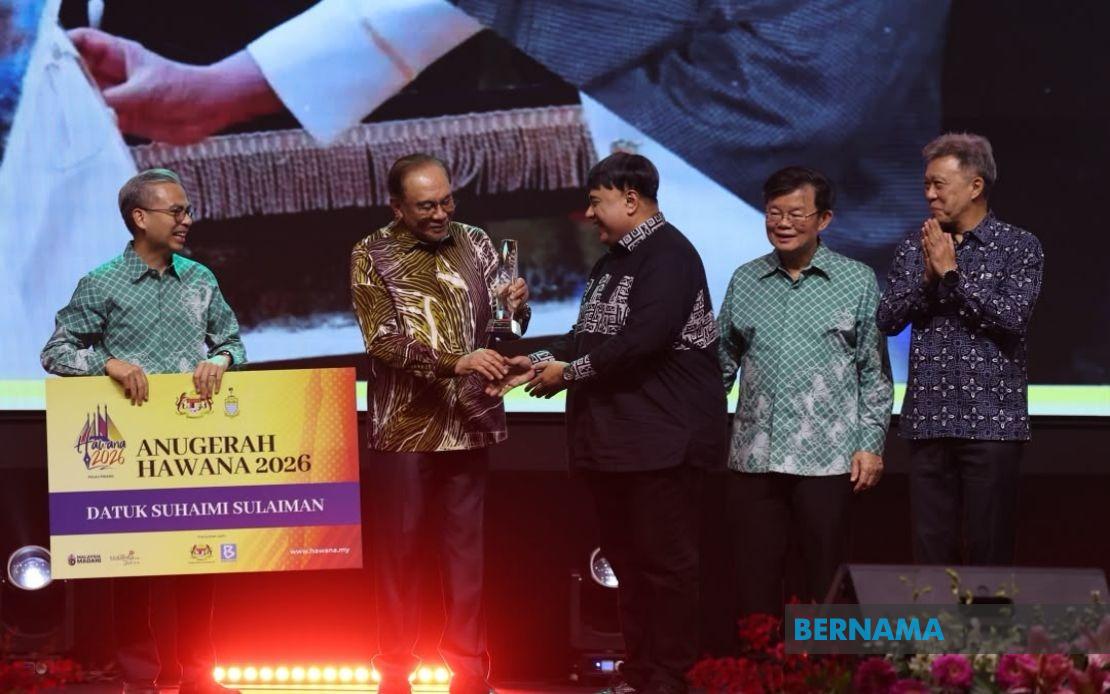
Datuk Suhaimi Sulaiman, a towering figure in Malaysian broadcasting who shaped the nation's media landscape across more than thirty years, has been honoured with the National Journalists' Day (HAWANA) 2026 Award. The distinction came at a glittering ceremony in Butterworth, recognising his profound impact on journalism and news dissemination in the country. Prime Minister Datuk Seri Anwar Ibrahim presented the award, underscoring its significance as a mark of state recognition for Suhaimi's lifetime of professional accomplishment.
The presentation took place at the HAWANA 2026 Grand Finale held at PICCA @ Arena Butterworth Convention Centre, drawing an assembly of senior government officials and media luminaries. Penang Chief Minister Chow Kon Yeow and Communications Minister Datuk Fahmi Fadzil were among those attending the occasion, alongside Malaysian National News Agency chairman Datuk Seri Wong Chun Wai. The gathering reflected the stature of both the awardee and the annual journalism honour, which celebrates excellence within Malaysia's fourth estate. Also present were Bernama chief executive officer Datin Paduka Nur-ul Afida Kamaludin and editor-in-chief Arul Rajoo Durar Raj, underlining the agency's central role in organising the event.
Suhaimi's career trajectory demonstrates the evolving nature of Malaysian journalism over recent decades. As former director-general of Broadcasting Malaysia—the national public broadcaster—he occupied one of the most influential positions within the domestic media establishment. His tenure coincided with critical periods of technological transition, institutional reform, and shifts in audience behaviour. The award recognises not merely seniority or longevity, but the substantive contributions he made to elevating standards and fostering professional practices within the broadcasting sector during his leadership.
In receiving the accolade, Suhaimi approached the moment with characteristic humility, framing the award as motivation for continued intellectual engagement rather than a retrospective finale to his career. He articulated that the recognition carries responsibility, particularly for mentoring younger practitioners navigating unprecedented change in their profession. His remarks suggested an unfinished commitment to the industry—a perspective that resonates with the contemporary challenges facing journalism across Southeast Asia and globally.
The technological context Suhaimi emphasised carries particular weight for Malaysian media practitioners. Artificial intelligence is fundamentally altering workflows, newsgathering practices, content distribution, and audience engagement strategies across the industry. From automated transcription and data analysis to algorithmic content curation and synthetic media detection, AI presents both opportunities and challenges that require journalists to acquire new competencies. Suhaimi's emphasis on continuous learning reflects a pragmatic understanding that professional relevance in media increasingly depends on adaptability and technical fluency.
For Malaysian broadcasters and journalists, the challenge of integrating AI tools while maintaining editorial integrity and public trust remains acute. Unlike some advanced economies with established AI governance frameworks in media, Malaysia continues developing institutional responses to these technological shifts. Senior practitioners like Suhaimi, who bridge the traditional and digital eras, occupy valuable positions in helping shape how the industry evolves. His willingness to engage with these transformations publicly signals to the profession that adaptation is not optional but essential.
The HAWANA award ceremony itself represents an important institutional ritual within Malaysia's media ecosystem. National Journalists' Day, commemorated annually, affirms journalism's role within democratic society and acknowledges individual contributions to the profession's standing. By honouring figures like Suhaimi, the award system reinforces professional identity and encourages practitioners to maintain ethical and quality standards. In the Malaysian context, where media freedom and independence remain subjects of ongoing public discourse, such recognition serves to elevate the profession's perceived value.
Suhaimi's career also reflects broader patterns in Malaysian institutional development. His progression through the ranks of a major public broadcaster during periods of significant national change provides perspective on how media institutions have adapted to political and social transitions. The respect accorded to him by current government figures—including the Prime Minister—suggests continuity in recognising the importance of experienced, respected media practitioners regardless of institutional changes or political transitions.
Looking forward, Suhaimi's emphasis on knowledge-sharing carries implications for media capacity-building across the region. Southeast Asian news organisations face similar pressures regarding technological change, audience fragmentation, and business model sustainability. Practitioners with deep experience navigating these challenges within their own national contexts can provide valuable insights for peers facing parallel difficulties. The HAWANA award acknowledges not only past contributions but implicitly endorses the continued relevance of such experienced voices in shaping the future of Malaysian journalism.
The recognition arrives at a moment when Malaysian media organisations are investing heavily in digital transformation and exploring new revenue models beyond traditional broadcasting and advertising. Newsrooms are grappling with how to maintain journalistic quality and audience trust while adopting technologies that fundamentally alter production processes. Suhaimi's perspective, informed by decades observing technological and institutional evolution within Malaysian broadcasting, carries practical value for organisational leaders making strategic decisions about editorial technology investment and workforce development.
%22%2F%3E%3C%2Fpattern%3E%3C%2Fdefs%3E%3Crect%20width%3D%22100%25%22%20height%3D%22100%25%22%20fill%3D%22url(%23ph29bu7g)%22%2F%3E%3Crect%20width%3D%22100%25%22%20height%3D%22100%25%22%20fill%3D%22url(%23ph29bu7p)%22%2F%3E%3Ctext%20x%3D%2250%25%22%20y%3D%2250%25%22%20text-anchor%3D%22middle%22%20dominant-baseline%3D%22central%22%20fill%3D%22rgba(255%2C255%2C255%2C0.95)%22%20font-family%3D%22Georgia%2C%20'Times%20New%20Roman'%2C%20serif%22%20font-weight%3D%22700%22%20font-size%3D%22272%22%20letter-spacing%3D%22-0.02em%22%3EJohor%3C%2Ftext%3E%3C%2Fsvg%3E)
%22%2F%3E%3C%2Fpattern%3E%3C%2Fdefs%3E%3Crect%20width%3D%22100%25%22%20height%3D%22100%25%22%20fill%3D%22url(%23ph1i38g)%22%2F%3E%3Crect%20width%3D%22100%25%22%20height%3D%22100%25%22%20fill%3D%22url(%23ph1i38p)%22%2F%3E%3Ctext%20x%3D%2250%25%22%20y%3D%2250%25%22%20text-anchor%3D%22middle%22%20dominant-baseline%3D%22central%22%20fill%3D%22rgba(255%2C255%2C255%2C0.95)%22%20font-family%3D%22Georgia%2C%20'Times%20New%20Roman'%2C%20serif%22%20font-weight%3D%22700%22%20font-size%3D%22170%22%20letter-spacing%3D%22-0.02em%22%3EJudicial%3C%2Ftext%3E%3C%2Fsvg%3E)