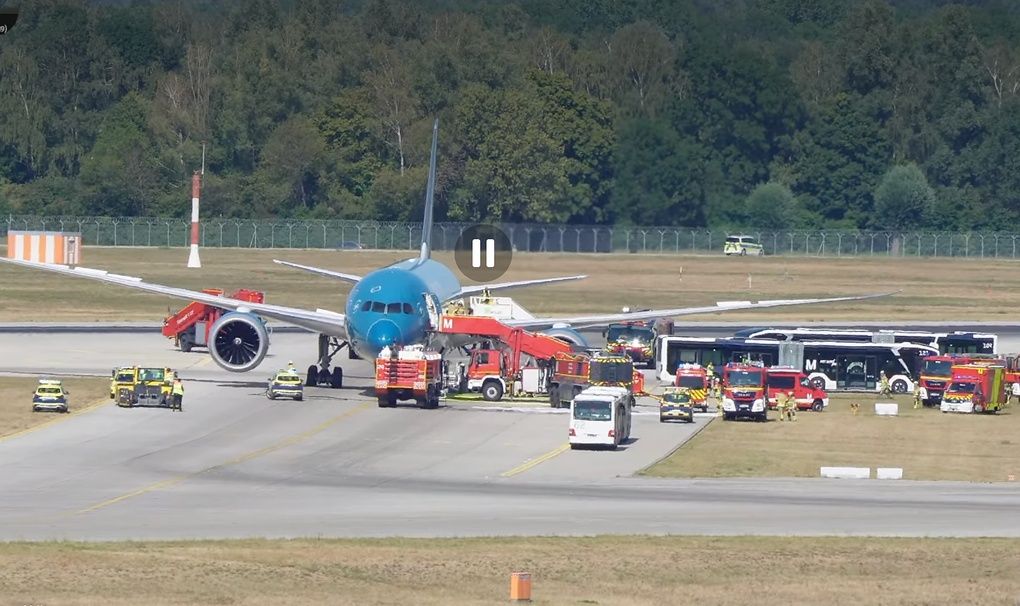
A Vietnam Airlines Boeing 787-9 departing Munich for Hanoi encountered a serious technical fault moments after beginning its takeoff roll on August 15, prompting the flight crew to abort the journey and execute an emergency return to the German airport. The wide-body aircraft, which had accelerated down the runway at an unusually steep angle before rotating near the end of the tarmac, managed to become airborne despite the anomaly before the decision was made to reverse course. The incident unfolded swiftly but remained under control throughout, with no injuries reported among the several hundred passengers and crew members aboard.
According to incident monitoring reports, the aircraft experienced what specialists describe as a delayed rotation sequence combined with a tailstrike contact—when the rear fuselage makes contact with the runway surface during takeoff—and a runway overrun situation. These interconnected technical failures triggered automatic safety protocols that prompted the cockpit to assess the situation and determine that returning to Munich represented the safest course of action. The crew's decision-making process, grounded in standard aviation procedures, underscores how modern aircraft systems are designed to detect and respond to anomalies before they escalate into more dangerous scenarios.
Following the aborted takeoff, the aircraft climbed to approximately 9,000 feet and entered a holding pattern, a tactical maneuver that allowed pilots to assess damage, manage fuel reserves by circulating in the air, and coordinate with ground authorities about the severity of the situation. This holding period also gave Munich Airport emergency personnel critical time to prepare for the aircraft's return, positioning firefighting equipment and medical teams on standby. The extended airtime served a dual purpose: it demonstrated the aircraft's fundamental airworthiness despite the technical issue, while simultaneously providing reassurance that the situation, though serious, remained manageable.
Roughly two hours after its initial departure, the Boeing 787 descended and executed a controlled landing at Munich Airport. Upon touchdown, contact with the runway surface had apparently caused damage to the aircraft's tire assemblies, with visible smoke emanating from the landing gear area—a typical indicator of friction-generated heat during emergency braking or tire failure. Emergency services immediately mobilized, and all passengers and crew members were safely evacuated from the aircraft and processed through the terminal without incident.
Vietnam Airlines responded swiftly to the operational disruption by immediately initiating support procedures for affected travelers. The carrier committed to arranging alternative transportation for all passengers whose journeys had been interrupted, while simultaneously launching a comprehensive investigation into the root cause of the technical malfunction. The airline indicated that detailed updates regarding the incident's specifics and the aircraft's status would be released once inspection procedures concluded and operational schedules were recalibrated.
The incident provides a stark illustration of the technical complexities involved in operating large wide-body aircraft on long-haul international routes. The Boeing 787 Dreamliner, while celebrated for its fuel efficiency and passenger comfort features, relies on highly sophisticated avionics and hydraulic systems that occasionally require intensive investigation when anomalies occur. The delayed rotation problem—which can occur due to sensor malfunctions, software glitches, or hydraulic system irregularities—represents a scenario that pilots train extensively to handle, making the successful outcome of this incident a validation of crew training protocols.
For Malaysia and the broader Southeast Asian aviation community, this incident carries several implications. Vietnam Airlines operates as one of the region's major carriers, with extensive route networks that include connections through Malaysian hubs and competition on regional routes from Kuala Lumpur. The airline's fleet of Boeing 787 and Airbus A350 aircraft are among the most modern in service across Asia, and technical incidents involving these aircraft capture attention from regional aviation authorities and competing carriers alike.
The Munich incident also reflects the robust international aviation safety framework that ensures incidents are thoroughly investigated and findings are shared across the industry. German authorities, European Aviation Safety Agency officials, and Boeing technical representatives would collaborate with Vietnamese aviation regulators and Vietnam Airlines engineers to determine whether the malfunction stemmed from maintenance oversight, design considerations, or manufacturing defects. This collaborative approach has made commercial aviation increasingly safe over recent decades, with each incident contributing to systemic improvements that benefit all carriers and passengers.
Vietnam Airlines has maintained direct service between Munich and both Hanoi and Ho Chi Minh City, representing important trade and tourism connections between Europe and Southeast Asia. The airline's deployment of premium wide-body aircraft on these routes underscores the significance of the routes and the airline's strategic positioning. While this incident will require temporary schedule adjustments and aircraft maintenance, the broader significance lies in how modern aviation systems detected the problem, responded appropriately, and ensured passenger safety—demonstrating that despite occasional technical challenges, the safeguards embedded in contemporary air transport remain fundamentally sound and effective.

