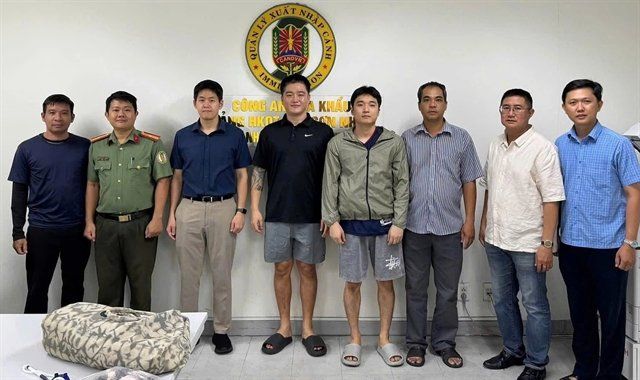
Vietnamese law enforcement authorities have intensified cooperation with international counterparts by apprehending and extraditing four South Korean nationals implicated in cross-border fraud operations. The coordinated efforts, spanning arrests in both Ho Chi Minh City and Hanoi, underscore the region's growing commitment to combating sophisticated cybercrime networks that exploit digital channels to victimise people across international boundaries.
On August 3, police in Ho Chi Minh City's Investigation Agency, working alongside the Ministry of Public Security's dedicated police investigation unit, arrested three South Korean suspects identified as Wang Taesan, Han Joonhee, and Bang Giseong. These individuals had been the subject of Interpol red notices following requests from South Korean police authorities investigating allegations of online fraud. Their capture represents a significant breakthrough in dismantling organised crime groups that leverage technology to circumvent geographical and jurisdictional limitations in their criminal pursuits.
The modus operandi employed by these individuals reflects the evolving sophistication of contemporary fraud schemes. One particularly insidious tactic involved fabricating allegations of compromising personal content. The suspects would contact potential victims, falsely claiming to possess intimate videos, and then threaten to disseminate such material unless substantial payments were transferred. Crucially, these videos never actually existed—the entire premise constituted an elaborate deception designed to manipulate victims through psychological coercion and shame.
Beyond sextortion tactics, the network deployed what authorities characterised as high-tech impersonation schemes. Members of the group assumed the identities of South Korean prosecutors and other law enforcement officials, contacting victims via telephone before sending digital links to forged documentation. These counterfeit papers included fabricated arrest warrants bearing victims' names, creating an appearance of official sanction and urgency. The fraudsters then asserted that victims' bank accounts had become entangled with criminal activity, demanding money transfers to supposedly neutral accounts for "verification" purposes—a social engineering technique that exploited legitimate institutional procedures to extract funds.
The three suspects were subsequently transferred to South Korean authorities at Tan Son Nhat International Airport in Ho Chi Minh City, formalising Vietnam's participation in addressing transnational organised crime. This extradition process demonstrates the practical application of regional security cooperation frameworks that enable countries to manage criminal elements operating across borders.
A parallel operation in northern Vietnam expanded the scope of these enforcement efforts. On August 27, authorities working through Lang Ward Police in Hanoi, coordinating with the Immigration Department under Hanoi Police command, transferred another South Korean suspect to counterparts at Noi Bai International Airport. The individual, Lee Sammin, had been apprehended on December 31, 2025, and carried an Interpol Red Notice for telecommunications-related online fraud offences.
Lee Sammin's criminal operation represented a distinct category of financial manipulation. Rather than relying on sextortion or impersonation of officials, his network centred on investment fraud. Operating through social media platforms and internet channels, Lee Sammin and associates assumed the personas of investment professionals and financial experts. They disseminated misleading information regarding shares purportedly scheduled for imminent listing, persuading victims to remit capital for supposed investment opportunities. The criminal network subsequently absconded with these funds, misappropriating a staggering total of approximately US$10.69 million from their victims.
The geographic and operational diversity of these cases illustrates how fraud networks adapt their methodologies based on target vulnerability and available technology. Where some groups exploit psychological manipulation and official impersonation, others capitalise on victim appetite for financial returns and investment opportunities. This polymorphic criminality presents particular challenges for enforcement agencies, as it requires specialised knowledge across multiple fraud categories and cultural contexts.
For Malaysia and the broader Southeast Asian region, these Vietnamese enforcement actions carry significant implications. As economies increasingly digitalise and populations embrace fintech solutions and social media commerce, cross-border fraud networks will inevitably view the region as a substantial market. Malaysian regulators and law enforcement must anticipate similar sophisticated schemes targeting local residents, particularly given Malaysia's large online-active population and growing wealth levels that render victims attractive targets for international organised crime syndicates.
The extradition successes achieved by Vietnam demonstrate the practical value of Interpol red notices and bilateral law enforcement cooperation. However, they also underscore a troubling reality: cybercriminals can operate with relative impunity across borders if countries lack robust information-sharing mechanisms or extradition treaties. Southeast Asian nations including Malaysia should leverage these precedents to strengthen their own international law enforcement partnerships and capacity to prosecute organised online fraud, recognising that victims increasingly span multiple jurisdictions simultaneously.
Cybersecurity experts warn that investment fraud schemes particularly pose growing threats throughout Asia-Pacific, where rapid urbanisation and rising middle-class populations create vulnerable demographics with accumulated savings but limited financial literacy. The Lee Sammin network's ability to defraud victims of over US$10 million despite operating largely online suggests that even modest operational competency, combined with psychological understanding, can generate substantial criminal proceeds. This asymmetry—where relatively small criminal teams generate massive losses distributed across thousands of victims—means that reactive enforcement, while necessary, remains insufficient without complementary public awareness and institutional safeguards.
Vietnam's coordinated approach, involving multiple police agencies and immigration authorities working through established international channels, provides a model for regional harmonisation. As digitisation accelerates across Southeast Asia and fraud networks adapt their tactics to exploit emerging platforms and technologies, sustained cooperation between countries will prove indispensable. The successful apprehension and extradition of these four South Korean nationals represents progress, yet the underlying vulnerability remains: fraudsters continue identifying innovative ways to exploit human psychology and technological systems across borders.

