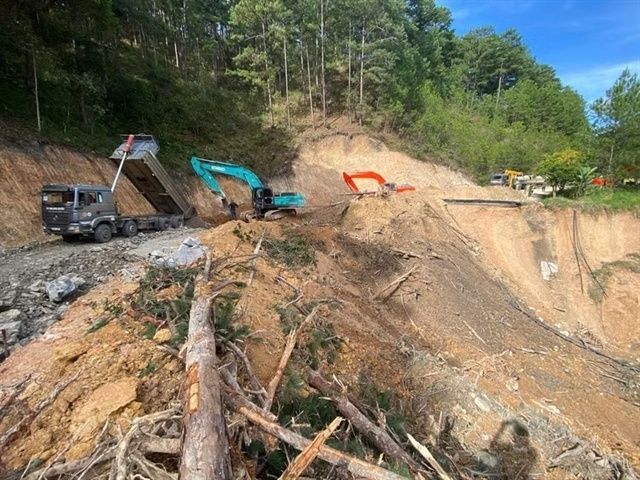
Vietnam's Ministry of Construction has declared a state of natural disaster emergency along a critical stretch of Ho Chi Minh Road passing through Tuyen Quang Province in the north, responding to extensive infrastructure damage inflicted by a month-long deluge that tested the region's drainage and road maintenance systems. The emergency designation centres on the Km115+000 position where Ho Chi Minh Road intersects with National Highway 2C, a convergence point managed by Road Management Zone I that has become particularly vulnerable to the cumulative effects of repeated heavy downpours.
The cascading rainfall episodes that pummelled the region throughout June 2026 triggered severe structural deformation along the affected corridor, creating immediate safety hazards for the constant flow of vehicles and commuters dependent on this vital north-south transport artery. The extent of damage prompted authorities to prioritise the protection of road users as the primary justification for invoking emergency powers, signalling that standard repair protocols would prove insufficient to address the scale of deterioration. Heavy rainfall in mountainous northern regions typically causes more pronounced infrastructure stress than in other areas due to topographical water runoff patterns and the vulnerability of older road sections to washout.
Data compiled by the Tuyen Quang Provincial Hydrometeorological Station and corroborated by the National Centre for Hydrometeorological Forecasting documented multiple successive heavy rainfall episodes concentrated between June 1 and June 30, establishing the meteorological context for the disaster declaration. The clustering of intense precipitation events within a single month, rather than spreading across the season, intensified pressure on drainage systems and soil stability beneath the roadbed. Such concentrated rainfall patterns are becoming increasingly common across Southeast Asia as climate variability continues reshaping seasonal weather behaviour.
The Ministry of Construction's response framework delegates specific operational responsibilities across multiple agencies to streamline emergency interventions. The Department for Roads of Vietnam and Road Management Zone I have received explicit directives to conduct comprehensive damage assessments, evaluate structural integrity, formulate repair strategies, and issue Emergency Construction Orders that expedite the procurement and deployment of repair materials and labour crews. This administrative structure acknowledges that emergency declarations must be paired with concrete implementation mechanisms to translate policy into tangible infrastructure restoration.
The accountability framework embedded within the emergency directive establishes clear reporting lines and performance expectations for senior officials. The Director General of the Department for Roads of Vietnam and the Director of Road Management Zone I assume direct responsibility to the Minister of Construction for documenting infrastructure damage at Km115+000 caused specifically by the June rainfall, creating institutional incentives for thorough assessment and rapid response. This assignment of accountability reflects a broader administrative trend across Southeast Asia where senior officials face personal consequences for inadequate disaster response, encouraging proactive engagement with emergency management protocols.
Beyond the primary damage zone at Km115+000, authorities have identified a secondary flooded corridor stretching between Km124+600 and Km128 where Ho Chi Minh Road overlaps with National Highway 2. This extended problem area requires immediate attention to prevent cascading traffic disruptions that could compound economic losses across the region. The dual-site emergency response indicates that rainfall damage extended more broadly across the provincial road network than initial assessments may have suggested, necessitating a coordinated approach to congestion management and traffic flow restoration.
The operational urgency surrounding congestion management reflects the critical importance of Ho Chi Minh Road to regional commerce and logistics networks. Any extended closure or significant capacity reduction along this corridor disrupts supply chains throughout northern Vietnam and potentially affects cross-border trade with Laos and China, making rapid restoration of safe passage a pressing regional concern. For Malaysian readers, this situation parallels the infrastructure vulnerabilities affecting crucial Malaysian highways during monsoon seasons, particularly in Peninsular Malaysia where similar rainfall patterns periodically damage road networks serving key economic corridors.
The Transport and Road Safety Division of the Ministry of Construction has received authority to coordinate implementation efforts across all participating agencies, effectively serving as the central command structure for the emergency response. This centralisation of coordination authority prevents fragmented responses and ensures that repair priorities align with transport policy objectives rather than isolated bureaucratic interests. The division's elevated role reflects recognition that infrastructure emergencies demand unified rather than compartmentalised governmental action.
The emergency construction framework explicitly contemplates a defined endpoint where officials will reassess conditions and consider terminating the emergency status once repair works conclude. The Department for Roads of Vietnam must formally report completion of emergency construction to the Ministry of Construction, providing the documentation foundation for determining whether road conditions have stabilised sufficiently to rescind the emergency declaration. This staged approach prevents indefinite emergency status while maintaining flexibility for extended intervention if rainfall patterns shift or hidden damage emerges during repair activities.
The June 2026 Ho Chi Minh Road emergency reflects broader infrastructure resilience challenges confronting Southeast Asian nations as climate patterns become less predictable and extreme weather events increase in frequency and intensity. Vietnam's experience with concentrated rainfall damage offers relevant lessons for Malaysian policymakers evaluating road maintenance budgets and emergency response preparedness. The interconnected nature of regional transport networks means that infrastructure emergencies in Vietnam can indirectly affect Malaysian trade flows and cross-border logistics, underscoring the importance of monitoring and supporting regional infrastructure stability across the wider Southeast Asian context.

