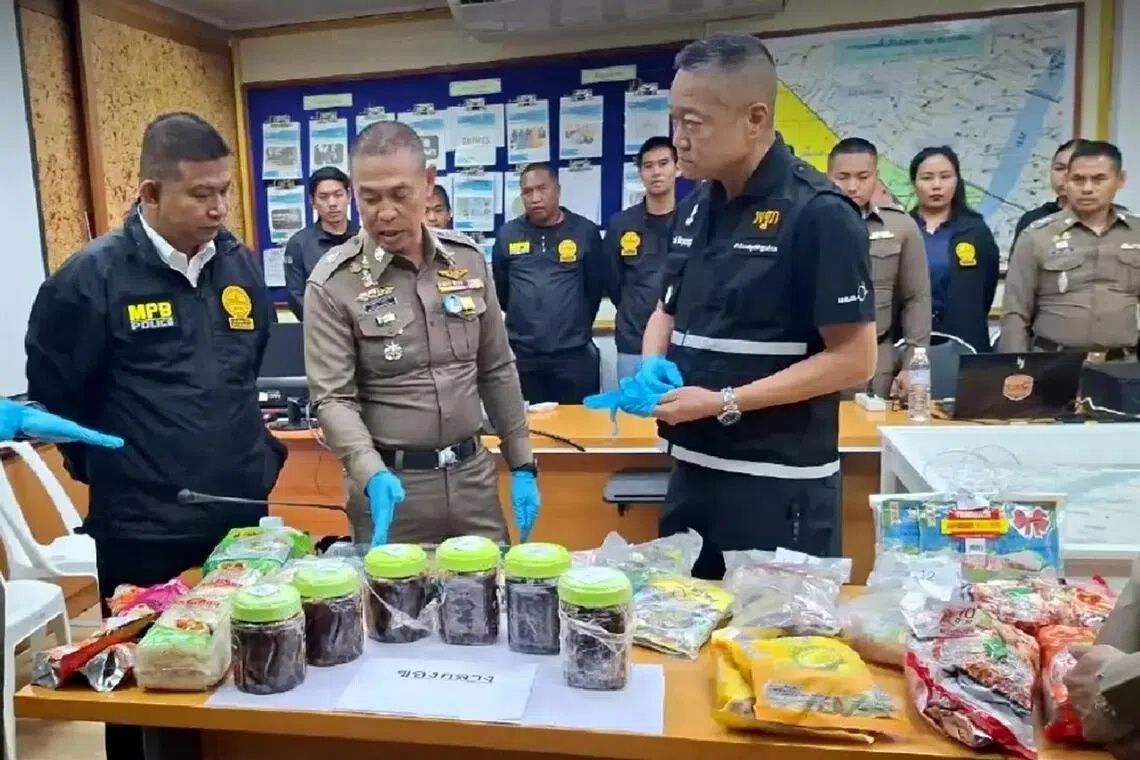
Bangkok police have exposed a transnational methamphetamine smuggling operation orchestrated by a Vietnamese crime network that channelled drugs through Thailand to Japan, employing an elaborate layering system designed to obscure the criminal chain of command. Metropolitan Police Bureau commissioner police lieutenant-general Siam Boonsom disclosed the findings on July 17, alongside fellow senior officers from the capital's law enforcement apparatus, following an investigation that began when a courier became suspicious of unusually heavy tamarind paste containers.
The operation's discovery came through an unexpected break when an individual hired to transport goods internationally raised concerns about six jars of tamarind paste destined for Tokyo. Upon closer inspection, investigators uncovered six foil-wrapped packages secreted within the containers, with laboratory analysis confirming the presence of more than two kilograms of crystal methamphetamine, colloquially termed ice. The incident illustrated the vulnerability of international courier systems to exploitation by criminal networks seeking to exploit legitimate commercial channels for illicit purposes.
Investigators concluded that the network operated under the direction of Vietnamese nationals based in Hanoi, who managed the operation remotely while maintaining distance from frontline smuggling activities. This geographical separation served a critical function in insulating senior organisers from direct accountability and reducing the likelihood of their identification by authorities. The arrangement reflected modern transnational organised crime patterns, where command structures are deliberately fragmented across borders to complicate law enforcement investigations.
The distribution mechanism revealed a sophisticated understanding of supply chain vulnerabilities. Anonymous Facebook accounts were utilised to hire motorcycle delivery couriers to collect packages from residences occupied by Vietnamese nationals throughout Thailand. These intermediaries then transferred the goods to Thai couriers contracted specifically for international transport, creating multiple disconnected points in the smuggling chain. This compartmentalisation ensured that individual participants possessed limited knowledge of the operation's full scope, complicating any potential cooperation with authorities.
Financial management of the operation demonstrated equally careful planning. A Thai bank account nominally belonging to Sompong, a Thai national implicated in the scheme, served as the financial conduit for the network's transactions. Vietnamese accomplices were orchestrated to withdraw cash in amounts ranging from 20,000 to 50,000 baht at irregular intervals before departing Thailand, a pattern designed to minimise the accumulation of suspicious financial activity that might trigger regulatory scrutiny. The deliberate use of rotating individuals and modest withdrawal amounts reflected awareness of anti-money laundering protocols.
Police investigations have identified at least four individuals warranting arrest: Sompong, the Thai national through whose account funds flowed, and three Vietnamese nationals allegedly responsible for managing various operational components including social media recruitment, cash extraction, and command authority. Sompong has categorically denied involvement in the criminal enterprise, though his central role in the financial infrastructure raises significant questions about his degree of culpability. The inclusion of his girlfriend in investigators' examination, despite her absence from formal arrest warrants, suggests police believe she possessed knowledge of illicit activities whilst assessing the extent of her participation.
The case exemplifies a broader pattern that Thai authorities have confronted repeatedly: the manipulation of ostensibly innocent couriers and transporters by criminal networks exploiting their economic circumstances. Police indicated that multiple incidents have involved unsuspecting individuals contracted to carry packages without understanding their contents, a tactic that simultaneously provides operational insulation for organisers and potential legal cover for low-level participants. This model distributes risk throughout the supply chain whilst concentrating profits at the apex.
Thailand's geographical position as a terrestrial and maritime crossroads between production regions in Southeast Asia and consumer markets in developed nations has rendered it particularly vulnerable to transit trafficking. The country's extensive network of land borders, combined with its developed commercial and transportation infrastructure, creates conditions favourable to criminal entrepreneurs seeking efficient routes for drug distribution. The sophistication demonstrated by this Vietnamese network reflects the evolving operational capabilities of organised crime groups adapting to contemporary law enforcement challenges.
The methodical approach adopted by this syndicate indicates substantial financial resources and organisational capacity. The coordination required to establish financial mechanisms, recruit multiple layers of operatives across international boundaries, and manage logistics across three countries demands considerable expertise and capital investment. Such operations typically generate returns sufficient to absorb periodic losses through interdiction, suggesting the network possessed multiple concurrent smuggling channels beyond this individual seizure.
For Malaysian authorities and regional security agencies, the case underscores the necessity for enhanced cooperation mechanisms across Southeast Asian law enforcement bodies. The transnational character of the operation, spanning Vietnam, Thailand, and Japan, highlights how criminal networks exploit jurisdictional boundaries and the limitations inherent in purely domestic regulatory frameworks. Intelligence sharing protocols and coordinated investigative procedures remain essential for disrupting supply chains before they reach terminal markets.
The broader implications extend to the evolution of drug trafficking methodologies in Southeast Asia. As enforcement agencies become increasingly sophisticated at detecting conventional concealment methods, criminal organisations adapt by targeting commercial products with legitimate demand, obscuring illicit shipments within ordinary trade flows. The tamarind paste method, whilst specific to this case, represents a category of innovation wherein criminals exploit the volume and legitimacy of commercial networks to camouflage prohibited substances. Customs and border authorities face the perpetual challenge of distinguishing contraband from authentic commerce without dismantling the legitimate commercial frameworks upon which regional economies depend.

