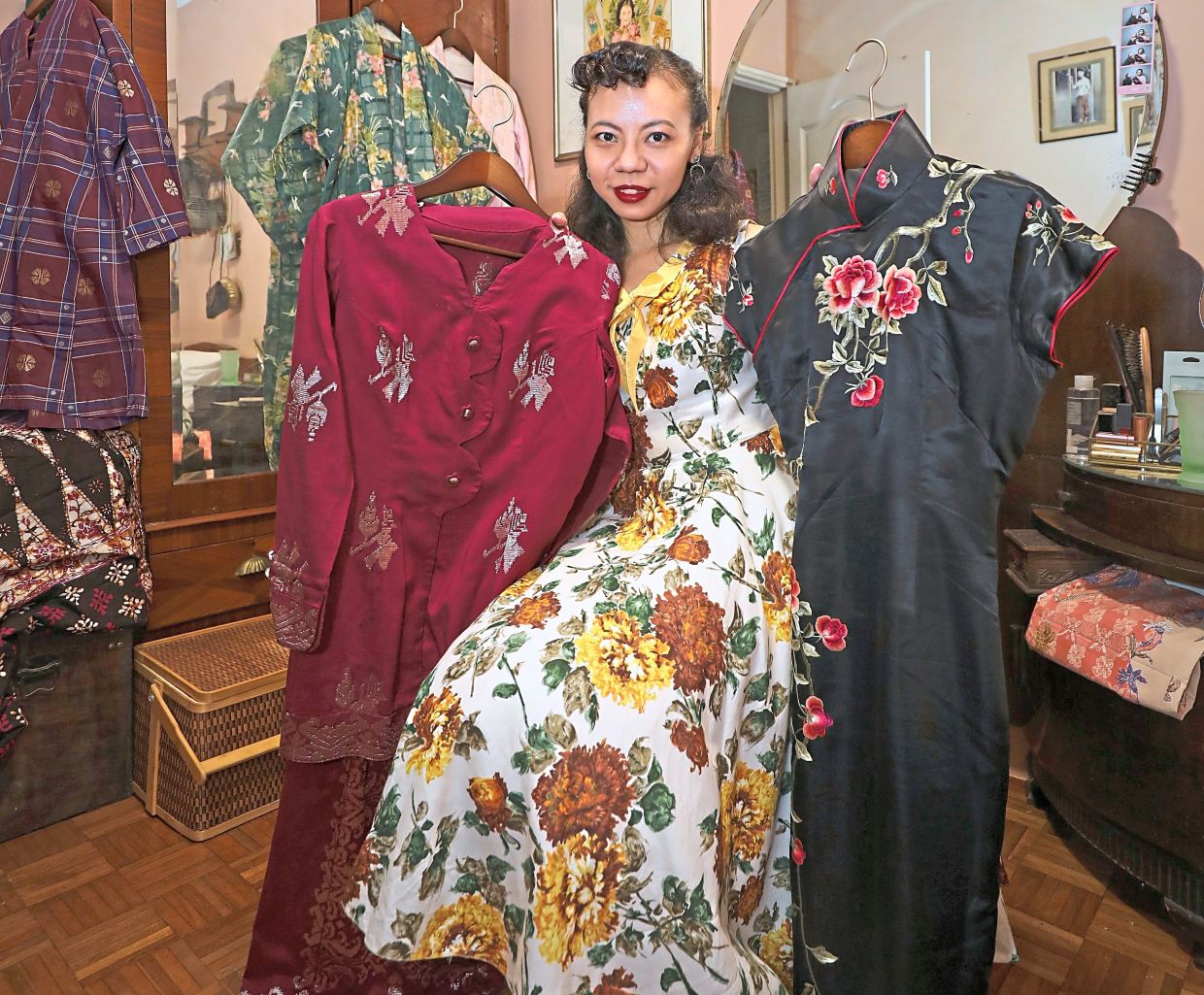
A faded photograph tucked away in Suzanne Lim's bedroom captures her late grandparents mid-pirouette in a 1950s dance hall, their finest clothes frozen in black and white. That single image—a testament to their love of music, movement, and style—set her on a lifelong journey to understand and preserve the material culture of Malaysia's recent past. The 33-year-old graphic designer credits this intimate connection to family history as the catalyst for what has evolved into a serious pursuit of vintage Malaysian garments, from intricate kebaya and cheongsam to batik and songket textiles that represent decades of craftsmanship and cultural expression.
Lim's childhood was steeped in performance and tradition. Inspired by her grandparents' passion for dancing and dressing well, she began formal lessons in Latin and ballroom at a young age, eventually competing in these disciplines. The connection deepened during her secondary school years when she joined the cultural club, performing traditional dances that required elaborate costumes with matching accessories. These formative experiences planted seeds of curiosity about the garments themselves—their construction, their historical moment, the social circumstances that shaped them. What started as practical exposure to traditional dress gradually transformed into an intellectual fascination with how clothing functions as a historical record.
When Lim purchased her first vintage piece, the transaction rippled into something far more consequential than a simple wardrobe addition. The experience awakened what she describes as an inescapable passion, one that now manifests through curating a personal collection and sharing her finds across social media platforms. Rather than simply displaying these items in a museum-like context, Lim photographs herself wearing them against heritage backdrops, creating a visual dialogue between past aesthetics and contemporary sensibility. This approach serves a dual purpose: it keeps dormant cultural artifacts alive within the flow of daily life, while simultaneously offering younger Malaysians permission to engage with traditional dress as a living practice rather than a relic.
For Lim, vintage garments function as more than aesthetic objects. They are historical documents that reveal the economic conditions, social hierarchies, and cultural priorities of their era. A particular textile tells stories about trade routes, about access to materials, about the occasions that warranted special dress. By studying and wearing these pieces, she gains access to layers of understanding about Malaysian society that conventional historical education often leaves unexplored. This perspective resonates with another young heritage enthusiast navigating similar terrain through different methods.
Mohamad Alif Daniel Mohammad Nor, now 25, traces his engagement with history back to his grandmother's stories—conversations that bloomed into broader interests in film, music, and eventually the material culture of specific historical periods. His collecting began in his mid-teens with Japanese occupation currency notes, an entry point that led him toward deeper involvement with historical re-enactment through Persatuan Reka Ulang Sejarah (PRUS). Unlike Lim's approach, which emphasizes personal interpretation layered atop historical foundations, Mohamad Alif Daniel's work demands meticulous accuracy. Yet both recognize that engaging physically and emotionally with clothing from the past generates understanding that textbooks cannot provide—a comprehension that encompasses not just facts but the lived experience of how people thought, dressed, and carried themselves.
Lim articulates a concern increasingly relevant to digital-age Malaysia: museums feel distant, reliable historical sources go unread, and younger generations absorb information through fragmented online channels. She sees her platform and her carefully curated choices as a counterweight to this erosion of accessible cultural knowledge. By demonstrating that certain textiles, construction techniques, and design traditions existed—and still exist—she makes heritage tangible and immediate rather than abstract. Her commitment to accuracy reflects this responsibility, though she acknowledges the tension between preservation and creativity.
This tension reveals itself in Lim's willingness to offer modern interpretations of vintage pieces while simultaneously maintaining what she considers the fundamental integrity of the garments. She does not claim strict period accuracy in every outfit, recognizing that such rigid adherence might alienate younger people exploring these traditions. Instead, she advocates for a middle path: drawing inspiration from historical pieces, applying contemporary styling sensibilities, but never straying so far from authenticity that the garment becomes unmoored from its cultural and historical anchors. This philosophy reflects deeper anxiety about cultural identity—the fear that excessive reinterpretation might dilute meaning or create confusion about what these clothes actually represent.
The growth Lim has observed in her peer group's interest in vintage collecting appears partly driven by psychological and sociological factors specific to contemporary life. As digital existence becomes increasingly dematerialized, younger Malaysians express a hunger for tactile, physical connection to the world around them. Vintage clothing and objects satisfy this craving for authenticity and tangibility while simultaneously offering a form of escapism from the relentless presentism of social media and technology. The act of searching for, acquiring, and wearing vintage items engages multiple senses and creates a meaningful temporal experience that scrolling through feeds cannot replicate.
Moreover, the creative freedom implicit in mixing historical and contemporary elements appeals to young people conditioned by remix culture and hybrid identity formation. Rather than viewing history as a set of fixed rules to be obeyed, many see it as a palette to be drawn from, a conversation across time rather than a monument to preserve unchanged. Lim recognizes this generational instinct and validates it, even as she insists on maintaining certain boundaries. Her perspective acknowledges that culture must evolve to remain vital, yet argues that this evolution requires grounding in genuine understanding and respect for foundational elements.
Mohamad Alif Daniel's experience adds another dimension to this cultural revival. Through his public engagement with traditional attire, particularly his documentation and advocacy through social media, he has noticed something remarkable: individuals who previously felt embarrassed wearing traditional clothing in public have been emboldened to do so. His work, alongside Lim's, suggests that the shame often associated with wearing traditional dress in multicultural, modernizing Malaysia runs partly through visibility and representation. When young people who command digital audiences normalize and celebrate traditional garments, they implicitly challenge the narrative that such clothing belongs only to formal cultural events or nostalgic contexts.
This shift holds significant implications for Malaysian society beyond the aesthetics of individual outfits. Cultural identity, particularly for young Malaysians navigating complex ethnic and religious landscapes, often feels fragile or context-dependent. When heritage dress becomes something worn only on designated occasions, it risks becoming performative—a costume rather than an expression of self. By incorporating traditional textiles and silhouettes into everyday wear, by making these items visible in contemporary social contexts, young collectors and enthusiasts signal that cultural identity is not separable from modernity. They argue, through practice rather than proclamation, that being truly Malaysian means integrating rather than compartmentalizing one's heritage.
The digital amplification of these individual efforts cannot be overlooked. Social media platforms function as grassroots museums where curated images of vintage garments reach audiences far exceeding any single institution's capacity. Comments, shares, and discussions create spaces for intergenerational knowledge exchange. Older Malaysians who recognize specific textiles or construction techniques offer context; younger people express curiosity and ask questions. This organic pedagogical process supplements formal education and fills gaps left by underfunded heritage institutions or textbooks that emphasize political history over cultural production.
Looking forward, the enthusiasm Lim and Mohamad Alif Daniel represent suggests that Malaysian heritage need not remain static or isolated within museums and memory. Instead, it can flow through the daily choices of young people who view vintage clothing as simultaneously personal expression, historical investigation, and cultural activism. Their work demonstrates that reconnecting with the past does not require rejecting modernity—rather, it requires thoughtful engagement with what previous generations created, worn, and valued. In a region experiencing rapid urbanization and economic change, this deliberate bridging of temporal divides offers Malaysians a way to root themselves in continuity even as they move forward.

