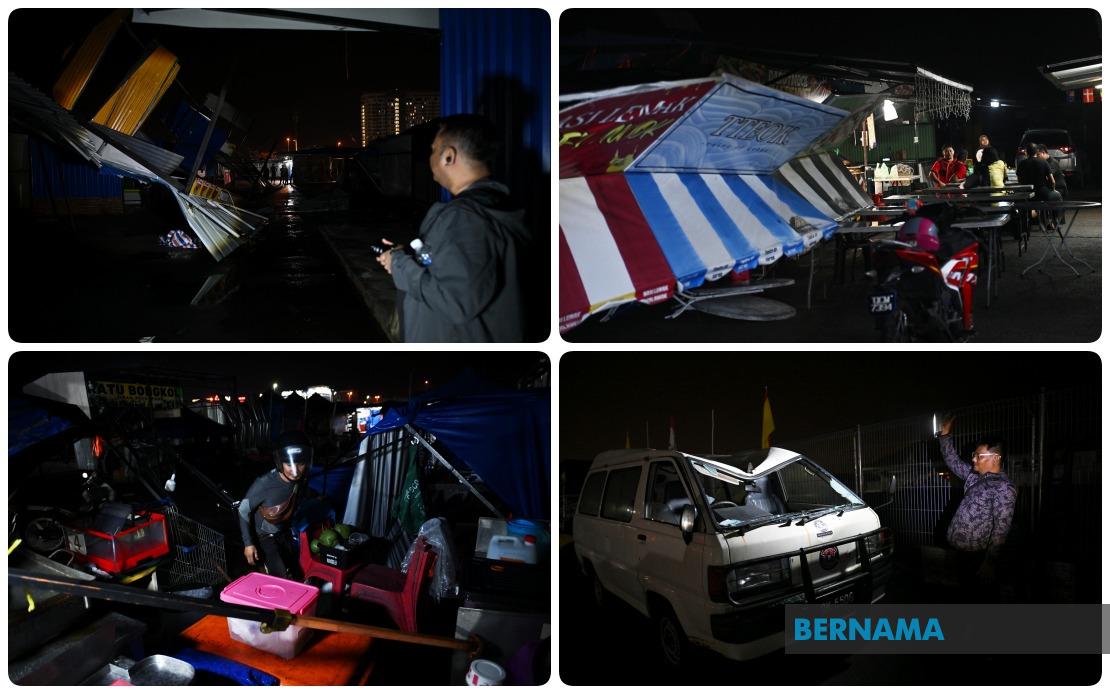
A powerful thunderstorm that swept through Kuching during peak business hours has left the N6 Metrocity 2 Youth Night Market in ruins, forcing authorities to shut the popular trading hub as vendors grapple with significant financial losses. The incident, described by market officials as the worst natural disaster to strike the establishment in recent memory, saw strong winds rip away vendor canopies, collapse infrastructure, and destroy merchandise and equipment across dozens of trader lots.
The tempestuous weather hit the district during the weekend evening trading period, when the night market typically attracts crowds of shoppers and sees brisk business activity. Vendor Mohamad Faisal, 42, recounted the harrowing experience of witnessing canopy structures becoming airborne projectiles that posed a direct threat to human safety. He described the scene as extraordinarily dangerous, with tent canopies flying in multiple directions around the marketplace as traders scrambled to evacuate the area. Many vendors, including Faisal himself, abandoned their stalls and fled the site as the situation deteriorated rapidly, prioritising personal safety over their merchandise and equipment.
The financial toll on traders who have invested a decade in operating at the venue has proven substantial. Long-established vendors estimate individual losses hovering around RM2,000, a considerable sum for small business operators whose margins are typically tight in the competitive street-trading environment. These figures account primarily for damaged and destroyed infrastructure directly related to their trading operations, without accounting for additional losses from spoiled inventory or equipment repairs that may extend beyond immediate storm damage.
Hamzah Hassan, deputy chairman of the N6 Metrocity 2 Youth Night Market management committee, confirmed that the storm's impact exceeded previous natural disasters the market had endured. Out of approximately 300 active trader lots, over 40 experienced severe damage, with loss estimates ranging substantially higher than initial vendor reports. Hassan indicated that individual traders faced canopy replacement costs between RM2,000 and RM5,000 depending on the size and structural complexity of their installations, figures that exclude damage to cooking equipment, water containers, and other essential business apparatus.
The destruction extended beyond individual vendor stalls to affect the broader market infrastructure. The management association's central stage, administrative office, and electrical supply systems all sustained significant damage during the onslaught. This widespread damage to shared facilities compounds the challenge of reopening and normalising operations, as comprehensive repairs will be necessary before the market can resume functioning safely and efficiently.
The Malaysian Meteorological Department had issued a thunderstorm warning for the Kuching district and surrounding areas in Sarawak, including Serian, Siburan, Samarahan, Simunjan, Kapit and Song, with the alert active between 5 pm and 9 pm on the day of the incident. The timing of the storm during the evening trading period, when the market reaches peak customer traffic, maximised both the danger to public safety and the disruption to vendor operations. Weather forecasting had provided advance notice, though the intensity of the actual storm appears to have exceeded preparedness measures available to market operators.
Market leadership has adopted a proactive stance in seeking external support to alleviate the financial burden imposed on affected traders. Hamzah appealed to relevant government ministries, elected representatives, and cooperative organisations for contributions and assistance packages. This outreach reflects recognition that individual vendors lack the financial reserves to absorb such catastrophic losses independently, and that collective action from stakeholders will be necessary to facilitate recovery and market stabilisation.
For Malaysia's small and medium-sized traders operating in informal markets, weather-related disasters present recurring vulnerability. Unlike large commercial establishments with comprehensive insurance coverage and diversified revenue streams, night market vendors typically operate on minimal capital reserves with limited protection against unexpected catastrophes. The Kuching incident exemplifies the precarious economic position of street traders across Southeast Asia, where climate volatility and inadequate infrastructure maintenance create compounding risks to livelihoods.
The closure of N6 Metrocity 2 Youth Night Market represents a significant disruption to local commerce in Kuching, affecting not only the traders directly but also consumers who rely on the market for affordable goods and dining options. The night market format has become integral to urban Malaysian culture, providing affordable retail and food service while generating employment for thousands of small operators. When such markets are damaged and forced to close, the cascading economic impacts extend through the local community beyond the immediate vendor community.
Recovery timelines remain uncertain as market management assesses the full extent of repairs required across shared facilities and coordinates with individual vendors regarding their own restoration efforts. The appeal for government and community assistance suggests that self-funded recovery may not be feasible within practical timeframes, highlighting a systemic gap in disaster preparedness and support mechanisms for informal sector enterprises. As climate patterns across the region become increasingly erratic, Malaysian policymakers face mounting pressure to develop more robust protection frameworks for vulnerable small business operators.

