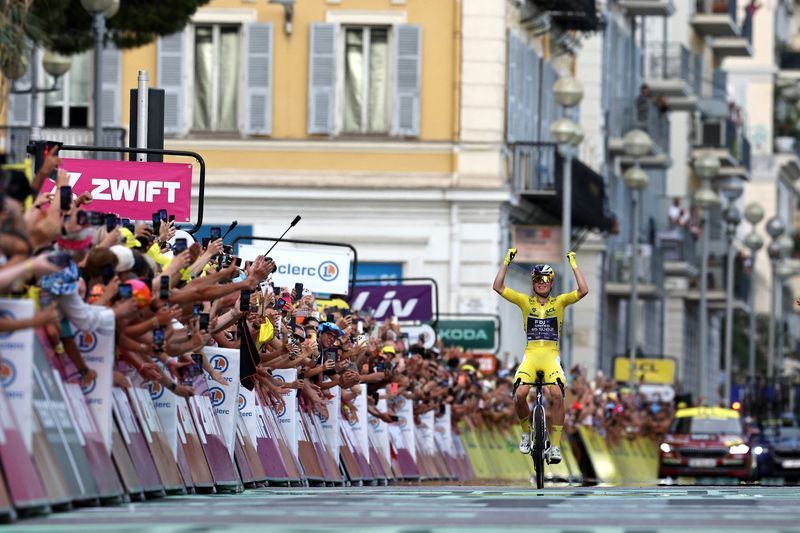
Demi Vollering etched her name deeper into cycling history on Sunday when the 29-year-old Dutch champion claimed her second Tour de France Femmes title, delivering a commanding performance on the race's decisive final stage near Nice that left no doubt about her superiority. The FDJ-Suez rider, who began the 99.2-kilometre conclusion with a slender eight-second advantage over Poland's Katarzyna Niewiadoma-Phinney, transformed that marginal lead into a comprehensive victory through a combination of tactical acumen and physical dominance that underscored her standing as one of contemporary cycling's most complete athletes.
Vollering's triumph represents the second time she has captured the Tour de France Femmes title, having previously won the race in 2023, and it arrives amid a remarkable run of success that has redefined expectations for female cyclists in grand tour competition. Beyond this weekend's victory, her résumé includes the 2026 Giro d'Italia Women and consecutive La Vuelta Femenina titles in 2024 and 2025, a collection of honours that positions her among the sport's most decorated riders regardless of gender. At 29 years old, Vollering remains in her prime, and these accumulating achievements suggest her legacy will ultimately be measured not just by individual races won but by the transformative influence she has exerted on professional women's cycling as a whole.
The decisive moment came during Sunday's fourth and final ascent of the Col d'Eze, a climb that has become a traditional decisive battleground in major cycling races around the French Riviera. It was here that Vollering launched the attack that Niewiadoma-Phinney could not match, breaking free to ride solo into Nice and secure the stage victory by over a minute. The 31-year-old Polish rider, who had mounted a spirited challenge throughout the three-week race, finished second on the stage, with Spain's Paula Blasi completing the podium at just over a minute down from the stage winner. In the final general classification, Vollering's winning margin over Niewiadoma-Phinney stood at one minute and 18 seconds, a comfortable cushion that vindicated her strategy of aggressive racing on the final day.
What distinguishes Vollering's approach to professional cycling is her ability to articulate not merely the technical demands of victory but the emotional and relational dimensions that underpin sustained high performance. Speaking after crossing the finish line, she reflected on the significance of winning while wearing the yellow jersey for the first time, drawing explicit attention to the collective effort that underpins individual achievement. She referenced Celia Gery, her teammate who had endured a difficult night before the stage, as emblematic of the interconnected nature of team cycling, where success emerges from the coordinated labour of numerous athletes working in concert toward a shared objective. This perspective reveals Vollering as a cyclist whose understanding of her sport extends beyond power metrics and tactical positioning to encompass the human architecture that enables excellence.
Vollering's victory in this Tour de France Femmes marks her third stage win during this year's edition of the race, bringing her cumulative total of stage victories across all editions of the Tour de France Femmes to six, a testament to her consistency in the most demanding circumstances. The capacity to win stages across different terrain and conditions demonstrates versatility that distinguishes truly elite cyclists from specialists who excel only under particular circumstances. Her ability to control the race through the three weeks while also winning the stage that mattered most suggests a cyclist operating at an exceptionally high level of tactical intelligence and physical capability simultaneously.
The context of Vollering's success gains additional significance when positioned against the broader trajectory of professional women's cycling over the past several years. The Tour de France Femmes, revived in its modern format in 2022 after a decades-long absence from the professional cycling calendar, has rapidly established itself as the sport's most prestigious women's competition. Vollering's back-to-back titles underscore the race's importance and her dominance within it. The growing investment in women's professional cycling, evidenced by the Tour's return and its expansion, reflects shifting attitudes toward gender equity in endurance sports and has created pathways for athletes like Vollering to compete at the highest levels year-round rather than being confined to a limited racing calendar.
For Malaysian and Southeast Asian cycling enthusiasts, Vollering's achievements carry particular resonance given the region's rapidly expanding cycling community and the increasing visibility of professional cycling across diverse demographics. The success of women cyclists at the highest levels of international competition provides compelling examples of athletic excellence that transcends geographic and cultural boundaries. As cycling continues to grow as both a competitive sport and recreational pursuit throughout Southeast Asia, the visibility of accomplished female cyclists like Vollering helps normalise women's participation at every level, from grassroots participation to professional ambition.
Vollering's second Tour de France Femmes crown arrives in a cycling landscape where the men's race continues to set benchmarks for sporting achievement and media attention. Slovenia's Tadej Pogacar claimed his fifth Tour de France title in July, achieving his third consecutive victory in the men's race and equalling the record for total Tour victories. While the disparity in attention and resources between men's and women's cycling remains substantial, the establishment of the women's Tour as a marquee three-week stage race represents meaningful progress toward gender parity in professional cycling's structure and prestige. Vollering's dominance in the women's race, parallel to Pogacar's achievements in the men's competition, illustrates how elite female and male cyclists can both claim legitimacy as champions of cycling's most demanding discipline.
Looking beyond this particular victory, Vollering's continued presence at the pinnacle of professional cycling raises questions about the sustainability of her dominance and the development of rival cyclists capable of challenging her supremacy. The competitive landscape in women's cycling continues to intensify as investment increases and training methodologies advance, suggesting that future editions of the Tour de France Femmes may produce even more tightly contested finishes. Niewiadoma-Phinney's consistent strong performances across multiple grand tours indicate that she represents a formidable competitor upon whom Vollering cannot rely for future victories. The emergence of additional strong performers worldwide promises to enhance the competitive quality of major races and deepen the talent pool from which grand tour champions emerge.

