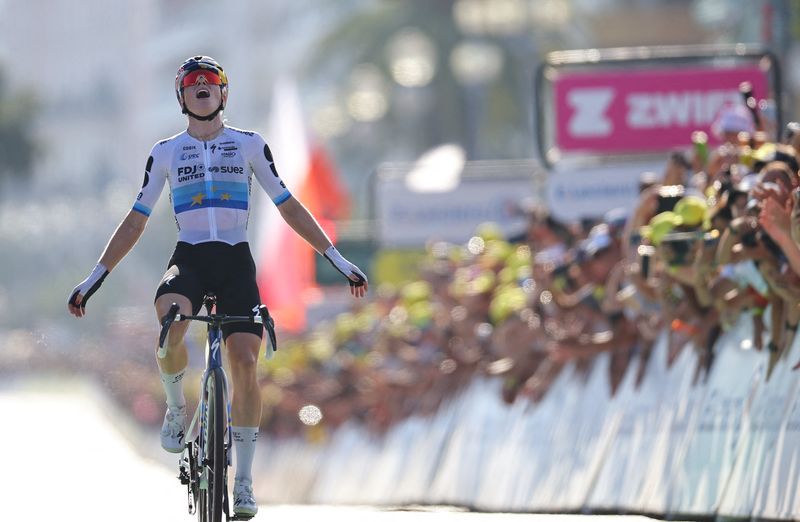
Demi Vollering of FDJ United-Suez moved into the overall lead of the Tour de France Femmes on Saturday, delivering a commanding performance on the demanding 171.9-kilometre mountain stage from Sisteron to Nice to wrest the yellow jersey from Poland's Kasia Niewiadoma-Phinney. The dramatic reversal of fortune sets up a thrilling conclusion to the prestigious women's cycling race, with just one stage remaining and the outcome still far from decided.
Vollering's decisive attack came on the brutal Chemin de l'Arieta climb with approximately six kilometres left to race. After accelerating clear of her nearest rivals, the Dutch champion extended her advantage on the subsequent descent into Nice, crossing the finish line with enough time in hand to claim maximum stage honours and crucial bonus seconds. The victory marked a remarkable turnaround for a rider who had appeared vulnerable the previous day, when she lost over a minute to Niewiadoma-Phinney on the Mont Ventoux ascent, one of professional cycling's most storied peaks.
The stage proved consequential even before the racing began. Pauline Ferrand-Prevot, the defending champion representing Visma-Lease a Bike, withdrew from the competition on Saturday morning due to illness, eliminating the strongest alternative contender for the overall title. Her absence simplified the narrative at the summit of the sport's premier women's stage race, leaving the battle between the remaining frontrunners even more concentrated.
Vollering's psychological resilience in bouncing back after Friday's setback reflects the mental demands of multi-day racing. Speaking after her triumph, the 27-year-old acknowledged that stage racing requires constant recalibration of mindset and strategy. She described her approach as living within each day rather than dwelling on prior disappointments, a philosophy she credited to her team's collaborative planning. Her comments underscore how professional cycling success demands not just physical prowess but also emotional discipline and tactical coordination between rider and support staff.
Italy's Elisa Longo Borghini of UAE Team ADQ claimed the stage runner-up position, narrowly outsprinting Niewiadoma-Phinney in the final metres into Nice. The close finish emphasised the marginal differences that separate elite competitors at this level of women's professional cycling. However, Niewiadoma-Phinney's third-place finish still proved costly, as she surrendered her race leadership and now trails Vollering by eight seconds entering Sunday's decisive finale around the Côte d'Azur coastline.
The tactical dimension of the day generated considerable controversy, with Niewiadoma-Phinney voicing sharp criticism of FDJ United-Suez's conduct during the climbing phase. The Polish rider alleged that teammate Celia Gery had deliberately impeded her progress near the barriers, forcing her to cease pedalling at a critical juncture. Niewiadoma-Phinney characterised such blocking as unsporting and contrary to the spirit of fair competition, suggesting that her respect for the French team had been diminished by what she viewed as childish gamesmanship. Such incidents highlight how professional stage racing, while demanding individual excellence, equally depends on team coordination and sometimes creates ethical grey zones in pursuit of victory.
Vollering's assumption of the yellow jersey marks her fifth occasion wearing cycling's most prestigious symbol during this edition. Her ascent reflects the fluidity of the 2026 Tour de France Femmes, where five different riders have held the overall lead across the eight completed stages. This distribution of leadership indicates a closely matched field where no competitor has managed to establish commanding superiority, a characteristic that bodes well for compelling final-stage drama.
The eight-second margin separating first and second place represents a narrow advantage that could be negated by a decisive move or even tactical positioning in Sunday's concluding stage. Professional cycling fans familiar with the sport's unpredictable dynamics recognise that stage races often feature stunning reversals on their final days, when fatigue combines with desperation among riders seeking redemption. The fact that Vollering enters the finale holding the golden jersey provides her with a strategic advantage, yet history demonstrates that such positions offer no guarantee of success.
For Malaysian and Southeast Asian cycling enthusiasts, the Tour de France Femmes represents a growing window into world-class women's professional cycling, a sport increasingly capturing global attention as female athletes demonstrate exceptional athleticism and tactical sophistication. The race's expansion and rising television coverage reflect broader momentum in women's sports globally, with sponsors and broadcasters investing significantly in female-focused cycling competition. Vollering's performances, alongside Niewiadoma-Phinney's consistent excellence and Longo Borghini's resilience, exemplify the calibre now defining the sport's pinnacle.
The significance of Friday's Mont Ventoux stage and Saturday's Arieta climb cannot be overstated in understanding the physical and mental toll of grand tour racing. These high-altitude mountain passes separate genuine contenders from secondary competitors, their slopes serving as crucibles where cycling talent and determination are tested simultaneously. Vollering's ability to recover from Ventoux's damage and strike decisively the following day demonstrates the champion's mindset required to succeed in professional cycling's most demanding contexts.
As the race approaches its conclusion, observers should anticipate that Niewiadoma-Phinney, now operating under pressure but freed from the burden of defending the yellow jersey, may launch an aggressive counter-attack on Sunday. Longo Borghini, having demonstrated strong climbing credentials and tactical positioning, cannot be discounted from title contention either. The eight-second buffer Vollering enjoys provides comfort but not certainty, suggesting that Sunday's finale will likely deliver the dramatic resolution befitting a grand tour's conclusion.
The Tour de France Femmes has evolved into one of professional cycling's marquee competitions, rivalling the men's race in terms of difficulty and drama whilst establishing its own compelling narrative. Vollering's yellow jersey acquisition and the surrounding tactical disputes exemplify why the event commands international attention from cycling professionals and enthusiasts alike, representing the sport's present excellence and future promise.

