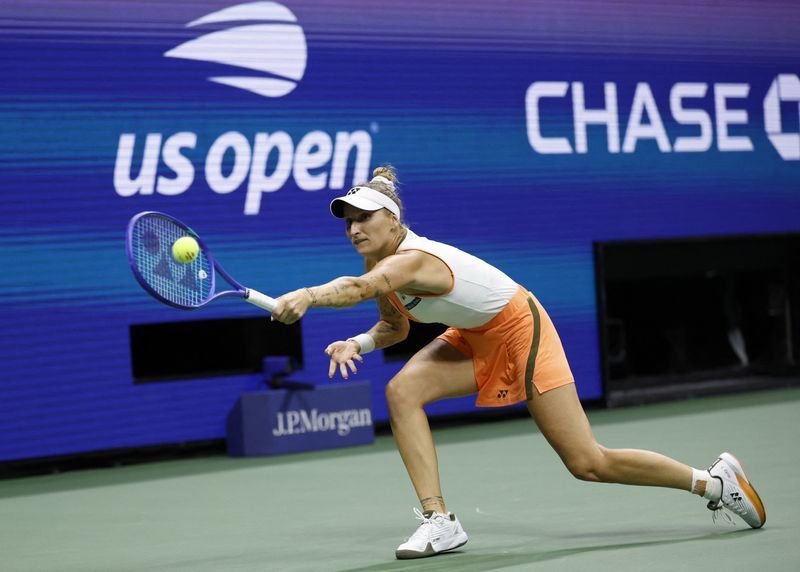
The tennis world's highest judicial body has confirmed receipt of an appeal from former Wimbledon champion Marketa Vondrousova challenging her four-year suspension for declining to submit a doping sample during an unannounced test at her home last December. The Court of Arbitration for Sport said on Tuesday that a hearing date has not yet been scheduled, but the ban currently stands until June 21, 2030, when the Czech player will turn 30—a career-defining consequence for an athlete still in her competitive prime.
Vondrousova's suspension was formally imposed in June following a determination by the International Tennis Integrity Agency that she refused to cooperate with doping control officials who arrived at her residence on December 3 for an out-of-competition examination. The incident, which Vondrousova has disputed, centred on her refusal to provide a biological sample when requested by a testing officer. Tennis anti-doping protocols require players to submit to such testing regardless of circumstance, and missing a test carries penalties identical to testing positive for a banned substance.
The 27-year-old player has maintained her innocence throughout, emphasizing that she has never used performance-enhancing drugs. In a statement released in April, she articulated her frustration with the testing process itself, describing the circumstances as deeply intrusive. She noted that an official's arrival at 8:15 p.m. demanding an immediate test represented, in her view, an unreasonable and distressing incursion into her personal life, contributing to what she characterized as reaching a breaking point after months of accumulated physical and mental strain.
Crucially, Vondrousova provided a biological sample just three days after the December 3 incident, and that subsequent test returned a negative result. This negative finding supports her contention that she does not use banned substances and raises questions about why the initial refusal to test should carry such severe penalties. For many observers following the case, the contrast between her insistence on her clean record and the sweeping nature of the sanction has created genuine ambiguity about whether the punishment is proportionate to the offence.
The suspension has already devastated her professional trajectory. Vondrousova has not competed professionally since withdrawing from the Adelaide International in January, citing a shoulder injury compounded by the uncertainty surrounding her legal status in the sport. Her world ranking has plummeted from sixth to 153rd, a collapse that reflects not only her absence from competition but also the erosion of ranking points from tournaments she previously contested. In practical terms, her career momentum has been essentially halted at what should be her peak years as an athlete.
Her accomplishments prior to this crisis underscore the magnitude of what she stands to lose. Vondrousova captured the prestigious Wimbledon singles title in 2023, making her one of the most celebrated Czech tennis players of recent decades. Before that breakthrough, she had reached the French Open final in 2019 and won a silver medal at the Tokyo Olympics in 2021. These achievements demonstrated her capacity to perform at the highest level and suggested a player capable of accumulating multiple Grand Slam titles over a career. The four-year ban threatens to erase those prospects entirely.
From a Southeast Asian perspective, this case carries implications beyond tennis. The incident illustrates ongoing tensions within international sports governance regarding player rights, privacy expectations, and the administration of anti-doping protocols. As the region continues developing its own sports infrastructure and hosting major international competitions, questions about how testing regimes balance deterrence against athlete welfare become increasingly relevant. Malaysia and neighbouring countries will be watching how CAS adjudicates this matter, as their own sports administrators may face similar dilemmas.
The appeal process through CAS represents Vondrousova's primary avenue for challenging the ban. The court, based in Switzerland, operates as an independent arbitration body tasked with resolving disputes in international sport. Its decisions are generally considered final and binding, though they can still be subject to limited judicial review under Swiss law. The stakes for Vondrousova are existential: a successful appeal could restore her to competition within months, while a dismissal would effectively conclude her professional tennis career at an age when most champions remain active.
The psychological and professional toll of this situation extends beyond the playing field. Vondrousova's case has sparked broader debate within tennis circles about whether current anti-doping enforcement mechanisms adequately protect athlete welfare and mental health. Some commentators have questioned whether the strict liability approach—where refusing a test carries the same weight as a positive result—remains appropriate in an era where athletes increasingly report mental health challenges and burnout. Others maintain that consistent enforcement is essential to maintain the integrity of competitive sport. This ideological tension will likely feature prominently in CAS proceedings.
As her appeal progresses through the arbitration process, Vondrousova remains effectively sidelined from the sport she has dominated. The timeline of her legal battle extends well beyond the typical competitive season, meaning she cannot return to tournaments or maintain her ranking even if a hearing favours her claims. This temporal dimension adds another layer of complexity to the case, as the longer the appeal process continues, the more her professional prospects deteriorate regardless of the eventual outcome. Her legal team will presumably argue that such circumstances warrant expedited proceedings, though CAS is known for careful, deliberate consideration of cases rather than rapid resolutions.

