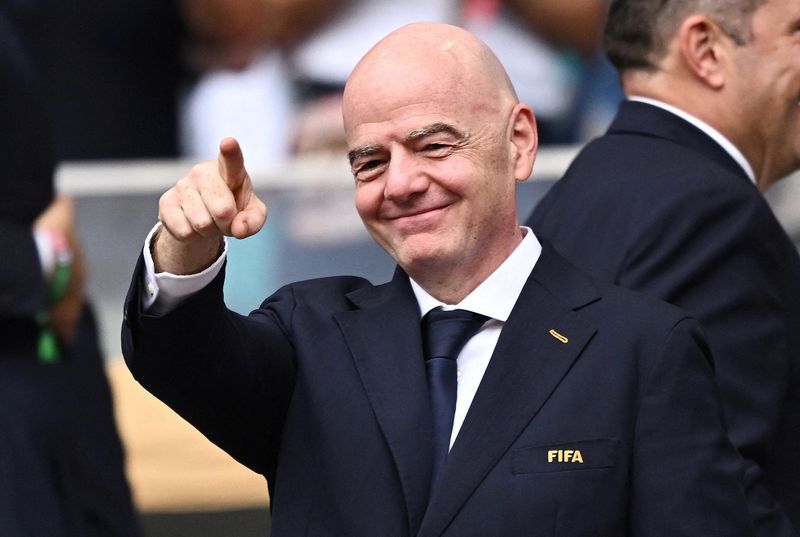
The Football Association of Wales has formally withdrawn its support for FIFA President Gianni Infantino's anticipated re-election campaign for the 2027-2031 term, marking the first national federation to take such action following the dramatic collapse of his signature commercial initiative. This move represents a significant blow to the Swiss administrator, who has controlled world football's governing body since 2016 and was previously expected to secure another term without meaningful opposition.
Infantino's ambitious scheme to generate up to $4.2 billion by offering private investors roughly a 20% stake in a newly established entity managing major competitions—most notably the World Cup—unraveled spectacularly last Friday after sustained resistance from multiple stakeholders. The proposal had been positioned as a transformative opportunity to modernize FIFA's financial structure and fund global football development, but the scheme encountered fierce pushback that ultimately proved insurmountable, forcing FIFA to abandon the initiative entirely.
In a formal statement, the Welsh FA articulated its loss of confidence in Infantino's leadership, pointing to "recent failures in good governance, processes, leadership, values, stakeholder management, communications and sound judgement." The federation emphasized that placing the sport's interests above other considerations was essential for FIFA's credibility, declaring its position that Infantino has forfeited the trust necessary to lead international football. This language suggests deeper institutional concerns beyond the commercial proposal itself, indicating accumulated dissatisfaction with his administrative approach.
The withdrawal from Wales comes as Infantino faces unprecedented criticism from regional powerhouses. Both UEFA, European football's governing confederation, and CONCACAF, representing North and Central American federations, announced over the weekend that they had lost confidence in his leadership. UEFA, which had actively led the opposition to Infantino's commercial scheme and welcomed its abandonment, subsequently issued a document preservation order—a legal maneuver that prevents the destruction of emails, files, and data when litigation is anticipated—suggesting possible formal legal challenges may follow.
Infantino's previous political invulnerability within FIFA appears to have been substantially undermined by this episode. Since succeeding Sepp Blatter in 2016, the FIFA president has been re-elected twice without facing opposition, projecting an image of organizational dominance and control. His April announcement that he would pursue a fourth term as FIFA chief had seemed like a straightforward formality, with few observers anticipating meaningful resistance to his candidacy.
However, the catastrophic failure of the commercial rights initiative has exposed latent tensions and dissatisfaction among FIFA member federations that had previously remained beneath the surface. Experts analyzing the situation told Reuters that the backlash suggests much deeper discord within the organization than Infantino's apparent monopoly on power had indicated, revealing cracks in his coalition of support that could substantially complicate his path forward.
The March Congress scheduled for Morocco will serve as the critical venue where member federations formally select FIFA's leadership. What appeared months ago to be a coronation ceremony now faces the prospect of genuine contestation, with national federations increasingly willing to voice opposition and potentially support alternative candidates. The Welsh withdrawal signals that other federations may feel emboldened to follow suit, potentially snowballing into organized opposition that could genuinely threaten Infantino's re-election prospects.
For Malaysian and Southeast Asian readers, this FIFA crisis carries particular relevance given the region's substantial interest in football and the potential ramifications for continental competitions and World Cup participation opportunities. Any leadership transition at FIFA could reshape how competitions are allocated, financed, and organized—matters of direct concern to national federations across Asia. The tournament structures, broadcasting arrangements, and development funding that flow from FIFA headquarters directly affect football's growth and commercial viability throughout the region.
The failed commercial rights scheme itself reflects broader questions about FIFA's governance philosophy that resonate globally. Infantino's proposal would have substantially commercialized World Cup management through private equity involvement, raising legitimate concerns about whether profit-maximizing investors might prioritize financial returns over sporting integrity or equitable global participation. The resistance to this vision suggests FIFA member federations, including those from developing nations, value the organization's role as a guardian of football's fundamental values over its potential as a profit-generating enterprise.
Infantino's previous reforms, while generally credited with improving FIFA's financial transparency and reducing corruption compared to the Blatter era, have increasingly been viewed by federations as insufficient or misguided. The commercial rights proposal apparently represented a bridge too far for many stakeholders, suggesting that Infantino's leadership approach has exhausted goodwill that was built through earlier anti-corruption efforts. The contrast between his prior unopposed re-elections and the current backlash illuminates how quickly institutional support can erode when a leader attempts transformational changes without broader consensus.
The document preservation order issued by UEFA indicates the possibility of formal legal proceedings that could extend well beyond the March Congress vote. Such litigation could tie FIFA in complex disputes precisely when the organization is attempting to maintain political stability and credibility. For member federations deciding how to vote in March, the prospect of their president being entangled in legal disputes with UEFA adds another dimension to concerns about Infantino's continued fitness for office.
As other national federations assess the Welsh decision and the broader institutional resistance from UEFA and CONCACAF, the calculus around Infantino's re-election is fundamentally altered. What seemed predetermined has become genuinely contestable, potentially opening space for alternative candidates or reform-focused challengers. The March Congress in Morocco will likely feature substantive debate about FIFA's direction rather than the expected perfunctory endorsement of Infantino's continued leadership.

